Pakistan PM Shehbaz Sharif Warns India Over Indus Waters
Pakistan PM warns India, says every drop of water is a red line. Pakistan wants peace but will respond to any challenge.
'%3E%3Crect%20width%3D'96'%20height%3D'96'%20fill%3D'%234A235A'%2F%3E%3Ccircle%20cx%3D'30'%20cy%3D'24'%20r%3D'44'%20fill%3D'%23fff'%20opacity%3D'.12'%2F%3E%3Ccircle%20cx%3D'60'%20cy%3D'74'%20r%3D'40'%20fill%3D'%23000'%20opacity%3D'.10'%2F%3E%3C%2Fg%3E%3Cg%20fill%3D'none'%20stroke%3D'%23fff'%20stroke-width%3D'3'%3E%3Ccircle%20cx%3D'48'%20cy%3D'48'%20r%3D'16'%2F%3E%3Cellipse%20cx%3D'48'%20cy%3D'48'%20rx%3D'6.5'%20ry%3D'16'%2F%3E%3Cline%20x1%3D'32'%20y1%3D'42'%20x2%3D'64'%20y2%3D'42'%2F%3E%3Cline%20x1%3D'32'%20y1%3D'54'%20x2%3D'64'%20y2%3D'54'%2F%3E%3C%2Fg%3E%3C%2Fsvg%3E)
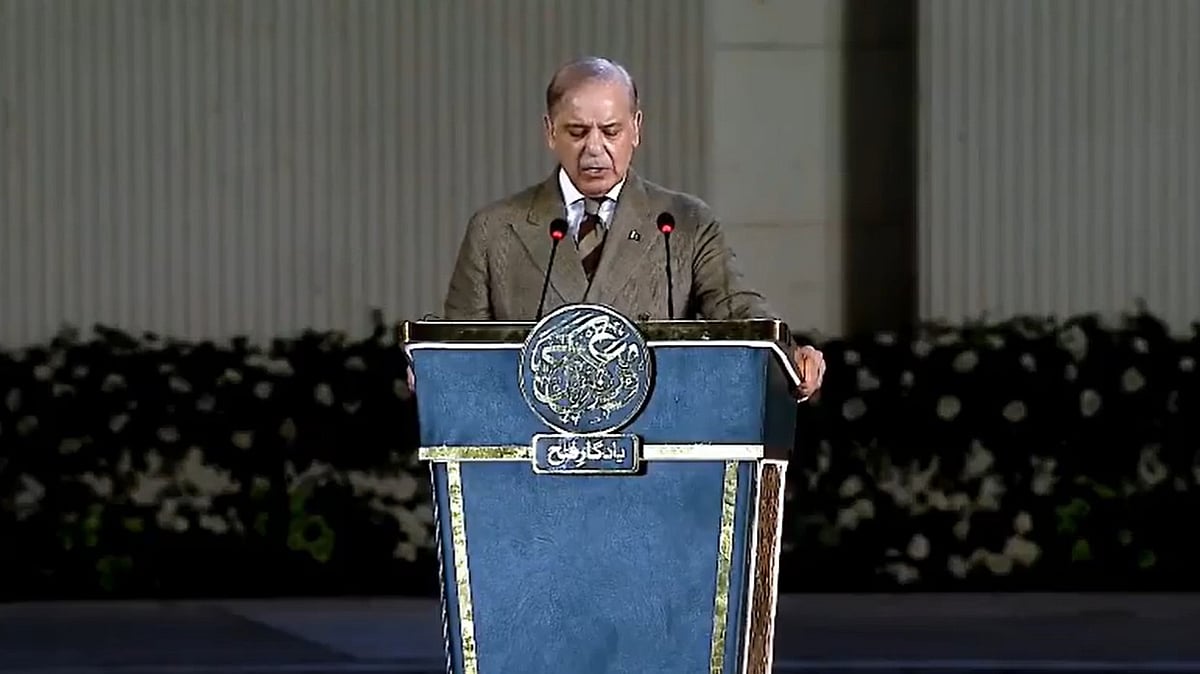
Pakistan Prime Minister Shehbaz Sharif warned India on Thursday against taking any action that could affect Pakistan's share of water under the Indus Waters Treaty.
Sharif made the remarks while addressing the inauguration of the Yadgar-e-Fatah in Islamabad, a day before Pakistan's Independence Day. He declared that every single drop of Pakistan's water is a red line and warned India that if it does not come to its senses, it will be responded to directly.
Pakistan wants peace but this should not be interpreted as weakness, Sharif said. He also warned that Pakistan would respond forcefully to any challenge to its sovereignty or national security.
Referring to the May 2025 military confrontation, Sharif claimed that Pakistan had demonstrated its ability to defend itself and warned that any future escalation could draw an even stronger response. He accused India of becoming an enemy of peace and alleged that New Delhi had unilaterally and illegally placed the Indus Waters Treaty in abeyance following what he described as India's defeat in the 2025 conflict.
The Indus Waters Treaty was brokered by the World Bank and signed by India and Pakistan in 1960. Under the agreement, the three eastern rivers Ravi, Beas and Sutlej were allocated primarily to India, while the three western rivers Indus, Jhelum and Chenab were allocated primarily to Pakistan, subject to specified rights and uses by both countries.
Pakistan is heavily dependent on the western rivers for its agricultural and irrigation needs, making any disruption to their flow a particularly sensitive issue for Islamabad. India announced in April 2025 that it was placing the treaty in abeyance following the Pahalgam terror attack in Jammu and Kashmir, in which 26 civilians were killed.
New Delhi blamed Pakistan-based or Pakistan-backed terrorists for the attack and announced a series of measures against Islamabad, including its decision concerning the Indus Waters Treaty. India has rejected Pakistan's characterisation of the issue and has maintained its position on the treaty.
The treaty has survived decades of conflict between the two neighbours and has traditionally been regarded as one of the most durable examples of India-Pakistan cooperation. However, the current situation has raised concerns about the future of the treaty and the potential consequences of any disruption to the water supply.
In his speech, Sharif also expressed gratitude to China and other Islamic countries for their support to Pakistan. He said that Pakistan values its relationships with these countries and hopes to strengthen them in the future.
The situation between India and Pakistan remains tense, and the warning by Sharif has added to the concerns about the potential escalation of the conflict. The international community is watching the situation closely, and there are hopes that the two countries will be able to find a peaceful resolution to their differences.
The Indus Waters Treaty is a critical component of the relationship between India and Pakistan, and any disruption to the treaty could have significant consequences for the region. The warning by Sharif has highlighted the importance of finding a peaceful resolution to the conflict and ensuring that the treaty is respected by both countries.
In conclusion, the warning by Pakistan Prime Minister Shehbaz Sharif to India over the Indus Waters Treaty has raised concerns about the potential escalation of the conflict between the two countries. The situation remains tense, and the international community is watching closely. It is hoped that the two countries will be able to find a peaceful resolution to their differences and ensure that the treaty is respected.
The issue of the Indus Waters Treaty is a complex one, and it requires careful consideration and negotiation by both countries. The treaty has survived decades of conflict, and it is hoped that it will continue to be a symbol of cooperation between India and Pakistan. However, the current situation has raised concerns about the future of the treaty, and it is essential that both countries work together to find a peaceful resolution to their differences.
The warning by Sharif has highlighted the importance of respecting the treaty and ensuring that the water supply is not disrupted. The consequences of any disruption to the water supply could be significant, and it is essential that both countries take steps to prevent such a situation from arising. The international community is watching the situation closely, and it is hoped that the two countries will be able to find a peaceful resolution to their differences.
The relationship between India and Pakistan is complex, and it is influenced by a range of factors, including historical, cultural, and economic considerations. The issue of the Indus Waters Treaty is just one aspect of the relationship, and it requires careful consideration and negotiation by both countries. The warning by Sharif has highlighted the importance of finding a peaceful resolution to the conflict and ensuring that the treaty is respected by both countries.
In the end, it is hoped that the two countries will be able to find a peaceful resolution to their differences and ensure that the Indus Waters Treaty is respected. The consequences of any disruption to the water supply could be significant, and it is essential that both countries take steps to prevent such a situation from arising. The international community is watching the situation closely, and it is hoped that the two countries will be able to find a peaceful resolution to their differences.
What it means for the region is that the situation between India and Pakistan remains tense, and the warning by Sharif has added to the concerns about the potential escalation of the conflict. The international community is watching the situation closely, and there are hopes that the two countries will be able to find a peaceful resolution to their differences. The issue of the Indus Waters Treaty is a critical component of the relationship between India and Pakistan, and any disruption to the treaty could have significant consequences for the region.
Frequently asked questions
What is the Indus Waters Treaty
The Indus Waters Treaty is a water-sharing agreement between India and Pakistan, signed in 1960.
Why did India put the treaty in abeyance
India put the treaty in abeyance following the Pahalgam terror attack in Jammu and Kashmir in 2025.