'%3E%3Crect%20width%3D'96'%20height%3D'96'%20fill%3D'%23B3261E'%2F%3E%3Ccircle%20cx%3D'30'%20cy%3D'24'%20r%3D'44'%20fill%3D'%23fff'%20opacity%3D'.12'%2F%3E%3Ccircle%20cx%3D'60'%20cy%3D'74'%20r%3D'40'%20fill%3D'%23000'%20opacity%3D'.10'%2F%3E%3C%2Fg%3E%3Cg%20fill%3D'%23fff'%3E%3Crect%20x%3D'29'%20y%3D'49'%20width%3D'8'%20height%3D'19'%20rx%3D'1'%2F%3E%3Crect%20x%3D'39'%20y%3D'40'%20width%3D'9'%20height%3D'28'%20rx%3D'1'%2F%3E%3Crect%20x%3D'50'%20y%3D'45'%20width%3D'8'%20height%3D'23'%20rx%3D'1'%2F%3E%3Crect%20x%3D'60'%20y%3D'53'%20width%3D'7'%20height%3D'15'%20rx%3D'1'%2F%3E%3Crect%20x%3D'41'%20y%3D'34'%20width%3D'5'%20height%3D'6'%2F%3E%3C%2Fg%3E%3C%2Fsvg%3E) Curated by Mumbai Alert · City Desk, City Desk · Mumbai Alert News · Mumbai Alert News
Curated by Mumbai Alert · City Desk, City Desk · Mumbai Alert News · Mumbai Alert News
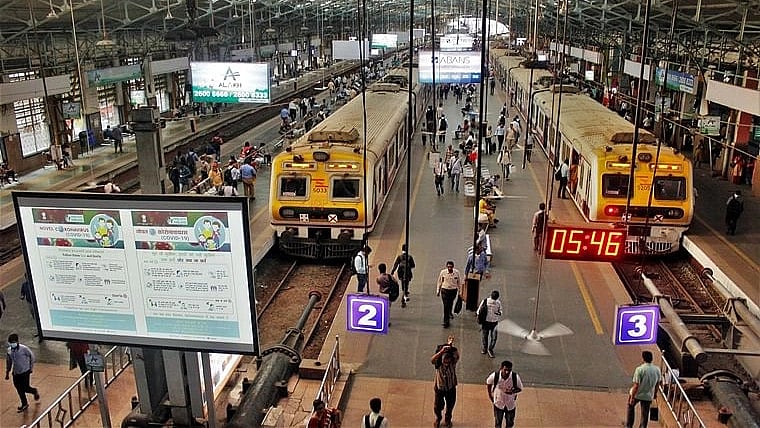
Run by Western Railway and Central Railway, the suburban
network is the fastest, cheapest way to cross the metropolis. Fast and slow trains, First and
Second class, dedicated ladies coaches and an interchange web of hubs like Dadar, Kurla,
Bandra and Thane let Mumbaikars stitch the whole region together. The three main corridors are
the Western, Central and Harbour lines, with
the Trans-Harbour line linking Thane to Navi Mumbai — increasingly joined by
the Mumbai Metro and Monorail.
The Lines
Service status is auto-read from the latest Mumbai train news and defaults to normal —
always confirm live before you travel.
Running normal Minor delays Disruption
Western Line
Western Railway Running normal Churchgate ↔ Dahanu Road (via Virar)
~124 km · 37+ stations
Key stationsChurchgate · Marine Lines · Mumbai Central · Dadar · Bandra · Andheri · Borivali · Vasai Road · Virar · Dahanu Road
The western seaboard — the business district, Bandra, the western suburbs and the far-northern towns of Vasai-Virar and Palghar.
Central Line (Main)
Central Railway Running normal CSMT ↔ Kalyan → Kasara / Khopoli
CSMT–Kalyan ~54 km, then to Kasara (~67 km) or Khopoli (~61 km)
Key stationsCSMT · Dadar · Kurla · Ghatkopar · Thane · Dombivli · Kalyan → (Kasara) / (Khopoli)
The central spine to the north-east; splits at Kalyan toward Kasara (foot of the Western Ghats) and Khopoli.
Harbour Line
Central Railway Running normal CSMT ↔ Panvel & CSMT ↔ Andheri (via Bandra)
~54 km to Panvel
Key stationsCSMT · Wadala · Vashi · Nerul · Belapur · Panvel | branch: Wadala · Bandra · Andheri
South Mumbai to Navi Mumbai (Vashi–Panvel) and, via the Bandra branch, across to the Western suburbs at Andheri.
Trans-Harbour Line
Central Railway Running normal Thane ↔ Vashi / Nerul / Panvel
~38 km · 17 stations
Key stationsThane · Airoli · Ghansoli · Vashi · Sanpada · Nerul · Belapur · Panvel
Links Thane directly with Navi Mumbai across Thane Creek — no need to route through the city.
Beyond the Locals — Metro & Monorail
Mumbai Metro
A growing rapid-transit network (multiple lines, e.g. the Versova–Ghatkopar corridor and newer underground and elevated lines) that complements the suburban railway east–west and eases pressure on the locals.
Mumbai Monorail
India’s first monorail runs between Chembur and Jacob Circle (Sant Gadge Maharaj Chowk) via Wadala — a ~20 km corridor linking eastern and central Mumbai, operated by the MMRDA.
Riding the Local — Practical Guide
🎫Tickets & passes
- Single & return journey tickets, priced by the number of zones/distance travelled.
- Season passes — monthly, quarterly, half-yearly and yearly — are the cheapest way to commute daily.
- Buy digitally: as of 2026 season passes moved to Indian Railways’ Rail One app (the older UTS on Mobile app was retired for season passes on 1 March 2026); UTS-style booking still covers unreserved journey tickets.
- At the station: ticket windows, ATVM self-service machines and smart cards for paper tickets.
🚃Classes & coaches
- First Class — costlier, less crowded, at fixed positions in the rake; a First Class pass or ticket is required.
- Second Class — the standard, most affordable option that the vast majority of commuters use.
- Ladies coaches are reserved for women throughout the day, with dedicated ladies specials at peak times.
- Coaches are also earmarked for senior citizens and differently-abled passengers, plus a luggage/handicapped compartment.
⚡Fast vs slow trains
- Slow (local) trains halt at every station — best for short hops and smaller stations.
- Fast trains skip minor stations and only stop at major hubs — much quicker over long distances.
- Check the indicator board / announcement for “F” (fast) or “S” (slow) and the destination before boarding.
- A fast train can cut a long north–south journey dramatically, so it is worth learning which stations yours skips.
⏰Peak hours & timing
- Services run from roughly 4:00 AM to around 1:00 AM, with trains every few minutes on core sections.
- Peak rush is broadly 8–11 AM (city-bound) and 5–9 PM (suburb-bound) — expect very heavy crowds.
- Travelling just outside the peak, or in the reverse-commute direction, is far more comfortable.
- A “mega block” (planned maintenance, usually on a Sunday) can suspend or divert services — check before you travel.
🛡️Safety & etiquette
- Never board or alight from a moving train, and stand clear of the doors and platform edge.
- Do not travel on the roof or footboard — it is dangerous and illegal.
- Respect the ladies, senior-citizen and differently-abled coaches; keep to your correct compartment.
- Mind your belongings in the crush, let passengers alight first, and use foot-over-bridges — never cross the tracks.
📱Useful apps & info
- Local-train timetable apps (m-Indicator style) show train times, platforms, fast/slow status and fares offline.
- Rail One / UTS-style official apps handle passes and unreserved tickets on your phone.
- Follow Western Railway and Central Railway official channels for live delays, mega-block notices and diversions.
- Plan interchanges (e.g. Dadar, Kurla, Bandra, Thane) in advance — they connect lines and save long detours.
Latest Mumbai Local Train News
Mumbai Local Train — FAQ
How many people use the Mumbai local train every day?
The Mumbai Suburban Railway carries on the order of 7–8 million commuter journeys a day, making it the lifeline of the city and one of the busiest suburban networks in the world.
Which are the main Mumbai local train lines?
The core network is the Western Line (Churchgate to Dahanu Road via Virar), the Central Line (CSMT to Kalyan, then Kasara or Khopoli), the Harbour Line (CSMT to Panvel and to Andheri) and the Trans-Harbour Line (Thane to Vashi, Nerul and Panvel).
Who runs the Mumbai local trains?
They are run by two zones of Indian Railways: Western Railway operates the Western Line, and Central Railway operates the Central, Harbour and Trans-Harbour lines.
What is the difference between a fast and a slow local?
A slow local stops at every station, while a fast local skips minor stations and halts only at major hubs — much quicker over long distances. Check the indicator board for “F” (fast) or “S” (slow) and the destination before boarding.
How do I buy a Mumbai local train ticket or season pass?
Buy single or return tickets at station windows, ATVM machines or on a mobile app. Season passes (monthly to yearly) are the cheapest way to commute daily and, as of 2026, are booked on Indian Railways’ Rail One app.
Fares, timings and app details change — always confirm live times and pass rules with Western
Railway, Central Railway or the official ticketing app before you travel.