Bhopal Sees 14 Dowry Convictions in 3,187 Cases Since 2021
Low conviction rate, most cases end in compromise. Dowry harassment cases on the rise.
'%3E%3Crect%20width%3D'96'%20height%3D'96'%20fill%3D'%23B3261E'%2F%3E%3Ccircle%20cx%3D'30'%20cy%3D'24'%20r%3D'44'%20fill%3D'%23fff'%20opacity%3D'.12'%2F%3E%3Ccircle%20cx%3D'60'%20cy%3D'74'%20r%3D'40'%20fill%3D'%23000'%20opacity%3D'.10'%2F%3E%3C%2Fg%3E%3Cg%20fill%3D'%23fff'%3E%3Crect%20x%3D'29'%20y%3D'49'%20width%3D'8'%20height%3D'19'%20rx%3D'1'%2F%3E%3Crect%20x%3D'39'%20y%3D'40'%20width%3D'9'%20height%3D'28'%20rx%3D'1'%2F%3E%3Crect%20x%3D'50'%20y%3D'45'%20width%3D'8'%20height%3D'23'%20rx%3D'1'%2F%3E%3Crect%20x%3D'60'%20y%3D'53'%20width%3D'7'%20height%3D'15'%20rx%3D'1'%2F%3E%3Crect%20x%3D'41'%20y%3D'34'%20width%3D'5'%20height%3D'6'%2F%3E%3C%2Fg%3E%3C%2Fsvg%3E)
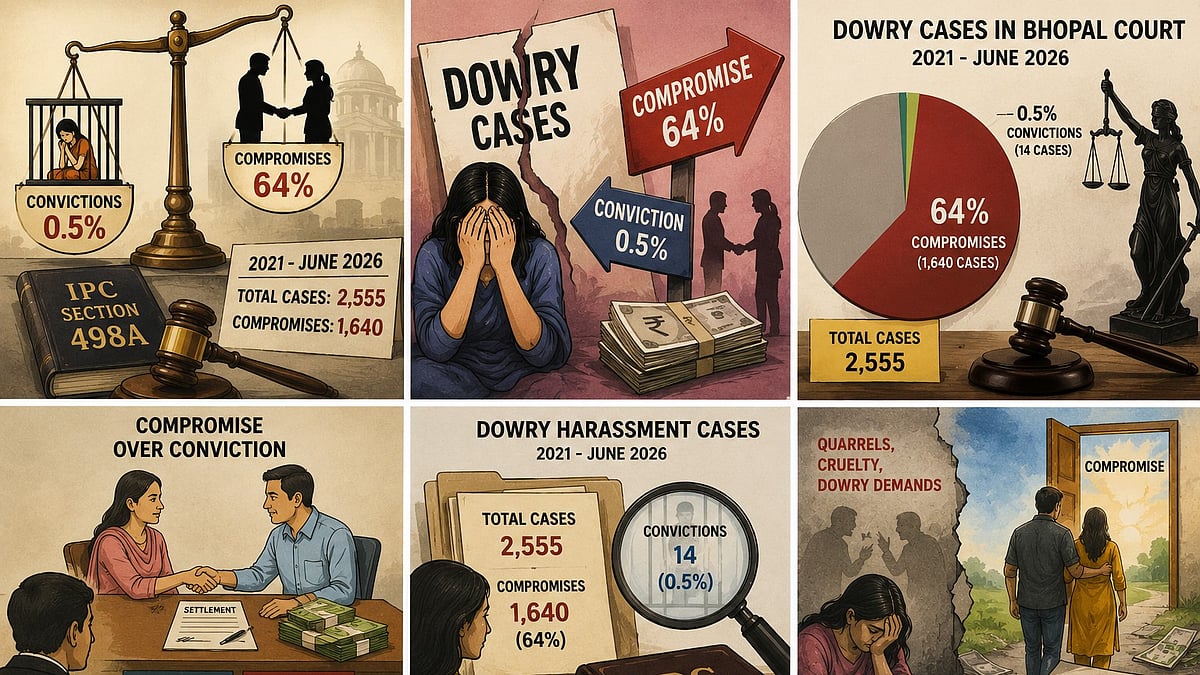
In Bhopal, Madhya Pradesh, the District and Sessions Court has reported a low conviction rate in dowry harassment cases. Between 2021 and June 2026, a total of 3,187 cases were tried under Section 498A of the Indian Penal Code, with only 14 convictions, resulting in a conviction rate of 0.5%.
Over the same period, 51% of the cases, or 1,640, were withdrawn after a compromise between the couples. This trend is evident in the annual breakdown of cases. In 2021, none of the 592 cases led to a conviction, while 227 ended in a compromise. The following year, 2022, saw five convictions out of 735 cases, with 298 compromises.
In 2023, four convictions were recorded out of 592 cases, with 419 compromises. The year 2024 saw one conviction out of 514 cases, with 346 compromises. In 2025, three convictions were recorded out of 488 cases, with 283 compromises. As of June 2026, one conviction was recorded out of 266 cases, with 67 compromises.
Section 498A of the IPC makes it a criminal offense for a husband or his relatives to subject a woman to cruelty for dowry. However, data shows that in most cases, the complainants withdraw the charges after reaching a compromise with their husbands, often involving an exchange of money.
According to Shail Awasthi, a counsellor at the Bhopal District Family Court, most cases are the result of ordinary differences between husbands and wives, with dowry harassment alleged to make the case more serious. In many instances, the compromise involves the return of gifts or payment of a lump sum.
For example, in one case, a woman filed a dowry harassment case in 2021 after quarrels began with her husband. She eventually secured a divorce and remarried. In 2026, she withdrew the case in return for Rs 5 lakh. In another case, a woman filed a case under Section 498A against her husband and in-laws after they separated. She agreed to withdraw the case on the condition that her jewelry and clothes be returned to her.
The low conviction rate and high number of compromises in dowry harassment cases raise questions about the effectiveness of the law in protecting women from cruelty and harassment. While the law aims to prevent dowry-related violence, the data suggests that many cases are settled out of court, often involving a financial settlement.
This trend has significant implications for the fight against dowry harassment in India. It highlights the need for greater awareness and support for women who are victims of dowry-related violence, as well as the importance of ensuring that the law is enforced effectively to protect their rights.
In conclusion, the low conviction rate in dowry harassment cases in Bhopal is a cause for concern. It underscores the need for a more effective implementation of the law and greater support for women who are victims of dowry-related violence.
The data also suggests that there is a need for a more nuanced approach to addressing dowry harassment, one that takes into account the complexities of each case and the needs of the victims. By working together to address these challenges, we can create a safer and more just society for all.
Frequently asked questions
What is the conviction rate in dowry harassment cases in Bhopal?
The conviction rate is 0.5%, with 14 convictions out of 3,187 cases.
Why do most dowry harassment cases end in compromise?
Most cases end in compromise due to ordinary differences between husbands and wives, with dowry harassment alleged to make the case more serious, and often involving an exchange of money.