India's First Hydrogen Train Travels 6000km
India's first hydrogen train reduces CO2 emissions. It travels between Haryana cities.
'%3E%3Crect%20width%3D'96'%20height%3D'96'%20fill%3D'%230B6E4F'%2F%3E%3Ccircle%20cx%3D'30'%20cy%3D'24'%20r%3D'44'%20fill%3D'%23fff'%20opacity%3D'.12'%2F%3E%3Ccircle%20cx%3D'60'%20cy%3D'74'%20r%3D'40'%20fill%3D'%23000'%20opacity%3D'.10'%2F%3E%3C%2Fg%3E%3Cg%20fill%3D'none'%20stroke%3D'%23fff'%20stroke-width%3D'3.2'%20stroke-linecap%3D'round'%20stroke-linejoin%3D'round'%3E%3Cpolyline%20points%3D'31%2C59%2041%2C49%2049%2C54%2063%2C37'%2F%3E%3Cpolyline%20points%3D'55%2C37%2063%2C37%2063%2C45'%2F%3E%3C%2Fg%3E%3C%2Fsvg%3E)
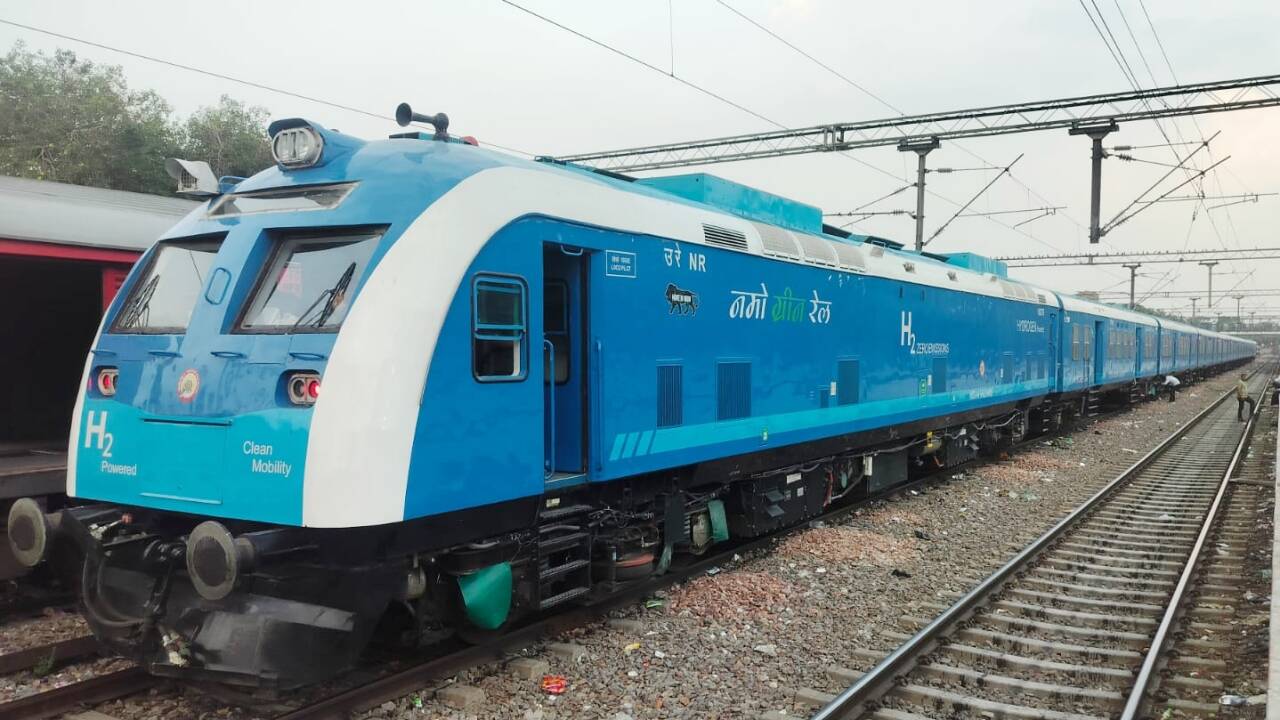
India's first hydrogen train has successfully traveled 6,000 km, significantly reducing carbon emissions in the process. The train, which consists of 10 coaches and can accommodate 2,600 passengers, operates on a route between Jind and Sonipat in the state of Haryana.
The hydrogen train has a maximum operating speed of 75 kmph, although it has been designed to reach speeds of up to 110 kmph. This innovative mode of transportation has resulted in a substantial reduction in CO2 emissions, with 36,444 kg of emissions cut during its 6,000 km journey.
The introduction of hydrogen trains in India is a significant step towards reducing the country's carbon footprint and promoting sustainable transportation. As the world's third-largest emitter of greenhouse gases, India is taking steps to reduce its reliance on fossil fuels and transition to cleaner energy sources.
The use of hydrogen as a fuel source has several advantages, including zero emissions at the point of use and a significant reduction in noise pollution. Hydrogen trains are also more energy-efficient than traditional diesel-powered trains, making them an attractive option for countries looking to reduce their environmental impact.
The success of India's first hydrogen train is a testament to the country's commitment to reducing its carbon emissions and promoting sustainable development. As the demand for clean and efficient transportation continues to grow, India is likely to see more hydrogen trains on its rails in the coming years.
The reduction of 36,444 kg of CO2 emissions is equivalent to taking 7,788 cars off the road for a day or planting 1,744 trees. This significant reduction in emissions highlights the potential of hydrogen trains to make a substantial impact on India's environment.
In the context of India's transportation sector, the introduction of hydrogen trains is a significant development. The country's rail network is one of the largest in the world, and the use of hydrogen trains could play a major role in reducing emissions and promoting sustainable development.
Overall, the success of India's first hydrogen train is a positive step towards a more sustainable future for the country. As India continues to grow and develop, it is likely that we will see more innovative and environmentally-friendly modes of transportation like the hydrogen train.
The impact of this development will be felt not only in India but also globally, as countries around the world look to reduce their carbon emissions and transition to cleaner energy sources. The use of hydrogen trains is a significant step towards a more sustainable future, and India is at the forefront of this development.
In conclusion, India's first hydrogen train has traveled 6,000 km, reducing CO2 emissions by 36,444 kg. This significant reduction in emissions highlights the potential of hydrogen trains to make a substantial impact on India's environment. As the country continues to grow and develop, it is likely that we will see more innovative and environmentally-friendly modes of transportation like the hydrogen train.
The future of transportation in India looks promising, with a focus on sustainability and reducing carbon emissions. The introduction of hydrogen trains is a significant step towards this goal, and it will be interesting to see how this technology develops in the coming years.
The success of the hydrogen train is a testament to India's commitment to reducing its carbon footprint and promoting sustainable development. It is a positive step towards a more sustainable future for the country, and it will have a significant impact on the environment and the transportation sector as a whole.
Frequently asked questions
What is the route of India's first hydrogen train?
The train operates between Jind and Sonipat in Haryana.
How much CO2 emissions has the train reduced?
The train has reduced 36444kg of CO2 emissions during its 6000km journey.