Bombay HC Allows Nitin Gadkari To Sue Meta, X, Google Over Deepfakes
Union Minister Nitin Gadkari gets court permission to sue tech giants over AI-generated content. Allegedly defamatory posts target him over ethanol-blended fuel programme.
'%3E%3Crect%20width%3D'96'%20height%3D'96'%20fill%3D'%23B3261E'%2F%3E%3Ccircle%20cx%3D'30'%20cy%3D'24'%20r%3D'44'%20fill%3D'%23fff'%20opacity%3D'.12'%2F%3E%3Ccircle%20cx%3D'60'%20cy%3D'74'%20r%3D'40'%20fill%3D'%23000'%20opacity%3D'.10'%2F%3E%3C%2Fg%3E%3Cg%20fill%3D'%23fff'%3E%3Crect%20x%3D'29'%20y%3D'49'%20width%3D'8'%20height%3D'19'%20rx%3D'1'%2F%3E%3Crect%20x%3D'39'%20y%3D'40'%20width%3D'9'%20height%3D'28'%20rx%3D'1'%2F%3E%3Crect%20x%3D'50'%20y%3D'45'%20width%3D'8'%20height%3D'23'%20rx%3D'1'%2F%3E%3Crect%20x%3D'60'%20y%3D'53'%20width%3D'7'%20height%3D'15'%20rx%3D'1'%2F%3E%3Crect%20x%3D'41'%20y%3D'34'%20width%3D'5'%20height%3D'6'%2F%3E%3C%2Fg%3E%3C%2Fsvg%3E)
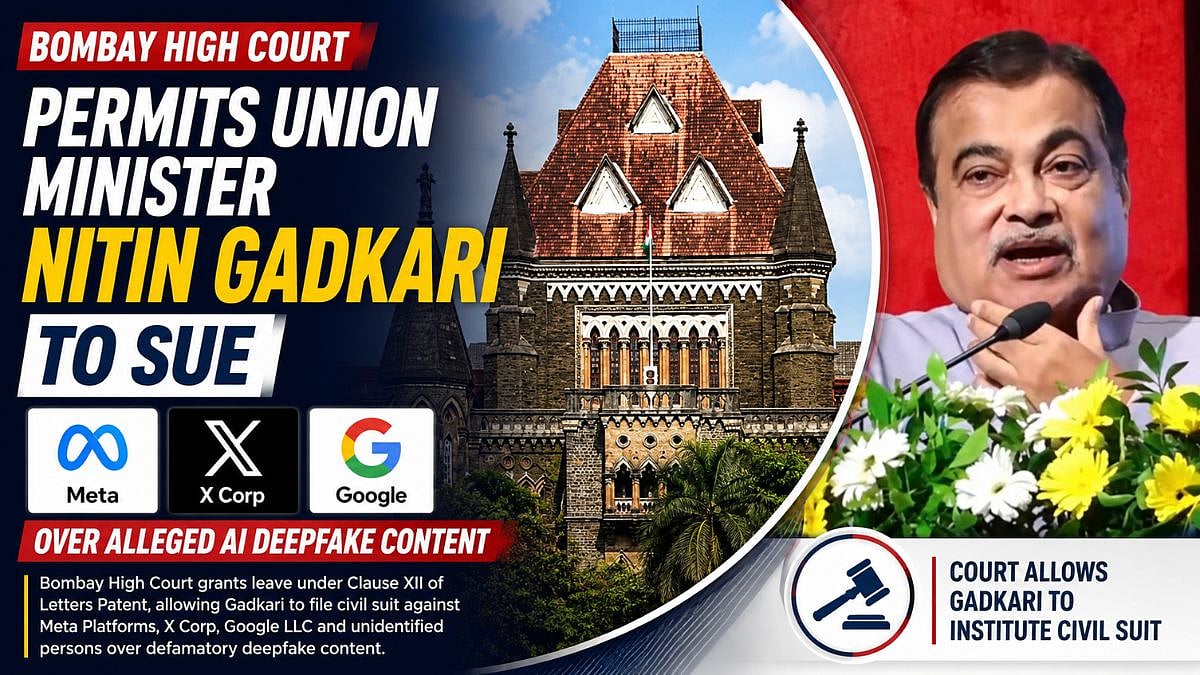
The Bombay High Court has granted Union Minister Nitin Gadkari permission to file a civil suit against Meta Platforms, X Corp, Google LLC, and unidentified individuals over allegedly defamatory deepfake and AI-generated content circulated online in his name.
On Monday, Justice Abhay Ahuja allowed Gadkari's application seeking leave under Clause XII of the Letters Patent, which is required when a part of the cause of action arises outside the territorial jurisdiction of the Bombay High Court.
Gadkari's advocate, Sandeep Ladda, argued that the allegedly defamatory posts and AI-generated deepfake content are available to users in Maharashtra through the online platforms. Since the material can be accessed in the state, a substantial part of the cause of action arises within the jurisdiction of the Bombay High Court, he submitted.
The court accepted the submissions and granted Gadkari leave to file the suit. In the proposed civil suit, Gadkari has alleged that fake, AI-generated, and defamatory content relating to the ethanol-blended fuel programme has been uploaded and circulated online.
According to the plaint, unidentified persons have shared posts and deepfake material falsely suggesting that Gadkari was personally responsible for the ethanol initiative and that he and his family derived financial benefits from it. The proposed suit contends that these allegations are 'false, malicious, and grossly defamatory' and have been created to mislead the public and damage Gadkari's reputation.
Through the civil action, the Union Minister for Road Transport and Highways proposes to seek permanent injunctions restraining the publication and circulation of the allegedly false and fabricated content.
The decision is significant as it highlights the growing concern over deepfake content and its potential to damage reputations. The case is also likely to have implications for tech giants and their role in regulating online content.
The Bombay High Court's decision to grant Gadkari permission to file the suit is a crucial step in the process. The court's ruling suggests that it is willing to entertain cases related to online defamation and deepfake content, even if the content is hosted on platforms outside its territorial jurisdiction.
The case is likely to be closely watched, given the high-profile nature of the plaintiff and the defendants. The outcome of the case could have significant implications for the regulation of online content and the protection of individuals' reputations in the digital age.
In the context of the growing concern over deepfake content, the case highlights the need for tech giants to take responsibility for regulating online content. The case also underscores the importance of protecting individuals' reputations in the digital age.
The decision is a significant development in the ongoing debate over online defamation and deepfake content. It is likely to have far-reaching implications for individuals, tech giants, and the regulation of online content in India.
In conclusion, the Bombay High Court's decision to grant Gadkari permission to file the suit is a crucial step in the process. The case is likely to be closely watched, and its outcome could have significant implications for the regulation of online content and the protection of individuals' reputations in the digital age.
Frequently asked questions
What is the basis of Nitin Gadkari's lawsuit against Meta, X, and Google?
Gadkari's lawsuit is based on allegedly defamatory deepfake and AI-generated content circulated online in his name, related to the ethanol-blended fuel programme.
What relief is Gadkari seeking through the civil action?
Gadkari is seeking permanent injunctions restraining the publication and circulation of the allegedly false and fabricated content.