Kospi Trading Halted After 8% Plunge
South Korea's stock market halted trading, erasing $328 billion in market capitalization. SK Hynix fell 12% despite a strong US debut.
'%3E%3Crect%20width%3D'96'%20height%3D'96'%20fill%3D'%230B6E4F'%2F%3E%3Ccircle%20cx%3D'30'%20cy%3D'24'%20r%3D'44'%20fill%3D'%23fff'%20opacity%3D'.12'%2F%3E%3Ccircle%20cx%3D'60'%20cy%3D'74'%20r%3D'40'%20fill%3D'%23000'%20opacity%3D'.10'%2F%3E%3C%2Fg%3E%3Cg%20fill%3D'none'%20stroke%3D'%23fff'%20stroke-width%3D'3.2'%20stroke-linecap%3D'round'%20stroke-linejoin%3D'round'%3E%3Cpolyline%20points%3D'31%2C59%2041%2C49%2049%2C54%2063%2C37'%2F%3E%3Cpolyline%20points%3D'55%2C37%2063%2C37%2063%2C45'%2F%3E%3C%2Fg%3E%3C%2Fsvg%3E)
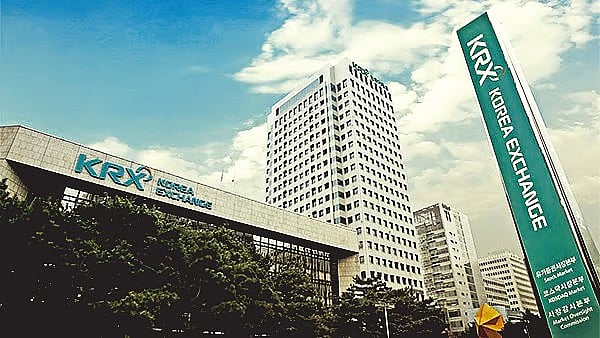
South Korea's Kospi stock market was forced to halt trading for 20 minutes on July 13 after experiencing a sharp 8% decline. This sudden drop resulted in the erasure of approximately $328 billion in market capitalization, marking one of the most significant single-day losses in recent memory.
The sell-off was largely driven by intense volatility in local equities, with tech shares bearing the brunt of the decline. SK Hynix Inc., a leading memory chip maker, saw its shares fall 12% in Seoul trading. This came as a surprise, given that the company's US-listed American depositary receipts (ADRs) had surged 13% during their Friday debut.
Analysts attributed the sharp local drop to profit-taking, noting that the ADR listing had largely priced in expectations for the company's $26.5 billion offering. SK Hynix has gained significant attention as a major supplier of high-bandwidth memory (HBM) chips for AI processors, including Nvidia Corp.'s platforms. The company's shares have risen more than 25-fold since the end of 2022.
However, the increased volatility in the stock can be attributed to leveraged ETFs and heightened market expectations for AI growth. Analysts from Korea Investment & Securities noted that Hynix's operating profit may underperform consensus by 8% due to slower HBM price gains compared to conventional memory.
The broader tech sector was also impacted, with Samsung Electronics shares declining as much as 9.8%. Futures for the Nasdaq 100 dropped 1.1%, and European equities were set to open down about 1%, signaling a global risk-off sentiment. Cryptocurrency markets followed suit, with Bitcoin slipping more than 2% to roughly $62,800.
Geopolitical developments further dampened investor confidence, as the US military conducted strikes against Iranian targets in response to drone and missile attacks on US allies and civilian vessels in the Strait of Hormuz. Rising oil prices have renewed concerns over inflation, prompting market participants to monitor upcoming US inflation data and anticipate potential Federal Reserve rate adjustments.
The recent turbulence in South Korea's market underscores the challenges posed by highly priced AI stocks, leveraged ETFs, and macroeconomic and geopolitical uncertainty. The Kospi has triggered 13 circuit-breakers since 2000, with seven occurring in 2026 alone, reflecting persistent volatility in the memory and technology sectors.
The halt in trading serves as a reminder of the fragility of investor sentiment in the current market environment. As the global economy continues to navigate the complexities of AI-driven tech rallies and geopolitical concerns, investors will be closely watching the developments in South Korea's market and their potential impact on the global economy.
In conclusion, the sudden halt in trading on the Kospi stock market is a significant event that highlights the volatility and uncertainty in the current market environment. As investors and market participants continue to monitor the situation, it is clear that the challenges posed by highly priced AI stocks, leveraged ETFs, and macroeconomic and geopolitical uncertainty will be a major focus in the coming days and weeks.