Recording Police in India is Legal
Citizens can record police in public, but with some limits.
'%3E%3Crect%20width%3D'96'%20height%3D'96'%20fill%3D'%231A5276'%2F%3E%3Ccircle%20cx%3D'30'%20cy%3D'24'%20r%3D'44'%20fill%3D'%23fff'%20opacity%3D'.12'%2F%3E%3Ccircle%20cx%3D'60'%20cy%3D'74'%20r%3D'40'%20fill%3D'%23000'%20opacity%3D'.10'%2F%3E%3C%2Fg%3E%3Cg%20fill%3D'%23fff'%3E%3Cpath%20d%3D'M31%2041%20L48%2031%20L65%2041%20Z'%2F%3E%3Crect%20x%3D'33'%20y%3D'43'%20width%3D'4'%20height%3D'17'%2F%3E%3Crect%20x%3D'41'%20y%3D'43'%20width%3D'4'%20height%3D'17'%2F%3E%3Crect%20x%3D'51'%20y%3D'43'%20width%3D'4'%20height%3D'17'%2F%3E%3Crect%20x%3D'59'%20y%3D'43'%20width%3D'4'%20height%3D'17'%2F%3E%3Crect%20x%3D'30'%20y%3D'62'%20width%3D'36'%20height%3D'4'%20rx%3D'1'%2F%3E%3C%2Fg%3E%3C%2Fsvg%3E)
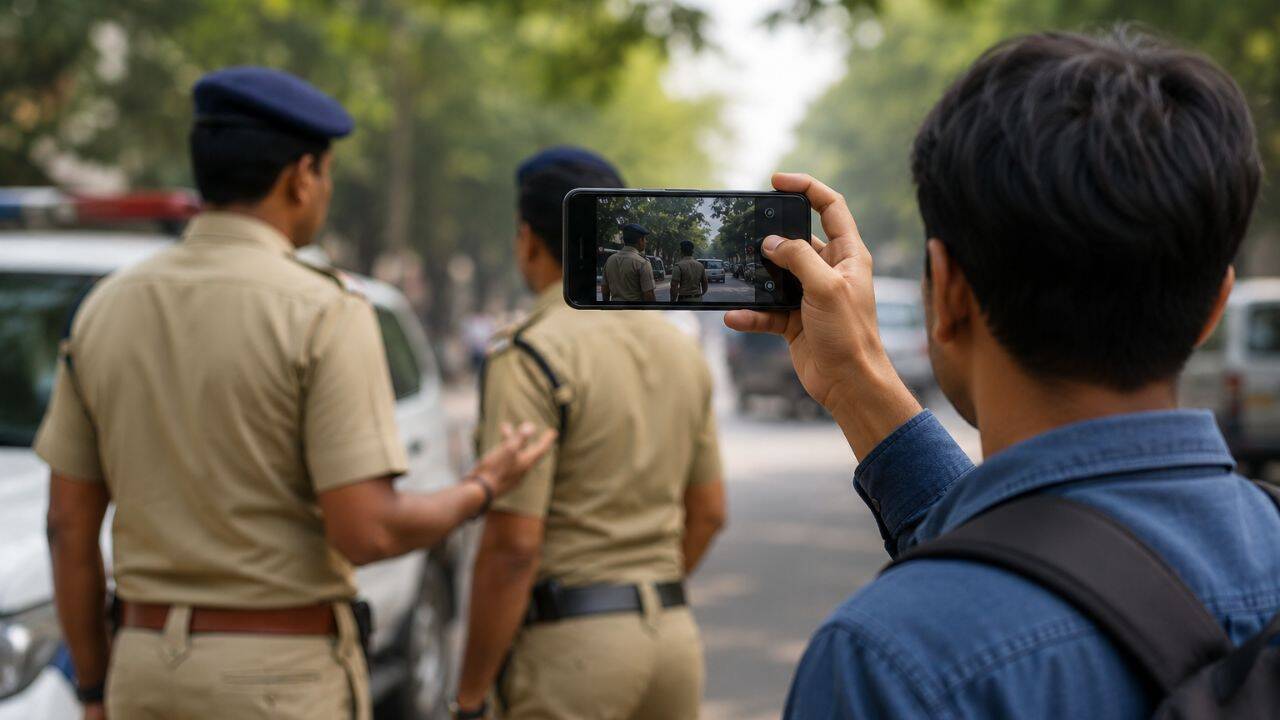
In India, citizens are generally allowed to record police officers while they are performing their duties in public spaces. This is permitted as long as the recording does not obstruct the police from carrying out their work or violate any other laws.
The police cannot seize phones or force the deletion of videos that have been lawfully recorded. However, uploading these videos online can lead to consequences if they are found to be defamatory or if they invade someone's privacy.
The Indian courts have emphasized the importance of transparency in the actions of the police, while also ensuring that individual rights are balanced with the need for effective policing. This means that citizens have the right to record police activities, but they must do so in a way that does not interfere with the police work or break any laws.
The legality of recording police in India is based on the principles of transparency and accountability. By allowing citizens to record police activities, the government aims to ensure that the police are held accountable for their actions and that citizens are protected from any potential abuse of power.
In recent years, there have been several instances where citizens have used their mobile phones to record police brutality or misconduct. These recordings have often been used as evidence in court cases, highlighting the importance of allowing citizens to record police activities.
However, it is also important to note that recording police activities can be a complex issue. While it can help to promote transparency and accountability, it can also raise concerns about privacy and the potential for misuse of recorded footage.
The Indian government has not yet introduced any specific laws or guidelines on recording police activities. However, the courts have provided some guidance on the issue, emphasizing the need for balance between transparency and individual rights.
In summary, citizens in India can legally record police officers performing their duties in public spaces, as long as the recording does not obstruct police work or break any other laws. While there are some limits to this right, it is an important aspect of promoting transparency and accountability in policing.
The ability to record police activities is a fundamental right that can help to ensure that citizens are protected from abuse of power and that the police are held accountable for their actions. As the use of mobile phones and other recording devices becomes more widespread, it is likely that the issue of recording police activities will continue to be an important aspect of the debate on transparency and accountability in India.
Ultimately, the key to resolving this issue is to find a balance between the need for transparency and accountability, and the need to protect individual rights and prevent the misuse of recorded footage. By allowing citizens to record police activities in a responsible and lawful manner, India can promote a more transparent and accountable policing system, which is essential for upholding the rule of law and protecting the rights of citizens.
The issue of recording police activities is not unique to India, and many countries around the world are grappling with the same challenges. However, by providing clear guidance on the legality of recording police activities, India can set an important precedent for other countries and help to promote a culture of transparency and accountability in policing.
In conclusion, the legality of recording police in India is an important issue that has significant implications for transparency, accountability, and the protection of individual rights. While there are some limits to this right, it is a fundamental aspect of promoting good governance and ensuring that the police are held accountable for their actions.