Economic Battles Reflect Inner Human Mind
Uncertainty and conflict arise from human instincts, Markets reflect expectations and trust
'%3E%3Crect%20width%3D'96'%20height%3D'96'%20fill%3D'%23B3261E'%2F%3E%3Ccircle%20cx%3D'30'%20cy%3D'24'%20r%3D'44'%20fill%3D'%23fff'%20opacity%3D'.12'%2F%3E%3Ccircle%20cx%3D'60'%20cy%3D'74'%20r%3D'40'%20fill%3D'%23000'%20opacity%3D'.10'%2F%3E%3C%2Fg%3E%3Cg%20fill%3D'%23fff'%3E%3Crect%20x%3D'29'%20y%3D'49'%20width%3D'8'%20height%3D'19'%20rx%3D'1'%2F%3E%3Crect%20x%3D'39'%20y%3D'40'%20width%3D'9'%20height%3D'28'%20rx%3D'1'%2F%3E%3Crect%20x%3D'50'%20y%3D'45'%20width%3D'8'%20height%3D'23'%20rx%3D'1'%2F%3E%3Crect%20x%3D'60'%20y%3D'53'%20width%3D'7'%20height%3D'15'%20rx%3D'1'%2F%3E%3Crect%20x%3D'41'%20y%3D'34'%20width%3D'5'%20height%3D'6'%2F%3E%3C%2Fg%3E%3C%2Fsvg%3E)
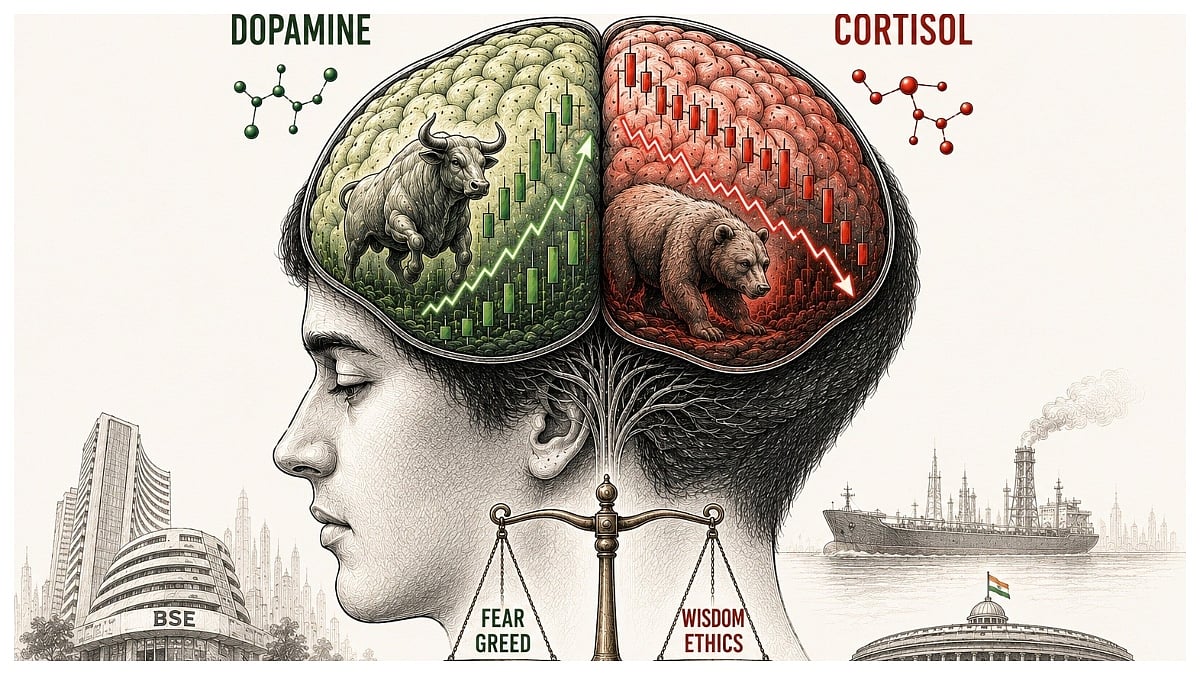
As markets reopen in Mumbai on July 13, India faces another week of uncertainty. The monsoon remains unpredictable, and investors are weighing risk against opportunity. Employers are hesitant to commit fresh capital, while policymakers navigate American reciprocal tariffs and an unfinished India-US trade agreement.
The current economic landscape is marked by competing pressures, with every nation pursuing security, prosperity, and influence. Confidence has not disappeared, but it is waiting for clarity. However, beneath these familiar headlines lies a deeper question that economics alone cannot answer. Why do intelligent societies, blessed with unprecedented scientific knowledge and technological progress, continue to generate uncertainty, conflict, and mistrust?
The answer may begin within the human mind. Before every market rally or crash, every election victory or defeat, and every diplomatic breakthrough or military confrontation, billions of human brains process hope, fear, ambition, and expectation. The human brain is a complex system, powered by electrical impulses, with chemistry carrying messages through molecules. Biology has refined these systems over millions of years to help humanity survive, compete, and cooperate.
Psychology transforms these impulses into judgment and emotion, which in turn influence economic decisions. Scientists have identified several natural chemical messengers that quietly influence behavior, including dopamine, cortisol, testosterone, and oxytocin. These hormones are not inherently good or bad, but together they form part of the remarkable biology that makes us human.
However, hormones do not start wars, crash markets, or topple governments. Those outcomes emerge when natural human instincts collide with poor judgment, misinformation, intolerance, weak institutions, unchecked ambition, and the absence of ethical leadership. Markets reflect more than earnings; they reflect expectations. Governments depend upon more than policies; they depend upon trust.
The past week has illustrated this reality, with tariff uncertainty delaying investment, oil prices responding to conflict, and businesses postponing decisions while awaiting policy clarity. Financial markets have oscillated between optimism and caution, reflecting the visible expression of millions of invisible human decisions.
In this complex landscape, it is essential to recognize that economic battles are not just fought on trading floors or in government offices, but also within the human mind. The pursuit of security, prosperity, and influence is driven by a delicate balance of hope, fear, ambition, and expectation.
As India navigates the challenges of the current economic landscape, it is crucial to acknowledge the role of human psychology in shaping economic decisions. By understanding the complex interplay between human instincts, judgment, and emotion, policymakers and business leaders can make more informed decisions that take into account the invisible battles being fought within every human mind.
In conclusion, the greatest economic battle lies not in the external world, but within the human mind. It is a battle between hope and fear, ambition and expectation, and it is this battle that ultimately shapes the course of economies and nations. As Mumbai and India look to the future, it is essential to recognize the importance of this inner battle and to strive for clarity, trust, and wise governance in the face of uncertainty and complexity.
The interplay between human psychology and economics is a complex and multifaceted issue, and one that requires careful consideration and analysis. By examining the ways in which human instincts and emotions influence economic decisions, we can gain a deeper understanding of the underlying drivers of economic activity and make more informed decisions about the future.
Ultimately, the key to navigating the challenges of the current economic landscape lies in recognizing the importance of human psychology and the invisible battles being fought within every human mind. By acknowledging and addressing these battles, we can work towards creating a more stable and prosperous economic future for Mumbai, India, and the world.
The economic landscape is constantly evolving, and it is essential to stay informed and adapt to changing circumstances. As the markets continue to reflect expectations and trust, it is crucial to recognize the role of human psychology in shaping economic decisions and to strive for clarity, trust, and wise governance in the face of uncertainty and complexity.
In the end, the greatest economic battle is not just about numbers and policies, but about the human mind and its complexities. It is a battle that requires careful consideration, analysis, and understanding, and one that will ultimately shape the course of economies and nations for years to come.