Supreme Court Urges Restraint On Student Protests
Supreme Court advises listening to protesting students, exercising restraint.
'%3E%3Crect%20width%3D'96'%20height%3D'96'%20fill%3D'%231A5276'%2F%3E%3Ccircle%20cx%3D'30'%20cy%3D'24'%20r%3D'44'%20fill%3D'%23fff'%20opacity%3D'.12'%2F%3E%3Ccircle%20cx%3D'60'%20cy%3D'74'%20r%3D'40'%20fill%3D'%23000'%20opacity%3D'.10'%2F%3E%3C%2Fg%3E%3Cg%20fill%3D'%23fff'%3E%3Cpath%20d%3D'M31%2041%20L48%2031%20L65%2041%20Z'%2F%3E%3Crect%20x%3D'33'%20y%3D'43'%20width%3D'4'%20height%3D'17'%2F%3E%3Crect%20x%3D'41'%20y%3D'43'%20width%3D'4'%20height%3D'17'%2F%3E%3Crect%20x%3D'51'%20y%3D'43'%20width%3D'4'%20height%3D'17'%2F%3E%3Crect%20x%3D'59'%20y%3D'43'%20width%3D'4'%20height%3D'17'%2F%3E%3Crect%20x%3D'30'%20y%3D'62'%20width%3D'36'%20height%3D'4'%20rx%3D'1'%2F%3E%3C%2Fg%3E%3C%2Fsvg%3E)
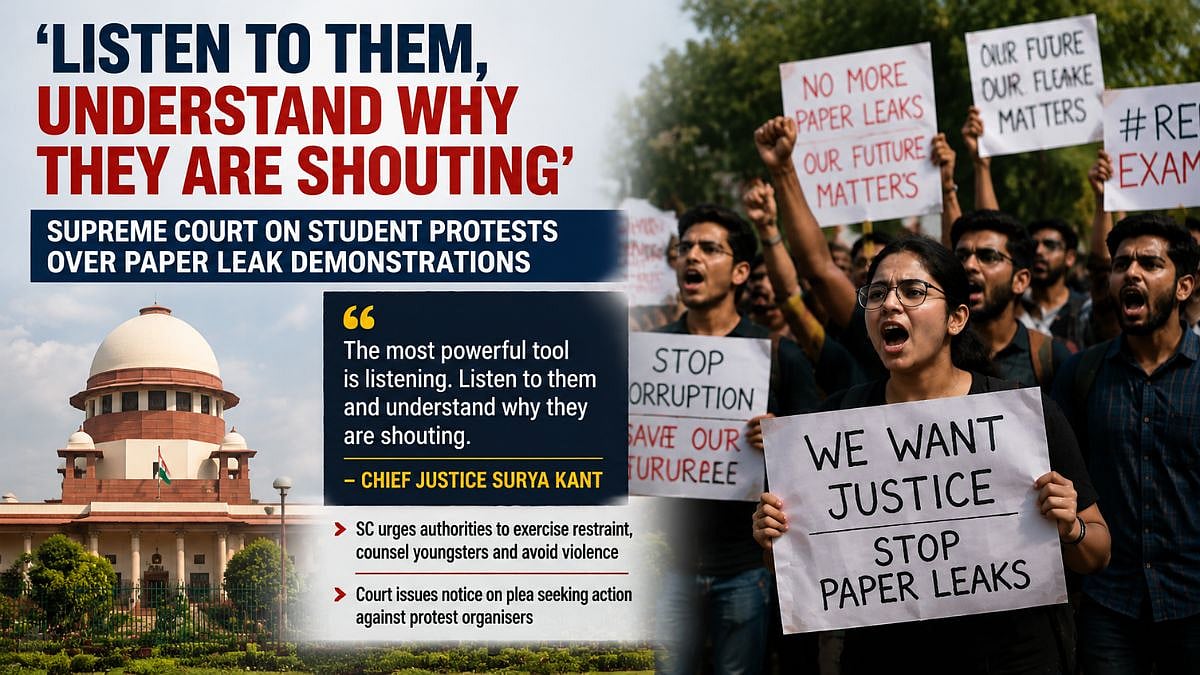
The Supreme Court on Wednesday advised authorities to listen to protesting students and exercise restraint, stating that counselling and dialogue can prevent demonstrations from escalating into violence.
A Bench of Chief Justice of India Surya Kant, Justice Joymalya Bagchi, and Justice V. Mohana was hearing petitions related to student protests over repeated question paper leaks. The court issued notice on a plea seeking accountability from protest organisers and tagged it with other pending petitions concerning the demonstrations.
Chief Justice Kant emphasized the importance of listening to the students, saying that it is the most powerful tool to understand their concerns. He cautioned that an aggressive response from the State could aggravate tensions and lead to further violence. The court stressed that police should exercise restraint during demonstrations to ensure situations do not spiral out of control.
The protests began in June, following a call by the online collective Cockroach Janta Party, which demanded the resignation of then Union Education Minister Dharmendra Pradhan over repeated question paper leaks. The demonstrations culminated in a Sansad Chalo march towards Parliament on July 20, despite Delhi Police saying permission had not been granted. Clashes broke out during the march, with allegations that police used disproportionate force.
Pradhan resigned on July 25, and the protests were subsequently called off. One of the pleas sought action against organisers for their alleged role in the July 20 demonstrations, arguing that accountability could not be limited to the government and police. Advocate Rizwan Ahmed questioned why protest organisers had not faced similar scrutiny, saying that withdrawing criminal cases against protesters solely on the basis of a political understanding could set a dangerous precedent for future demonstrations.
The Supreme Court's advice to listen to protesting students and exercise restraint is significant, as it acknowledges the importance of addressing the concerns of young people. The court's emphasis on counselling and dialogue as a means to prevent violence is also noteworthy, as it highlights the need for a peaceful and constructive approach to resolving conflicts.
The student protests over question paper leaks have brought attention to the issue of accountability in education. The repeated leaks have raised concerns about the integrity of the examination system and the need for reforms. The Supreme Court's decision to hear petitions related to the protests demonstrates its commitment to addressing the concerns of students and ensuring that their voices are heard.
In the context of Indian democracy, the Supreme Court's advice to listen to protesting students is a reminder of the importance of protecting the rights of citizens to express themselves peacefully. The court's emphasis on restraint and accountability is also a reminder of the need for the State to respond to protests in a manner that is proportionate and respectful of human rights.
The significance of the Supreme Court's decision lies in its potential to shape the way authorities respond to protests in the future. By emphasizing the importance of listening to protesting students and exercising restraint, the court is setting a precedent for a more peaceful and constructive approach to resolving conflicts. This approach is essential in a democracy, where the rights of citizens to express themselves must be protected and respected.
In conclusion, the Supreme Court's advice to listen to protesting students and exercise restraint is a significant development in the context of Indian democracy. The court's emphasis on counselling and dialogue as a means to prevent violence is a reminder of the importance of addressing the concerns of young people and ensuring that their voices are heard. The decision has the potential to shape the way authorities respond to protests in the future and is a step towards creating a more peaceful and constructive approach to resolving conflicts.
The Supreme Court's decision is a reminder that the rights of citizens to express themselves peacefully must be protected and respected. The court's emphasis on restraint and accountability is a reminder of the need for the State to respond to protests in a manner that is proportionate and respectful of human rights. The decision is a significant step towards creating a more just and equitable society, where the voices of all citizens are heard and respected.
Frequently asked questions
What was the Supreme Court's advice on student protests?
The Supreme Court advised authorities to listen to protesting students and exercise restraint, stating that counselling and dialogue can prevent demonstrations from escalating into violence.
What was the reason behind the student protests?
The student protests were over repeated question paper leaks, which led to demands for the resignation of then Union Education Minister Dharmendra Pradhan.