Delhi Court Takes Cognisance Of CBI Chargesheet In NEET Paper Leak Case
Delhi court takes action, CBI chargesheet filed against 13 accused, hearing to begin soon.
'%3E%3Crect%20width%3D'96'%20height%3D'96'%20fill%3D'%23B3261E'%2F%3E%3Ccircle%20cx%3D'30'%20cy%3D'24'%20r%3D'44'%20fill%3D'%23fff'%20opacity%3D'.12'%2F%3E%3Ccircle%20cx%3D'60'%20cy%3D'74'%20r%3D'40'%20fill%3D'%23000'%20opacity%3D'.10'%2F%3E%3C%2Fg%3E%3Cg%20fill%3D'%23fff'%3E%3Crect%20x%3D'29'%20y%3D'49'%20width%3D'8'%20height%3D'19'%20rx%3D'1'%2F%3E%3Crect%20x%3D'39'%20y%3D'40'%20width%3D'9'%20height%3D'28'%20rx%3D'1'%2F%3E%3Crect%20x%3D'50'%20y%3D'45'%20width%3D'8'%20height%3D'23'%20rx%3D'1'%2F%3E%3Crect%20x%3D'60'%20y%3D'53'%20width%3D'7'%20height%3D'15'%20rx%3D'1'%2F%3E%3Crect%20x%3D'41'%20y%3D'34'%20width%3D'5'%20height%3D'6'%2F%3E%3C%2Fg%3E%3C%2Fsvg%3E)
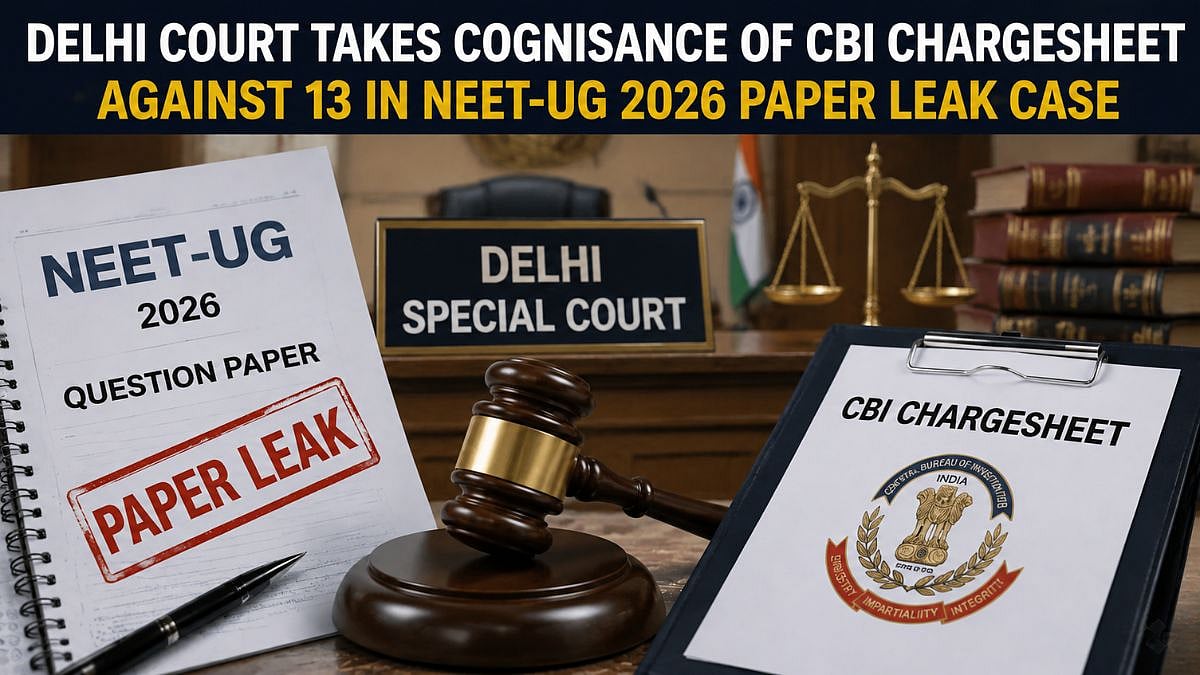
A Delhi court has taken cognisance of the Central Bureau of Investigation (CBI) chargesheet against 13 accused in the NEET-UG paper leak case. The chargesheet was submitted before the designated fast-track court dealing with criminal cases arising from paper leaks and other unfair means in public examinations.
The court, presided over by Special Judge Ajay Gupta, is likely to begin hearing arguments on charges from Thursday. During the proceedings, the CBI informed the court that the media was publishing the names of some witnesses, who could even be minors, as well as portions of the chargesheet. The court expressed displeasure over the publication of witness names and said that responsible media should refrain from doing such things.
According to the CBI chargesheet, three National Testing Agency (NTA) subject experts were the primary sources of the NEET paper leak. The chargesheet named P. V. Kulkarni for chemistry, Manisha Sanjay Havaldar for physics, and Manisha Gurunath Mandhare for botany and zoology as the primary sources of the leak.
The CBI began its crackdown on May 13, arresting several individuals in connection with the case. The agency arrested Mangilal, Dinesh, and Vikas Biwal in Rajasthan, and their mobile phones contained leaked PDFs received through Telegram on April 29. The CBI also arrested Yash Yadav in Gurugram and Shubham Khairnar in Nashik on May 13.
Dhananjay Lokhande was arrested in Pune the same day after he allegedly attempted to destroy his phone to clear evidence before being apprehended. Manisha Sanjay Waghmare was arrested in Pune the following day and was described as one of the prime conspirators in the leakage and dissemination of NEET UG 2026 questions for monetary consideration.
The CBI arrested alleged mastermind P. V. Kulkarni in Latur on May 15 and Manisha Mandhare in Pune on May 16. Shivraj Motegaonkar, founder of a coaching centre in Latur, was picked up on May 17. The agency arrested Manisha Sanjay Havaldar in Latur on May 22, and the final arrests were those of Tejas Shah and Dr Manoj Shirure from Pune and Latur, respectively, on May 26.
The chargesheet said that forensic imaging of mobile devices helped uncover the alleged conspiracy by recovering deleted WhatsApp chats and PDF documents containing the leaked questions. The NEET-UG examination was cancelled on May 12, and a re-exam was conducted after the paper leak was discovered.
The National Eligibility-cum-Entrance Test (Undergraduate), or NEET-UG, is conducted by the NTA for medical aspirants. The cancellation of the exam and the subsequent re-exam caused inconvenience to many students who were preparing for the exam.
The case highlights the need for strict measures to prevent paper leaks and ensure the integrity of public examinations. The CBI's investigation and the court's actions are steps towards bringing the accused to justice and preventing such incidents in the future.
The outcome of the case will be closely watched, and it is expected to have significant implications for the education sector. The court's decision will set a precedent for future cases of paper leaks and other unfair means in public examinations.
In conclusion, the Delhi court's decision to take cognisance of the CBI chargesheet in the NEET paper leak case is a significant step towards ensuring justice and preventing such incidents in the future. The case highlights the need for strict measures to prevent paper leaks and ensure the integrity of public examinations.
Frequently asked questions
What is the NEET-UG paper leak case about?
The NEET-UG paper leak case refers to the leakage of the National Eligibility-cum-Entrance Test (Undergraduate) question paper, which was conducted by the National Testing Agency (NTA) for medical aspirants.
How many people have been accused in the NEET paper leak case?
13 people have been accused in the NEET paper leak case, including three NTA subject experts who were the primary sources of the leak.