NITI Aayog Report To Reform Maharashtra's Skilling Ecosystem
Maharashtra's skilling ecosystem may see a shift in focus towards employment and career growth. A new NITI Aayog report calls for a change in approach.
'%3E%3Crect%20width%3D'96'%20height%3D'96'%20fill%3D'%23B3261E'%2F%3E%3Ccircle%20cx%3D'30'%20cy%3D'24'%20r%3D'44'%20fill%3D'%23fff'%20opacity%3D'.12'%2F%3E%3Ccircle%20cx%3D'60'%20cy%3D'74'%20r%3D'40'%20fill%3D'%23000'%20opacity%3D'.10'%2F%3E%3C%2Fg%3E%3Cg%20fill%3D'%23fff'%3E%3Crect%20x%3D'29'%20y%3D'49'%20width%3D'8'%20height%3D'19'%20rx%3D'1'%2F%3E%3Crect%20x%3D'39'%20y%3D'40'%20width%3D'9'%20height%3D'28'%20rx%3D'1'%2F%3E%3Crect%20x%3D'50'%20y%3D'45'%20width%3D'8'%20height%3D'23'%20rx%3D'1'%2F%3E%3Crect%20x%3D'60'%20y%3D'53'%20width%3D'7'%20height%3D'15'%20rx%3D'1'%2F%3E%3Crect%20x%3D'41'%20y%3D'34'%20width%3D'5'%20height%3D'6'%2F%3E%3C%2Fg%3E%3C%2Fsvg%3E)
A new report by NITI Aayog, Reimagining Skilling for Viksit Bharat@2047, has called for a significant shift in Maharashtra's existing skilling ecosystem. The report, released in August 2026, suggests moving away from enrolment and certificate-based training towards programmes tied directly to employment, wages, and career progression.
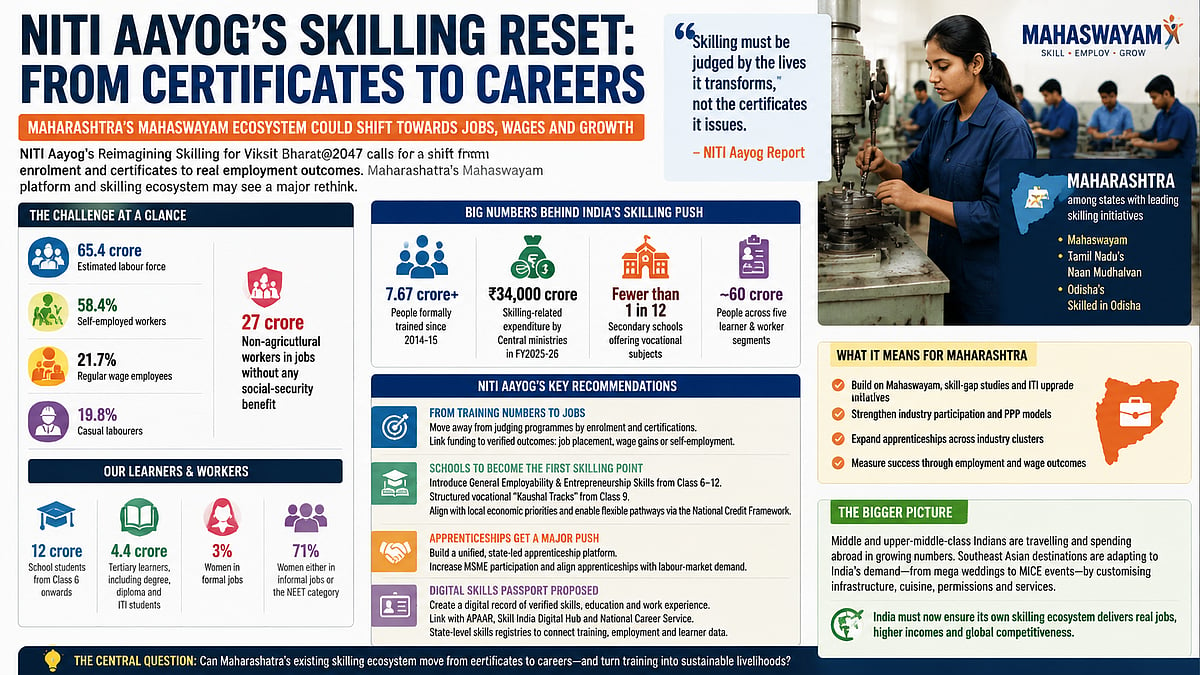
The report states that India has trained more than 7.67 crore people since 2014-15, with the Union Budget for 2025-26 allocating ₹34,000 crore towards skilling-related expenditure across Central ministries. However, the outcomes remain uneven, and the country's skilling architecture needs a fundamental overhaul.
Maharashtra has been identified as one of the states that have already developed significant skilling initiatives, including the Mahaswayam platform. The report suggests that states will be the primary drivers of the proposed transformation, adapting the national framework to local labour markets, infrastructure, and learner needs.
The report estimates India's labour force at 65.4 crore, with 58.4% self-employed, 21.7% regular wage employees, and 19.8% casual labourers. It also identifies 7 crore non-agricultural workers with at least one social-security benefit, compared to 27 crore workers in jobs without any social-security benefit.
The report highlights the importance of extending skilling beyond conventional ITI and short-term training programmes to workers already in the labour market, particularly those in informal employment. Maharashtra already operates Mahaswayam, a platform intended to bring jobseekers, employers, industry, and skilled youth onto a common platform.
The state is also seeking greater private-sector participation in technical training. Mahaswayam currently carries an expression of interest for upgrading ITIs through a public-private partnership model, besides a vocational-training project under the MCGM in Mumbai.
The NITI Aayog report's recommendations are significant for Maharashtra, as the state looks to reform its skilling ecosystem. The report's focus on employment, wages, and career growth is expected to bring about a significant shift in the state's approach to skilling.
The report's findings also highlight the challenges faced by India's workforce, including the lack of social-security benefits for many workers. The report notes that only 3% of women are in formal jobs, while 71% are either in informal employment or in the NEET category.
Overall, the NITI Aayog report's recommendations are expected to have a significant impact on Maharashtra's skilling ecosystem, with a focus on employment, wages, and career growth. The state's efforts to reform its skilling ecosystem are likely to be closely watched, as it seeks to address the challenges faced by its workforce.
The report's emphasis on adapting the national framework to local labour markets, infrastructure, and learner needs is also significant. It highlights the importance of tailoring skilling initiatives to the specific needs of each state, rather than adopting a one-size-fits-all approach.
In conclusion, the NITI Aayog report's recommendations are expected to bring about a significant shift in Maharashtra's skilling ecosystem, with a focus on employment, wages, and career growth. The state's efforts to reform its skilling ecosystem are likely to have a positive impact on its workforce, particularly those in informal employment.
The report's findings and recommendations are also likely to have implications for other states, as they seek to reform their own skilling ecosystems. The emphasis on adapting the national framework to local labour markets, infrastructure, and learner needs is likely to be adopted by other states, as they seek to address the challenges faced by their workforces.
As Maharashtra looks to implement the report's recommendations, it is likely to face several challenges. The state will need to work closely with private-sector partners to upgrade its ITIs and provide vocational training to workers. It will also need to address the lack of social-security benefits for many workers, particularly those in informal employment.
Overall, the NITI Aayog report's recommendations are expected to have a significant impact on Maharashtra's skilling ecosystem, with a focus on employment, wages, and career growth. The state's efforts to reform its skilling ecosystem are likely to be closely watched, as it seeks to address the challenges faced by its workforce.
The report's emphasis on employment, wages, and career growth is likely to bring about a significant shift in the state's approach to skilling. The state's skilling ecosystem is likely to become more focused on providing workers with the skills they need to access better-paying jobs and advance in their careers.
In the long term, the report's recommendations are likely to have a positive impact on Maharashtra's economy, as a more skilled workforce is likely to attract more investment and create more jobs. The state's efforts to reform its skilling ecosystem are likely to be seen as a model for other states, as they seek to address the challenges faced by their workforces.
The report's findings and recommendations are also likely to have implications for India's workforce as a whole. The emphasis on adapting the national framework to local labour markets, infrastructure, and learner needs is likely to be adopted by other states, as they seek to address the challenges faced by their workforces.
In conclusion, the NITI Aayog report's recommendations are expected to bring about a significant shift in Maharashtra's skilling ecosystem, with a focus on employment, wages, and career growth. The state's efforts to reform its skilling ecosystem are likely to have a positive impact on its workforce, particularly those in informal employment.
The report's emphasis on employment, wages, and career growth is likely to bring about a significant shift in the state's approach to skilling. The state's skilling ecosystem is likely to become more focused on providing workers with the skills they need to access better-paying jobs and advance in their careers.
The report's findings and recommendations are also likely to have implications for other states, as they seek to reform their own skilling ecosystems. The emphasis on adapting the national framework to local labour markets, infrastructure, and learner needs is likely to be adopted by other states, as they seek to address the challenges faced by their workforces.
As Maharashtra looks to implement the report's recommendations, it is likely to face several challenges. The state will need to work closely with private-sector partners to upgrade its ITIs and provide vocational training to workers. It will also need to address the lack of social-security benefits for many workers, particularly those in informal employment.
Overall, the NITI Aayog report's recommendations are expected to have a significant impact on Maharashtra's skilling ecosystem, with a focus on employment, wages, and career growth. The state's efforts to reform its skilling ecosystem are likely to be closely watched, as it seeks to address the challenges faced by its workforce.
The report's emphasis on employment, wages, and career growth is likely to bring about a significant shift in the state's approach to skilling. The state's skilling ecosystem is likely to become more focused on providing workers with the skills they need to access better-paying jobs and advance in their careers.
In the long term, the report's recommendations are likely to have a positive impact on Maharashtra's economy, as a more skilled workforce is likely to attract more investment and create more jobs. The state's efforts to reform its skilling ecosystem are likely to be seen as a model for other states, as they seek to address the challenges faced by their workforces.
The report's findings and recommendations are also likely to have implications for India's workforce as a whole. The emphasis on adapting the national framework to local labour markets, infrastructure, and learner needs is likely to be adopted by other states, as they seek to address the challenges faced by their workforces.
In conclusion, the NITI Aayog report's recommendations are expected to bring about a significant shift in Maharashtra's skilling ecosystem, with a focus on employment, wages, and career growth. The state's efforts to reform its skilling ecosystem are likely to have a positive impact on its workforce, particularly those in informal employment.
What it means for Mumbai and India is that the skilling ecosystem will be more focused on providing workers with the skills they need to access better-paying jobs and advance in their careers. This will likely lead to a more skilled workforce, which will attract more investment and create more jobs. The report's emphasis on adapting the national framework to local labour markets, infrastructure, and learner needs will also ensure that the skilling ecosystem is tailored to the specific needs of each state.
The report's recommendations are likely to have a positive impact on India's economy, as a more skilled workforce will lead to increased productivity and competitiveness. The report's emphasis on employment, wages, and career growth will also ensure that workers have access to better-paying jobs and opportunities for advancement.
Overall, the NITI Aayog report's recommendations are expected to bring about a significant shift in Maharashtra's skilling ecosystem, with a focus on employment, wages, and career growth. The state's efforts to reform its skilling ecosystem are likely to have a positive impact on its workforce, particularly those in informal employment.
The report's findings and recommendations are also likely to have implications for other states, as they seek to reform their own skilling ecosystems. The emphasis on adapting the national framework to local labour markets, infrastructure, and learner needs is likely to be adopted by other states, as they seek to address the challenges faced by their workforces.
In conclusion, the NITI Aayog report's recommendations are expected to bring about a significant shift in Maharashtra's skilling ecosystem, with a focus on employment, wages, and career growth. The state's efforts to reform its skilling ecosystem are likely to have a positive impact on its workforce, particularly those in informal employment.
Frequently asked questions
What is the main focus of the NITI Aayog report on skilling ecosystem?
The main focus of the report is on employment, wages, and career growth.
How will Maharashtra adapt the national framework to local labour markets?
Maharashtra will adapt the national framework to local labour markets, infrastructure, and learner needs.