Hyderabad Astronomer Rohan Naidu Probes Early Universe
Rohan Naidu's study reveals supermassive black hole, sheds light on cosmic dawn.
'%3E%3Crect%20width%3D'96'%20height%3D'96'%20fill%3D'%23B3261E'%2F%3E%3Ccircle%20cx%3D'30'%20cy%3D'24'%20r%3D'44'%20fill%3D'%23fff'%20opacity%3D'.12'%2F%3E%3Ccircle%20cx%3D'60'%20cy%3D'74'%20r%3D'40'%20fill%3D'%23000'%20opacity%3D'.10'%2F%3E%3C%2Fg%3E%3Cg%20fill%3D'%23fff'%3E%3Crect%20x%3D'29'%20y%3D'49'%20width%3D'8'%20height%3D'19'%20rx%3D'1'%2F%3E%3Crect%20x%3D'39'%20y%3D'40'%20width%3D'9'%20height%3D'28'%20rx%3D'1'%2F%3E%3Crect%20x%3D'50'%20y%3D'45'%20width%3D'8'%20height%3D'23'%20rx%3D'1'%2F%3E%3Crect%20x%3D'60'%20y%3D'53'%20width%3D'7'%20height%3D'15'%20rx%3D'1'%2F%3E%3Crect%20x%3D'41'%20y%3D'34'%20width%3D'5'%20height%3D'6'%2F%3E%3C%2Fg%3E%3C%2Fsvg%3E)
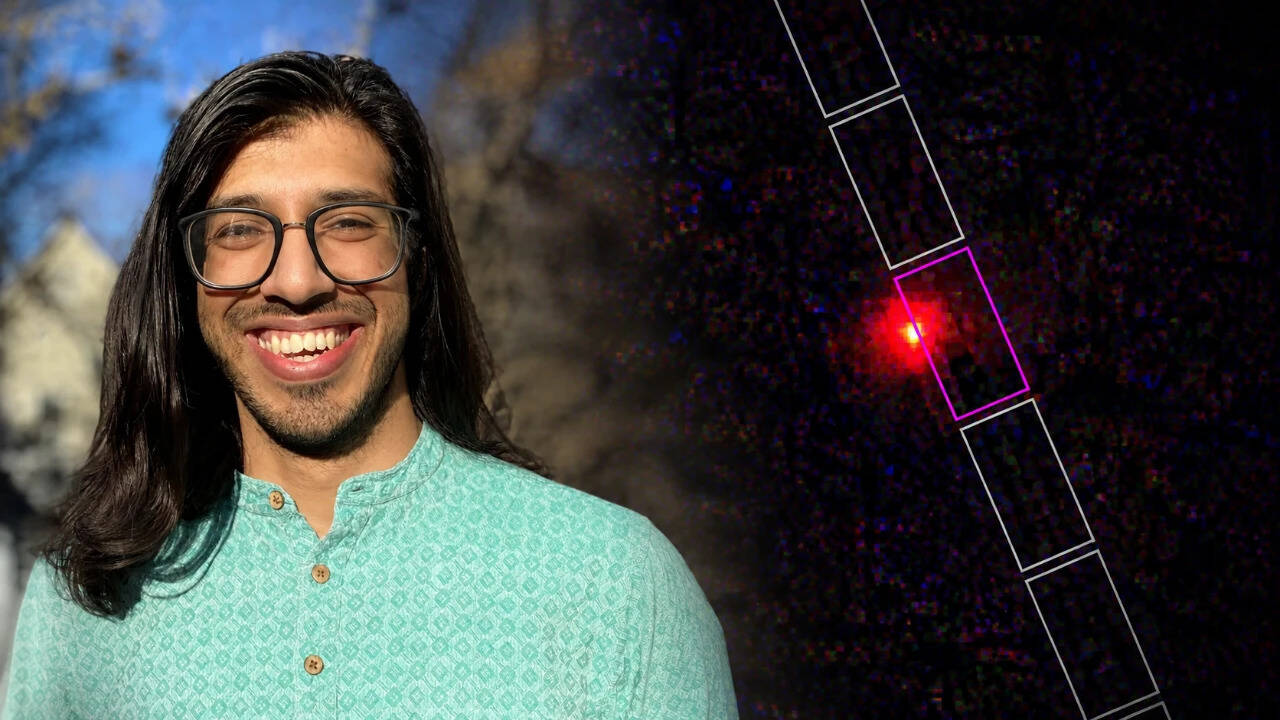
Rohan Naidu, a renowned astronomer from Hyderabad, has made significant contributions to our understanding of the early universe. His recent study focuses on a cosmic dawn object, which has revealed a supermassive black hole enveloped by dense gas. This groundbreaking research not only provides insights into the rapid growth of early black holes but may also offer clues about the mysterious 'little red dots' recently detected by the Webb telescope.
Naidu's journey to becoming a leading astronomer is a fascinating one. Despite dropping out of engineering, he pursued his passion for astronomy and has now become a prominent figure in the field. His work has far-reaching implications for our understanding of the universe and its evolution.
The study of supermassive black holes is crucial in understanding the formation and growth of galaxies. Naidu's research suggests that these black holes grew rapidly in the early universe, feeding on dense gas and dust. This process had a profound impact on the surrounding environment, shaping the galaxy as we know it today.
The 'little red dots' detected by the Webb telescope are a fascinating phenomenon that has puzzled astronomers. These objects are incredibly small and emit a unique red light, which has sparked intense debate about their nature. Naidu's research may provide valuable insights into the origin and properties of these enigmatic objects.
The early universe is a complex and mysterious period in the history of our cosmos. Astronomers like Naidu are working tirelessly to unravel its secrets, using cutting-edge technology and innovative research methods. As our understanding of the universe evolves, we may uncover new and exciting phenomena that challenge our current knowledge.
Rohan Naidu's work is a testament to the power of human curiosity and the importance of pursuing one's passion. His research has the potential to revolutionize our understanding of the early universe and inspire future generations of astronomers.
In conclusion, Rohan Naidu's study has significant implications for our understanding of the early universe. His work on supermassive black holes and the 'little red dots' may provide valuable insights into the formation and evolution of galaxies. As we continue to explore the mysteries of the cosmos, astronomers like Naidu will play a vital role in shaping our understanding of the universe.
The research conducted by Naidu and his team is a remarkable example of the advancements being made in the field of astronomy. With the help of cutting-edge technology and innovative research methods, scientists are able to study the universe in unprecedented detail. As we look to the future, it is exciting to think about the new discoveries that will be made and the secrets that will be uncovered.
The study of the early universe is an ongoing process, with new discoveries being made regularly. Astronomers like Naidu are at the forefront of this research, using their knowledge and expertise to advance our understanding of the cosmos. As we continue to explore the universe, we may uncover new and exciting phenomena that challenge our current knowledge and inspire future generations of scientists.
In the end, Rohan Naidu's research is a reminder of the importance of pursuing one's passion and the power of human curiosity. His work has the potential to revolutionize our understanding of the early universe and inspire future generations of astronomers. As we look to the future, it is exciting to think about the new discoveries that will be made and the secrets that will be uncovered.
Frequently asked questions
Who is Rohan Naidu?
Rohan Naidu is a renowned astronomer from Hyderabad who has made significant contributions to our understanding of the early universe.
What is the significance of Rohan Naidu's research?
Rohan Naidu's research has significant implications for our understanding of the early universe, including the growth of supermassive black holes and the origin of 'little red dots'.