Bombay HC Rules On Goregaon Flyover Land Acquisition
Bombay HC directs BMC to follow 2013 law, lessees to get fair compensation
'%3E%3Crect%20width%3D'96'%20height%3D'96'%20fill%3D'%23B3261E'%2F%3E%3Ccircle%20cx%3D'30'%20cy%3D'24'%20r%3D'44'%20fill%3D'%23fff'%20opacity%3D'.12'%2F%3E%3Ccircle%20cx%3D'60'%20cy%3D'74'%20r%3D'40'%20fill%3D'%23000'%20opacity%3D'.10'%2F%3E%3C%2Fg%3E%3Cg%20fill%3D'%23fff'%3E%3Crect%20x%3D'29'%20y%3D'49'%20width%3D'8'%20height%3D'19'%20rx%3D'1'%2F%3E%3Crect%20x%3D'39'%20y%3D'40'%20width%3D'9'%20height%3D'28'%20rx%3D'1'%2F%3E%3Crect%20x%3D'50'%20y%3D'45'%20width%3D'8'%20height%3D'23'%20rx%3D'1'%2F%3E%3Crect%20x%3D'60'%20y%3D'53'%20width%3D'7'%20height%3D'15'%20rx%3D'1'%2F%3E%3Crect%20x%3D'41'%20y%3D'34'%20width%3D'5'%20height%3D'6'%2F%3E%3C%2Fg%3E%3C%2Fsvg%3E)
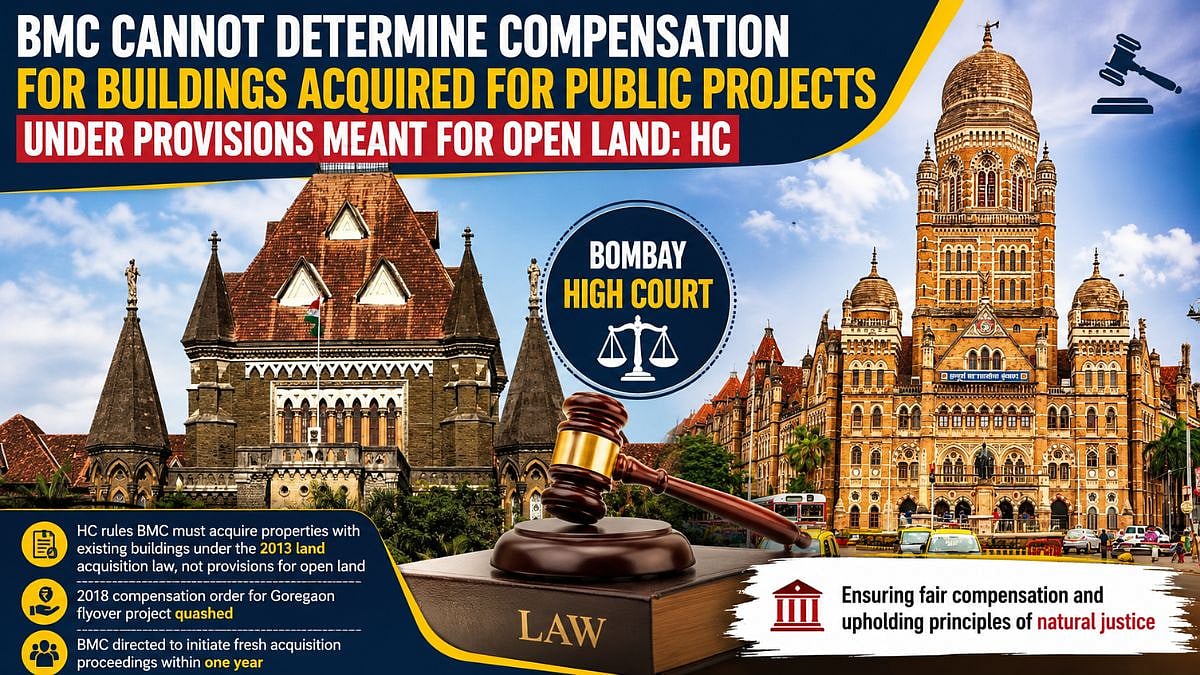
The Bombay High Court has ruled that the Brihanmumbai Municipal Corporation (BMC) must follow the Right to Fair Compensation and Transparency in Land Acquisition, Rehabilitation and Resettlement Act, 2013, to compensate buildings acquired for public projects.
The court's decision came in response to petitions filed by lessees Rohan Tiwari and others, as well as landowners JD and Company Pvt. Ltd., whose properties were acquired for the construction of the Goregaon flyover.
The BMC had determined compensation for the affected properties under provisions meant for open land, but the petitioners argued that this was incorrect and that the acquisition ought to have been carried out under the 2013 Act.
The High Court agreed with the petitioners, holding that the BMC had applied the wrong legal provisions. The court noted that the BMC had demolished the petitioners' buildings without following the proper procedure and directed the civic body to initiate fresh acquisition proceedings under the 2013 Act.
The BMC has been given one year to complete the exercise. The court's decision is a significant victory for the petitioners, who had been seeking fair compensation for their properties.
The Goregaon flyover project has been ongoing for several years and has required the acquisition of several properties in the area. The BMC had offered the petitioners the option of monetary compensation, Transferable Development Rights (TDR), or relocation, but the petitioners had insisted that compensation be paid before possession was taken.
However, in 2016, municipal officials began demolishing structures without first paying compensation, prompting the petitions before the High Court.
The court's decision highlights the importance of following the proper procedures when acquiring properties for public projects. It also underscores the need for fair compensation to be paid to affected property owners.
The BMC will now have to revisit the acquisition process and ensure that it is carried out in accordance with the 2013 Act. This may involve re-determining the compensation payable to the petitioners and other affected property owners.
The decision is likely to have implications for other public projects in Mumbai, where properties are being acquired for infrastructure development.
In recent years, there have been several instances of property owners challenging the acquisition process and seeking fair compensation. The High Court's decision in this case is likely to set a precedent for future cases.
The BMC has not commented on the decision, but it is likely that the civic body will appeal the ruling. However, for now, the petitioners have secured a significant victory in their quest for fair compensation.
The case highlights the complexities and challenges involved in acquiring properties for public projects in Mumbai. It also underscores the need for transparency and fairness in the acquisition process.
As the BMC moves forward with the acquisition process, it will be important for the civic body to ensure that it is following the proper procedures and paying fair compensation to affected property owners.
This will not only help to avoid legal challenges but also ensure that the rights of property owners are protected.
The decision is a significant development in the ongoing debate about property acquisition and compensation in Mumbai. It is likely to have far-reaching implications for the city's infrastructure development and the rights of property owners.
In conclusion, the Bombay High Court's decision is a significant victory for the petitioners and a reminder of the importance of following the proper procedures when acquiring properties for public projects. It highlights the need for fair compensation and transparency in the acquisition process and is likely to have implications for future cases in Mumbai.