Bombay HC Slams Thane Restaurant Over Analog Paneer Use
Thane restaurant's licence suspended, Bombay HC says customers have right to know what they eat
'%3E%3Crect%20width%3D'96'%20height%3D'96'%20fill%3D'%23B3261E'%2F%3E%3Ccircle%20cx%3D'30'%20cy%3D'24'%20r%3D'44'%20fill%3D'%23fff'%20opacity%3D'.12'%2F%3E%3Ccircle%20cx%3D'60'%20cy%3D'74'%20r%3D'40'%20fill%3D'%23000'%20opacity%3D'.10'%2F%3E%3C%2Fg%3E%3Cg%20fill%3D'%23fff'%3E%3Crect%20x%3D'29'%20y%3D'49'%20width%3D'8'%20height%3D'19'%20rx%3D'1'%2F%3E%3Crect%20x%3D'39'%20y%3D'40'%20width%3D'9'%20height%3D'28'%20rx%3D'1'%2F%3E%3Crect%20x%3D'50'%20y%3D'45'%20width%3D'8'%20height%3D'23'%20rx%3D'1'%2F%3E%3Crect%20x%3D'60'%20y%3D'53'%20width%3D'7'%20height%3D'15'%20rx%3D'1'%2F%3E%3Crect%20x%3D'41'%20y%3D'34'%20width%3D'5'%20height%3D'6'%2F%3E%3C%2Fg%3E%3C%2Fsvg%3E)
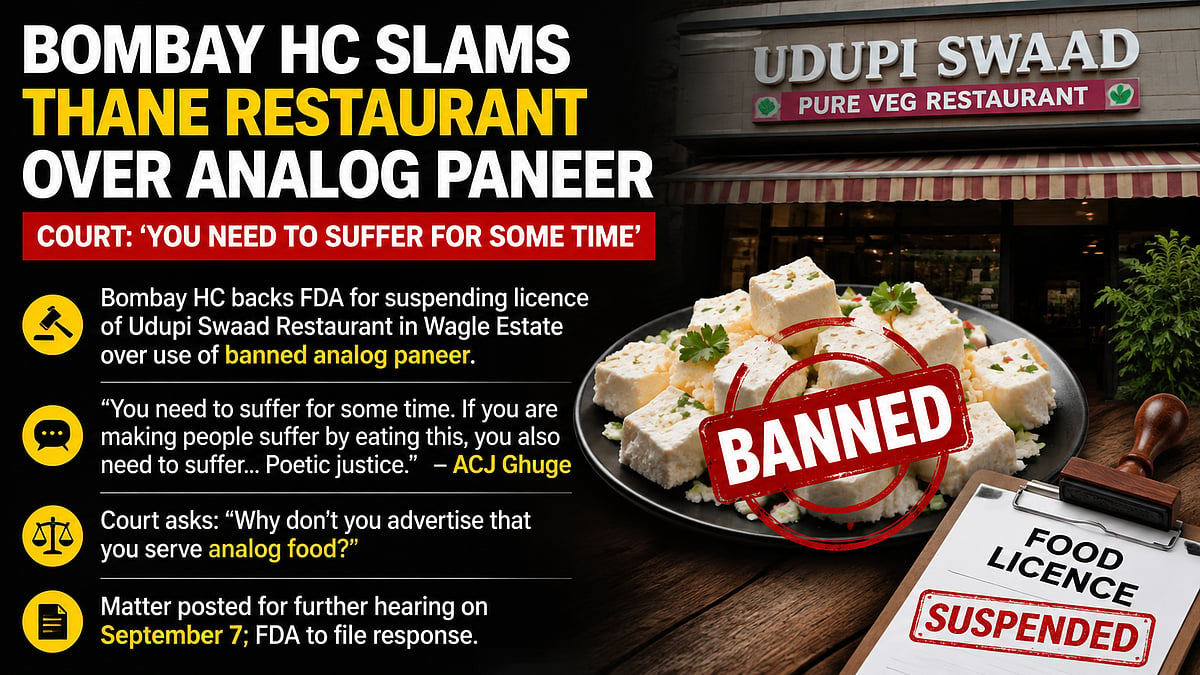
The Bombay High Court has come down heavily on a Thane restaurant, Udupi Swaad Restaurant, for using banned analog paneer. The restaurant's licence was suspended by the Maharashtra Food and Drug Administration (FDA) after a report found its paneer sample to be unsafe and substandard.
The court was hearing a petition filed by the restaurant challenging the FDA's action. The bench, comprising Acting Chief Justice Ravindra Ghuge and Justice Gautam Ankhad, observed that the eatery would have to suffer for some time for serving customers a product different from what they believed they were eating.
The FDA had suspended the restaurant's licence after a report in June found its paneer sample to be unsafe and substandard. The restaurant's advocate argued that the FDA had acted without first issuing a mandatory improvement notice under Section 32 of the Food Safety and Standards Act.
However, the FDA defended its action, citing the state-wide prohibition on the use of analog paneer. The court questioned whether customers had been informed that they were being served analog paneer instead of genuine paneer. The judge asked why the restaurant did not put up a notice informing customers that it served analog food.
The bench observed that customers may not always know what ingredients are being used in the food they order. The court rejected the restaurant's plea to convert the suspension into an improvement notice, saying that the restaurant must suffer for misleading customers.
The use of analog paneer is a serious issue, as it can be harmful to consumers' health. The Maharashtra FDA has been cracking down on restaurants and eateries that use banned substances, including analog paneer. The court's decision is a significant step towards ensuring that customers are protected from such practices.
The Bombay High Court's decision is also a reminder that restaurants and eateries have a responsibility to inform their customers about the ingredients used in their food. Customers have the right to know what they are eating, and it is the responsibility of the restaurant to ensure that they are serving safe and genuine food.
In recent years, there have been several instances of restaurants and eateries being caught using banned substances, including analog paneer. The Maharashtra FDA has been working to crack down on such practices, and the court's decision is a significant step towards ensuring that customers are protected.
The court's decision is also a warning to other restaurants and eateries that use banned substances. The use of analog paneer is a serious issue, and restaurants that engage in such practices will face severe consequences. The court's decision is a significant step towards ensuring that customers are protected from such practices, and it is a reminder that restaurants and eateries have a responsibility to inform their customers about the ingredients used in their food.
In conclusion, the Bombay High Court's decision to slam a Thane restaurant for using banned analog paneer is a significant step towards ensuring that customers are protected from such practices. The court's decision is a reminder that restaurants and eateries have a responsibility to inform their customers about the ingredients used in their food, and it is a warning to other restaurants and eateries that use banned substances.
Frequently asked questions
Why was the Thane restaurant's licence suspended?
The restaurant's licence was suspended by the Maharashtra Food and Drug Administration (FDA) after a report found its paneer sample to be unsafe and substandard.
What is analog paneer?
Analog paneer is a banned substance that is used as a substitute for genuine paneer.