Madras High Court Quashes Case Against Farmer Over Peaceful Protest
Court rules protest is a hallmark of democracy, protected under Constitution. Farmer faced charges for hunger strike.
'%3E%3Crect%20width%3D'96'%20height%3D'96'%20fill%3D'%231A5276'%2F%3E%3Ccircle%20cx%3D'30'%20cy%3D'24'%20r%3D'44'%20fill%3D'%23fff'%20opacity%3D'.12'%2F%3E%3Ccircle%20cx%3D'60'%20cy%3D'74'%20r%3D'40'%20fill%3D'%23000'%20opacity%3D'.10'%2F%3E%3C%2Fg%3E%3Cg%20fill%3D'%23fff'%3E%3Cpath%20d%3D'M31%2041%20L48%2031%20L65%2041%20Z'%2F%3E%3Crect%20x%3D'33'%20y%3D'43'%20width%3D'4'%20height%3D'17'%2F%3E%3Crect%20x%3D'41'%20y%3D'43'%20width%3D'4'%20height%3D'17'%2F%3E%3Crect%20x%3D'51'%20y%3D'43'%20width%3D'4'%20height%3D'17'%2F%3E%3Crect%20x%3D'59'%20y%3D'43'%20width%3D'4'%20height%3D'17'%2F%3E%3Crect%20x%3D'30'%20y%3D'62'%20width%3D'36'%20height%3D'4'%20rx%3D'1'%2F%3E%3C%2Fg%3E%3C%2Fsvg%3E)
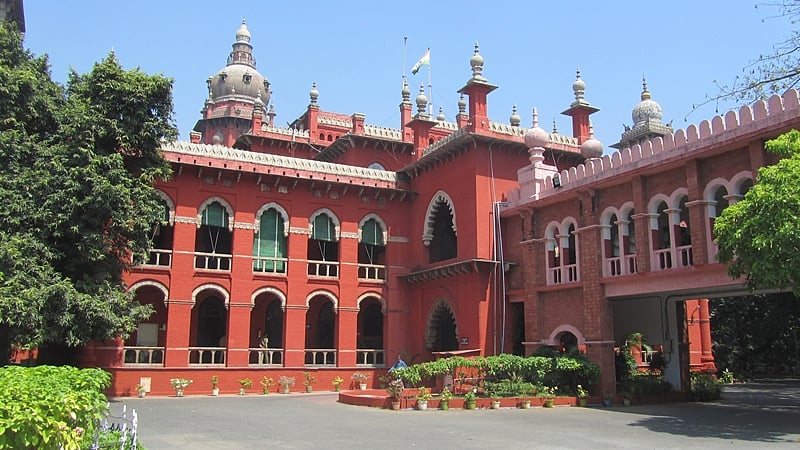
The Madras High Court has dismissed a case against a farmer who participated in a hunger strike, stating that peaceful protests are a fundamental right in a democracy. The court made this observation while quashing the criminal proceedings against the farmer, Krishnamoorthy.
The case originated from a petition filed by Krishnamoorthy, seeking to quash the proceedings pending before the Judicial Magistrate in Palladam, Tiruppur district. According to the prosecution, Krishnamoorthy and others staged a hunger strike demanding the withdrawal of criminal cases registered against M Easan, the founder of the Tamil Nadu Farmers Protection Association.
The police alleged that the protest was held without prior permission and caused inconvenience to the public while obstructing the free movement of people. However, the court found that the prosecution had failed to produce any material to show that the protest caused inconvenience to the public or obstructed free movement.
Justice M Nirmal Kumar held that the allegations against the petitioner were general in nature and did not disclose any specific act that would attract the provisions invoked by the police. The court observed that peaceful protests are a hallmark of democracy and are protected under the Constitution, provided they do not cause public inconvenience or violate the law.
Krishnamoorthy argued that the association had been working on issues affecting farmers through peaceful and democratic means, including public awareness campaigns, lawful agitations, representations, and legal proceedings. He submitted that the hunger strike was organised after repeated criminal cases were registered against the association's founder and was intended to draw the attention of the government, public authorities, and the general public.
The petitioner also contended that the protest was held on private property and not on a public road. He argued that he was exercising his fundamental rights under Articles 19(1)(a) and 19(1)(b) of the Constitution. It was further submitted that there was no prohibitory order in force on the day of the protest.
The State opposed the plea, arguing that the protest had been conducted without permission and had caused inconvenience to the public and obstructed free movement. However, the court noted that no member of the public had lodged a complaint against the protest, and the Village Administrative Officer's complaint was not sufficient to establish that the protest had caused any disruption.
The court's decision highlights the importance of protecting the right to peaceful protest in a democracy. The judgment emphasizes that citizens have the right to express their grievances and demands through peaceful means, as long as they do not violate the law or cause public inconvenience.
In the context of India's democratic framework, the court's ruling is significant. The Constitution guarantees the right to freedom of speech and expression, as well as the right to assemble peacefully. The court's decision reinforces these fundamental rights and sets a precedent for future cases involving peaceful protests.
The Madras High Court's judgment is a reminder that democracy thrives on the participation of citizens in the democratic process. Peaceful protests and demonstrations are an essential part of this process, allowing citizens to express their opinions and demands. By protecting the right to peaceful protest, the court has upheld a fundamental aspect of India's democratic system.
In conclusion, the Madras High Court's decision to quash the case against the farmer is a significant victory for the right to peaceful protest in India. The judgment emphasizes the importance of protecting this fundamental right and sets a precedent for future cases involving peaceful demonstrations. As India continues to evolve as a democracy, it is essential to protect and promote the rights of citizens to express themselves peacefully and participate in the democratic process.
The court's ruling has implications for the broader democratic landscape in India. It highlights the need for the government and law enforcement agencies to respect and protect the right to peaceful protest. By doing so, India can strengthen its democratic institutions and ensure that citizens have a meaningful say in the decision-making process.
Ultimately, the Madras High Court's decision is a testament to the power of peaceful protest in a democracy. It demonstrates that citizens can bring about change and influence policy through peaceful means, and that the courts will protect their right to do so. As India continues to navigate the complexities of democracy, the court's ruling serves as a reminder of the importance of protecting and promoting the fundamental rights of citizens.