
Monsoon Rainfall 13% Below Average
Monsoon rainfall is below normal, kharif acreage affected. Food inflation may rise.
'%3E%3Crect%20width%3D'96'%20height%3D'96'%20fill%3D'%230B6E4F'%2F%3E%3Ccircle%20cx%3D'30'%20cy%3D'24'%20r%3D'44'%20fill%3D'%23fff'%20opacity%3D'.12'%2F%3E%3Ccircle%20cx%3D'60'%20cy%3D'74'%20r%3D'40'%20fill%3D'%23000'%20opacity%3D'.10'%2F%3E%3C%2Fg%3E%3Cg%20fill%3D'none'%20stroke%3D'%23fff'%20stroke-width%3D'3.2'%20stroke-linecap%3D'round'%20stroke-linejoin%3D'round'%3E%3Cpolyline%20points%3D'31%2C59%2041%2C49%2049%2C54%2063%2C37'%2F%3E%3Cpolyline%20points%3D'55%2C37%2063%2C37%2063%2C45'%2F%3E%3C%2Fg%3E%3C%2Fsvg%3E)
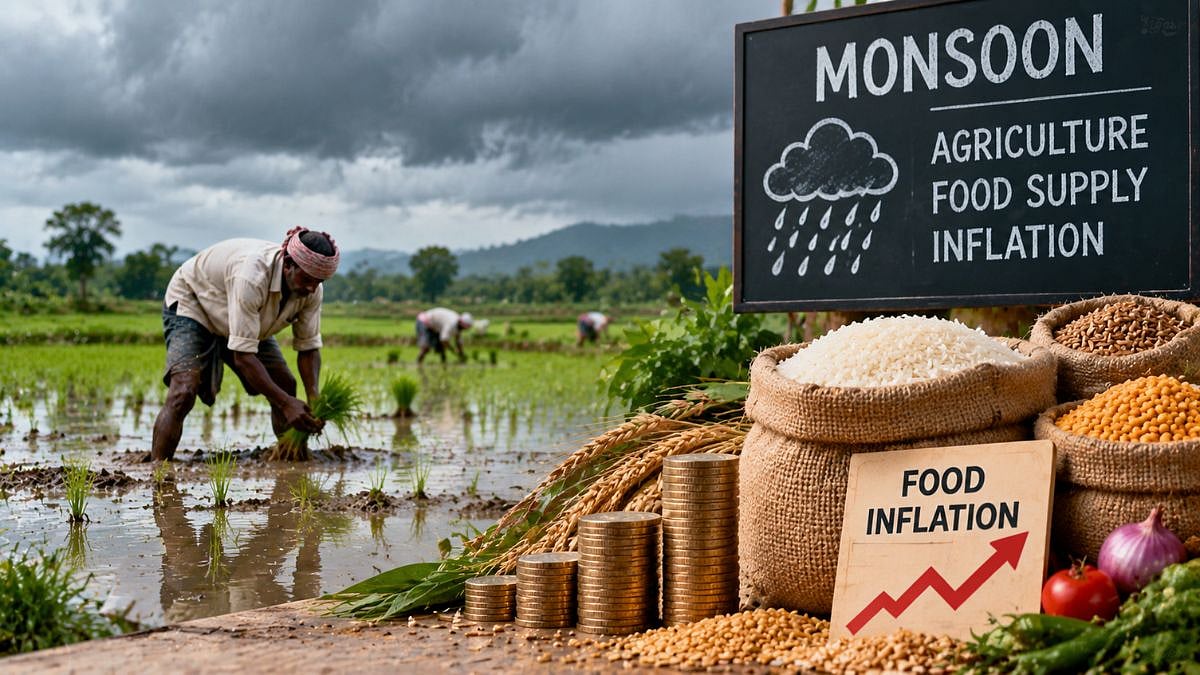
The southwest monsoon has entered its final phase, and the spatial distribution of rainfall will be crucial for the final kharif acreage. According to a report by Bank of Baroda, cumulative southwest monsoon rainfall from June 1 to September 4 stood at 629.7 millimeters, which is 13% below the long-period average.
The reduced rainfall has resulted in a lower kharif sowing area. However, the acreage of pulses has improved, with higher sowing for both tur and urad. The report also noted higher acreage for jute and mesta.
The rainfall this year is also below last year's 791.8 millimeters for the same period. Regionally, the Southern Peninsula reported a deficit of 26%, while East and North Eastern India were down 24%. North Western India was 9% below normal, and the central region was 5% below normal rainfall.
Moderate El Nino conditions are currently prevailing and are projected to strengthen in the remaining period of the season. This could have implications for food inflation in the near term.
The kharif acreage has seen a mixed trend, with a decline in the acreage of rice, oilseeds, and coarse cereals. However, the acreage of pulses and jute and mesta has seen an improvement. The water reservoir level is also lower than last year, with the All India reservoir at 70% of the total storage capacity.
The report also noted lower sown area for oilseeds, with slower growth noted in soybean and groundnut. Cotton and sugarcane sowing has also been lower for the same period.
The final phase of the monsoon will be critical in determining the final kharif acreage and its impact on food inflation. The spatial distribution of rainfall will play a crucial role in this regard.
The monsoon's performance will have significant implications for the Indian economy, particularly for the agricultural sector. The government will be closely watching the situation to ensure that the impact of the reduced rainfall is minimized.
In conclusion, the monsoon's final phase rainfall distribution will be critical for the final kharif acreage and food inflation. The government and farmers will be hoping for a good distribution of rainfall to mitigate the effects of the reduced rainfall so far.
The situation will be closely monitored in the coming days, and any further developments will be reported. The impact of the monsoon's performance on the Indian economy will be significant, and it is essential to keep a close eye on the situation.
The agricultural sector is a critical component of the Indian economy, and any disruptions to it can have far-reaching consequences. The monsoon's performance is a crucial factor in determining the sector's performance, and its impact will be closely watched in the coming days.
The final phase of the monsoon will be critical in determining the course of the Indian economy, particularly the agricultural sector. The spatial distribution of rainfall will play a crucial role in this regard, and it is essential to keep a close eye on the situation.
Frequently asked questions
What is the current status of monsoon rainfall in India?
The cumulative southwest monsoon rainfall from June 1 to September 4 stood at 629.7 millimeters, which is 13% below the long-period average.
How will the monsoon's performance affect the Indian economy?
The monsoon's performance will have significant implications for the Indian economy, particularly for the agricultural sector, and may lead to higher food inflation.