Maharashtra Rolls Out Ambulance Policy With Digital Tracking
Maharashtra introduces comprehensive ambulance policy with digital tracking and transparent fares.
'%3E%3Crect%20width%3D'96'%20height%3D'96'%20fill%3D'%23B3261E'%2F%3E%3Ccircle%20cx%3D'30'%20cy%3D'24'%20r%3D'44'%20fill%3D'%23fff'%20opacity%3D'.12'%2F%3E%3Ccircle%20cx%3D'60'%20cy%3D'74'%20r%3D'40'%20fill%3D'%23000'%20opacity%3D'.10'%2F%3E%3C%2Fg%3E%3Cg%20fill%3D'%23fff'%3E%3Crect%20x%3D'29'%20y%3D'49'%20width%3D'8'%20height%3D'19'%20rx%3D'1'%2F%3E%3Crect%20x%3D'39'%20y%3D'40'%20width%3D'9'%20height%3D'28'%20rx%3D'1'%2F%3E%3Crect%20x%3D'50'%20y%3D'45'%20width%3D'8'%20height%3D'23'%20rx%3D'1'%2F%3E%3Crect%20x%3D'60'%20y%3D'53'%20width%3D'7'%20height%3D'15'%20rx%3D'1'%2F%3E%3Crect%20x%3D'41'%20y%3D'34'%20width%3D'5'%20height%3D'6'%2F%3E%3C%2Fg%3E%3C%2Fsvg%3E)
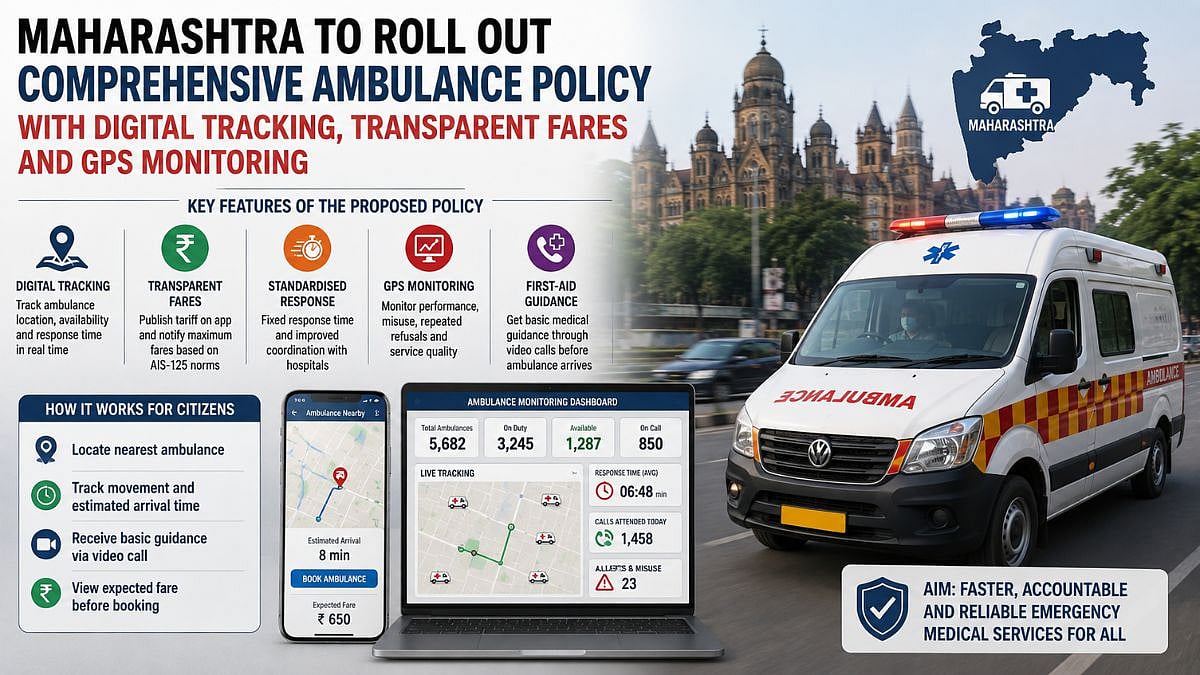
Maharashtra is set to introduce a comprehensive State Ambulance Policy aimed at making emergency medical transport faster, more transparent and accountable.
The policy was announced by Transport Minister Pratap Sarnaik on Friday, who said every registered ambulance in the state will be brought under a digital monitoring system. This system will allow authorities to track the location, availability, response time and service quality of ambulances in real time.
The policy also proposes transparent fare regulation, standardised emergency response and better coordination between ambulances and hospitals. The proposed framework will cover the entire ambulance ecosystem, from registration and dispatch to patient transport and hospital admission.
At present, Maharashtra has around 1,076 ambulances operating under the MEMS 108 partnership project, besides an estimated 4,500-5,000 ambulances run by private hospitals, charitable trusts and NGOs. However, there is no single platform providing citizens with reliable information on ambulance availability, expected arrival time, onboard medical facilities or fare structure.
The new policy seeks to bridge this gap through four interconnected digital platforms designed for citizens, ambulance drivers, onboard medical tablets and government authorities. Under the proposed system, people will be able to locate the nearest ambulance, track its movement, know the estimated arrival time, receive basic guidance through video calls and view the expected fare before booking.
A key feature of the policy is fare transparency. Registered ambulances may be required to publish their tariff on the app, while the state plans to notify maximum fares based on AIS-125 ambulance classifications. Digital trip records and e-receipts are also proposed to curb overcharging during emergencies.
The policy will also include a first-aid guidance module to help citizens provide immediate assistance before an ambulance arrives. According to Sarnaik, technology, transparency and accountability can save lives by ensuring timely medical help reaches those in need.
The state government is expected to finalise the policy soon, which will then be implemented across the state. The introduction of this policy is expected to significantly improve the emergency medical transport system in Maharashtra.
The policy is a significant step towards making emergency medical services more accessible and reliable for the citizens of Maharashtra. With the use of technology and digital platforms, the state aims to reduce response times, improve service quality and increase transparency in the ambulance ecosystem.
Overall, the comprehensive State Ambulance Policy is a welcome move, which is expected to have a positive impact on the lives of people in Maharashtra.
The policy's focus on fare transparency, digital tracking and emergency care measures is expected to make a significant difference in the state's emergency medical transport system.
The state government's efforts to improve the ambulance ecosystem are commendable, and the introduction of this policy is a step in the right direction.
In conclusion, the comprehensive State Ambulance Policy is a significant development in Maharashtra's emergency medical transport system. The policy's emphasis on technology, transparency and accountability is expected to save lives and improve the overall quality of emergency medical services in the state.
Frequently asked questions
What is the main objective of the Maharashtra Ambulance Policy?
The main objective of the policy is to make emergency medical transport faster, more transparent and accountable.
How will the policy improve ambulance services in Maharashtra?
The policy will improve ambulance services by introducing digital tracking, transparent fares and emergency care measures.