Ocean Feedback Loop Regulated Earth's Climate
A natural process kept Earth's climate stable for 60 million years. Researchers found a link between sea levels and carbon dioxide levels.
'%3E%3Crect%20width%3D'96'%20height%3D'96'%20fill%3D'%23B3261E'%2F%3E%3Ccircle%20cx%3D'30'%20cy%3D'24'%20r%3D'44'%20fill%3D'%23fff'%20opacity%3D'.12'%2F%3E%3Ccircle%20cx%3D'60'%20cy%3D'74'%20r%3D'40'%20fill%3D'%23000'%20opacity%3D'.10'%2F%3E%3C%2Fg%3E%3Cg%20fill%3D'%23fff'%3E%3Crect%20x%3D'29'%20y%3D'49'%20width%3D'8'%20height%3D'19'%20rx%3D'1'%2F%3E%3Crect%20x%3D'39'%20y%3D'40'%20width%3D'9'%20height%3D'28'%20rx%3D'1'%2F%3E%3Crect%20x%3D'50'%20y%3D'45'%20width%3D'8'%20height%3D'23'%20rx%3D'1'%2F%3E%3Crect%20x%3D'60'%20y%3D'53'%20width%3D'7'%20height%3D'15'%20rx%3D'1'%2F%3E%3Crect%20x%3D'41'%20y%3D'34'%20width%3D'5'%20height%3D'6'%2F%3E%3C%2Fg%3E%3C%2Fsvg%3E)
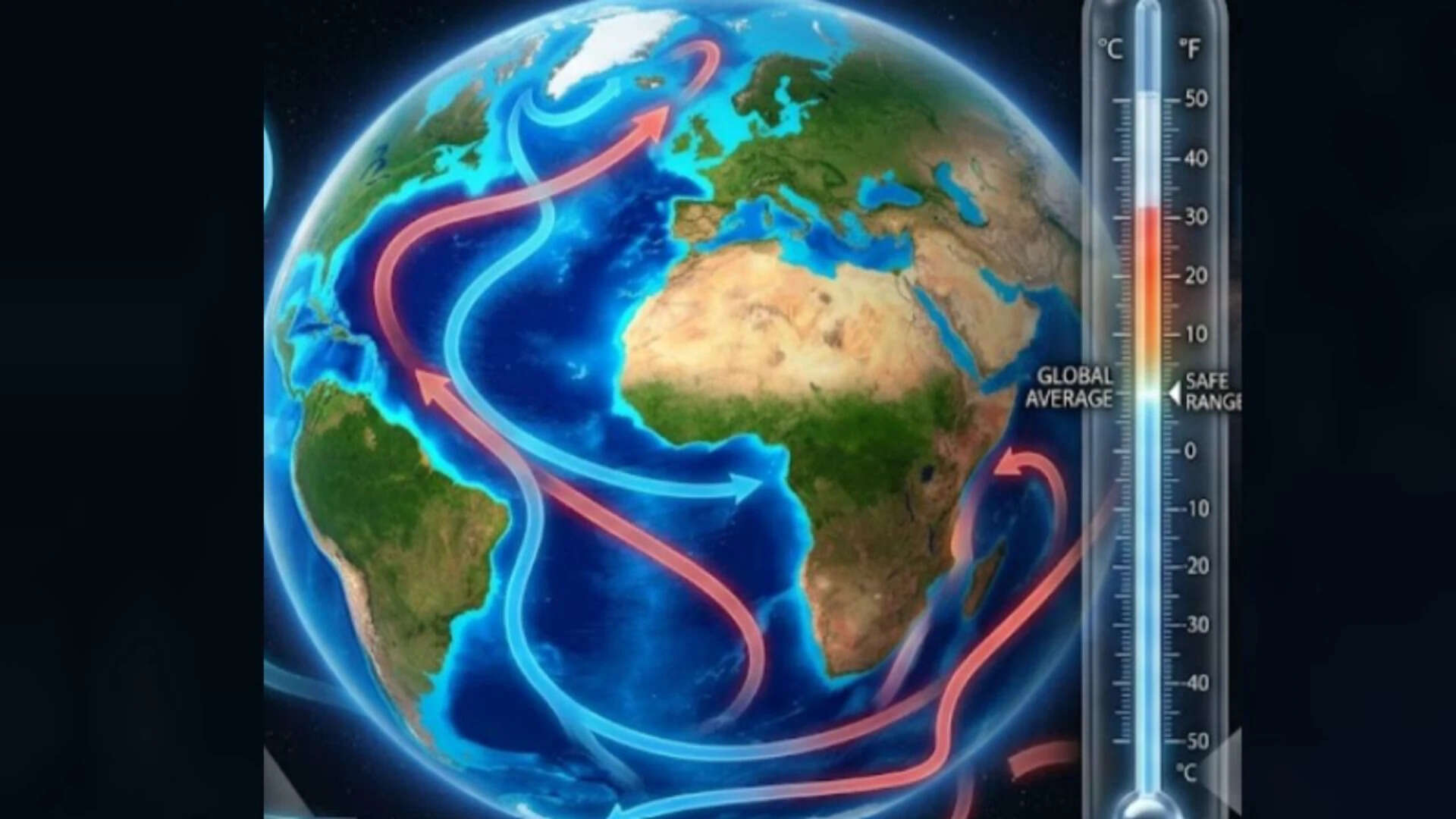
A recent study has made a groundbreaking discovery about the Earth's climate. For the past 60 million years, the planet's climate has been stable, and researchers have now identified a natural process that may have contributed to this stability.
The study found that changes in sea levels played a crucial role in controlling the amount of phosphate that reached the oceans. This, in turn, affected marine life and the amount of carbon buried beneath the seafloor. As a result, the level of carbon dioxide in the atmosphere was also impacted.
The researchers' findings offer a new explanation for how the Earth naturally regulated long-term warming and cooling. This process, which involves a feedback loop between the oceans and the atmosphere, may have helped to keep the planet's climate stable over millions of years.
The study's results are based on an analysis of oceanic and atmospheric data from the past 60 million years. During this time, the Earth's climate has undergone significant changes, including periods of warming and cooling. However, despite these fluctuations, the planet's climate has remained relatively stable, and the study's findings may help to explain why.
The Earth's climate is a complex system, and there are many factors that contribute to its stability. The study's results highlight the importance of the oceans in regulating the planet's climate. The oceans play a crucial role in absorbing and storing carbon dioxide, and changes in sea levels can have a significant impact on this process.
The study's findings have significant implications for our understanding of the Earth's climate. They suggest that natural processes, such as changes in sea levels, can have a major impact on the planet's climate. This knowledge can be used to improve our understanding of how the Earth's climate works and to develop more effective strategies for mitigating the effects of climate change.
In recent years, there has been a growing concern about the impact of human activities on the Earth's climate. The study's findings highlight the importance of considering natural processes, such as changes in sea levels, when developing strategies for mitigating the effects of climate change.
The Earth's climate is a complex and dynamic system, and there is still much to be learned about how it works. The study's findings are an important contribution to our understanding of the Earth's climate and highlight the need for further research into the natural processes that regulate the planet's climate.
In conclusion, the study's findings offer a new explanation for how the Earth naturally regulated long-term warming and cooling. The discovery of a feedback loop between the oceans and the atmosphere highlights the importance of considering natural processes when developing strategies for mitigating the effects of climate change. This knowledge can be used to improve our understanding of the Earth's climate and to develop more effective strategies for protecting the planet.
The significance of this study cannot be overstated. It has the potential to revolutionize our understanding of the Earth's climate and to inform the development of strategies for mitigating the effects of climate change. As the world continues to grapple with the challenges of climate change, the study's findings are a timely reminder of the importance of considering natural processes when developing strategies for protecting the planet.