Sonam Wangchuk Ends Hunger Strike July 20
Activist Sonam Wangchuk to end hunger strike, sets conditions for government accountability.
'%3E%3Crect%20width%3D'96'%20height%3D'96'%20fill%3D'%231A5276'%2F%3E%3Ccircle%20cx%3D'30'%20cy%3D'24'%20r%3D'44'%20fill%3D'%23fff'%20opacity%3D'.12'%2F%3E%3Ccircle%20cx%3D'60'%20cy%3D'74'%20r%3D'40'%20fill%3D'%23000'%20opacity%3D'.10'%2F%3E%3C%2Fg%3E%3Cg%20fill%3D'%23fff'%3E%3Cpath%20d%3D'M31%2041%20L48%2031%20L65%2041%20Z'%2F%3E%3Crect%20x%3D'33'%20y%3D'43'%20width%3D'4'%20height%3D'17'%2F%3E%3Crect%20x%3D'41'%20y%3D'43'%20width%3D'4'%20height%3D'17'%2F%3E%3Crect%20x%3D'51'%20y%3D'43'%20width%3D'4'%20height%3D'17'%2F%3E%3Crect%20x%3D'59'%20y%3D'43'%20width%3D'4'%20height%3D'17'%2F%3E%3Crect%20x%3D'30'%20y%3D'62'%20width%3D'36'%20height%3D'4'%20rx%3D'1'%2F%3E%3C%2Fg%3E%3C%2Fsvg%3E)
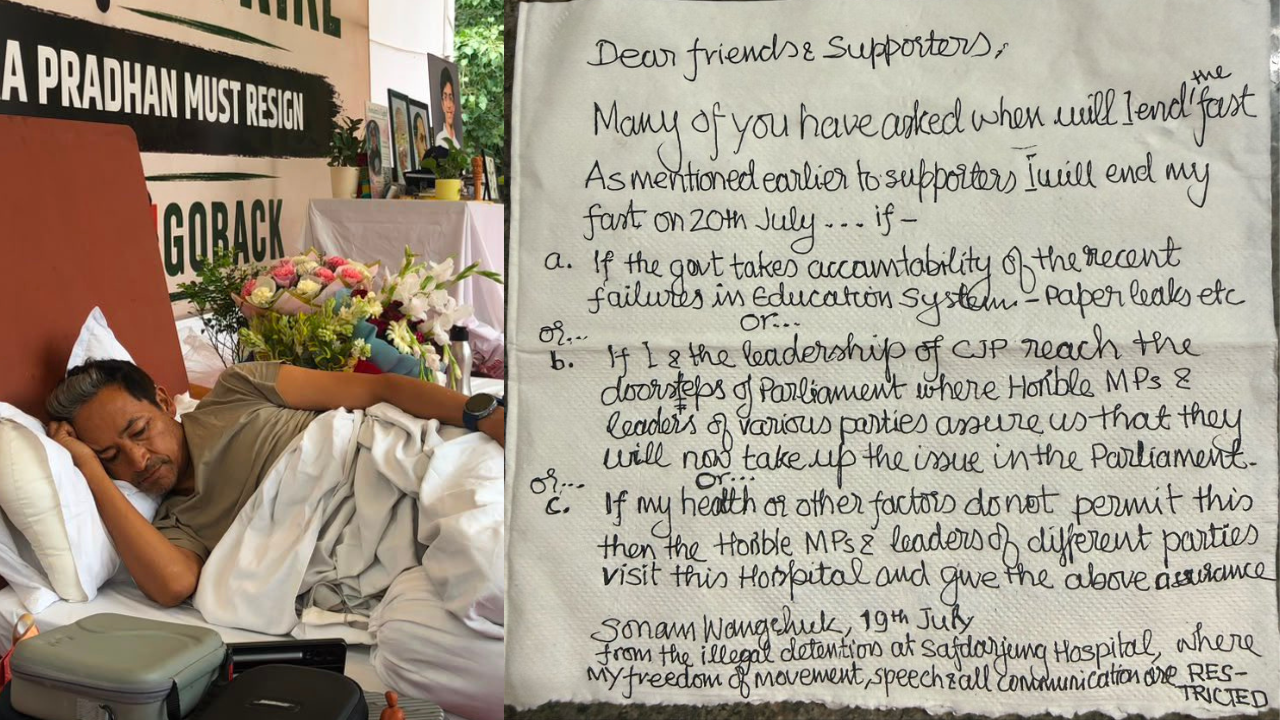
Activist Sonam Wangchuk will end his hunger strike on July 20, after setting certain conditions to end his protest against the failures of the education system.
Wangchuk has been on a hunger strike to demand government accountability and parliamentary assurances from leaders. The activist is currently hospitalized, which he claims is an illegal detention.
The conditions set by Wangchuk are aimed at bringing about reforms in the education system and ensuring that the government takes responsibility for its failures. He has been advocating for changes in the education policy to make it more effective and accessible to all.
Wangchuk's hunger strike has gained significant attention and support from various quarters, with many people expressing solidarity with his cause. The activist's demands for government accountability and parliamentary assurances are seen as a step towards bringing about transparency and accountability in the education system.
The march to Parliament, scheduled for July 20, is expected to draw attention to the issues faced by the education system and the need for reforms. The event is being organized by the Centre for Justice and Peace (CJP) and is expected to be attended by various stakeholders, including students, teachers, and activists.
Wangchuk's decision to end his hunger strike on July 20 is seen as a significant development, as it comes ahead of the planned march to Parliament. The activist's conditions for ending his protest are likely to be a major focus of the march, with participants expected to demand that the government takes concrete steps to address the issues faced by the education system.
The education system in India has been facing several challenges, including inadequate infrastructure, lack of qualified teachers, and outdated curriculum. The system has been criticized for being ineffective and inaccessible to many, particularly those from marginalized communities.
Wangchuk's protest and the planned march to Parliament are seen as an attempt to bring about changes in the education system and ensure that it is more effective and accessible to all. The event is expected to draw attention to the need for reforms and the importance of government accountability in addressing the issues faced by the education system.
In conclusion, Sonam Wangchuk's decision to end his hunger strike on July 20, ahead of the planned march to Parliament, is a significant development that highlights the need for reforms in the education system. The activist's conditions for ending his protest are likely to be a major focus of the march, with participants expected to demand that the government takes concrete steps to address the issues faced by the education system.
The outcome of the march and Wangchuk's protest remains to be seen, but one thing is clear - the need for reforms in the education system is urgent and requires immediate attention from the government. The march to Parliament on July 20 is expected to be an important step towards bringing about changes in the education system and ensuring that it is more effective and accessible to all.
The significance of Wangchuk's protest and the planned march to Parliament cannot be overstated. The event is expected to draw attention to the issues faced by the education system and the need for reforms, and is likely to be an important step towards bringing about changes in the education policy. As the country moves forward, it is essential that the government takes concrete steps to address the issues faced by the education system and ensures that it is more effective and accessible to all.
In the end, the success of Wangchuk's protest and the planned march to Parliament will depend on the government's response to the demands made by the activist and the participants. The government must take concrete steps to address the issues faced by the education system and ensure that it is more effective and accessible to all. Only then can the country expect to see meaningful changes in the education system and a brighter future for its citizens.