UPI Sees Record Growth In 5 Years, Expands To 12 Countries
UPI clocks record growth, expands to 12 countries. Transaction volumes and values soar.
'%3E%3Crect%20width%3D'96'%20height%3D'96'%20fill%3D'%234A235A'%2F%3E%3Ccircle%20cx%3D'30'%20cy%3D'24'%20r%3D'44'%20fill%3D'%23fff'%20opacity%3D'.12'%2F%3E%3Ccircle%20cx%3D'60'%20cy%3D'74'%20r%3D'40'%20fill%3D'%23000'%20opacity%3D'.10'%2F%3E%3C%2Fg%3E%3Cg%20fill%3D'none'%20stroke%3D'%23fff'%20stroke-width%3D'3'%3E%3Ccircle%20cx%3D'48'%20cy%3D'48'%20r%3D'16'%2F%3E%3Cellipse%20cx%3D'48'%20cy%3D'48'%20rx%3D'6.5'%20ry%3D'16'%2F%3E%3Cline%20x1%3D'32'%20y1%3D'42'%20x2%3D'64'%20y2%3D'42'%2F%3E%3Cline%20x1%3D'32'%20y1%3D'54'%20x2%3D'64'%20y2%3D'54'%2F%3E%3C%2Fg%3E%3C%2Fsvg%3E)
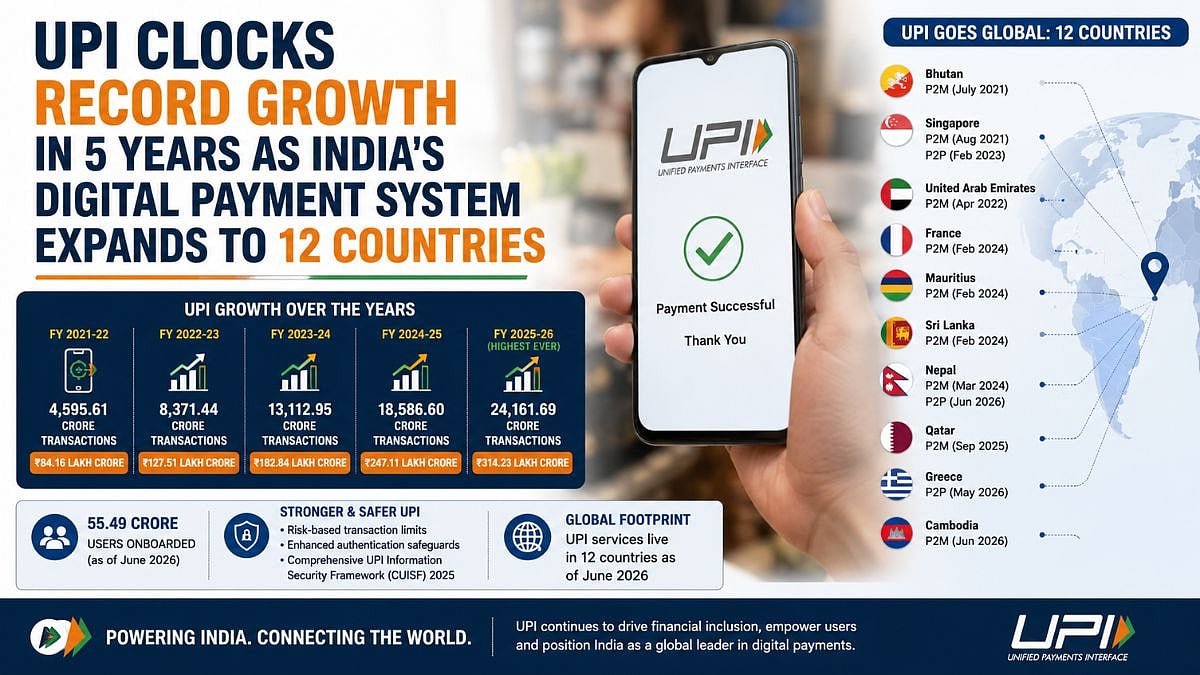
India's Unified Payments Interface (UPI) has witnessed remarkable growth over the past five financial years, cementing its position as the country's primary digital payment platform.
The made-in-India payment system has also expanded its footprint internationally, with 12 countries now adopting UPI-enabled payment services through partnerships with local financial institutions.
Union Minister of State for Finance Pankaj Chaudhary shared the figures in a written reply in the Lok Sabha on July 22, 2026. The minister outlined the government's efforts to strengthen the security and transparency of UPI transactions.
Launched on April 11, 2016, by the National Payments Corporation of India (NPCI) under the regulatory supervision of the Reserve Bank of India (RBI), UPI has emerged as the backbone of India's digital payments ecosystem.
As of June 2026, 55.49 crore users had been onboarded onto the UPI platform. The growth in transactions has been equally significant, with UPI processing 4,595.61 crore transactions worth Rs 84.16 lakh crore in FY 2021–22.
This increased to 8,371.44 crore transactions in FY 2022–23, followed by 13,112.95 crore in FY 2023–24 and 18,586.60 crore in FY 2024–25. FY 2025–26 marked UPI's highest-ever performance, with the platform processing 24,161.69 crore transactions valued at Rs 314.23 lakh crore.
The steady rise in both transaction volume and value underlines the growing reliance of consumers and businesses on digital payments, making UPI one of India's most impactful financial technology initiatives.
The government, RBI and NPCI have introduced several measures to improve the safety and transparency of UPI-based transactions. These include risk-based transaction limits to curb fraudulent transactions and enhanced security requirements for UPI applications.
NPCI has also issued the Comprehensive UPI Information Security Framework (CUISF) 2025 and the Mobile Application Security Framework to strengthen the resilience of the UPI ecosystem.
The government highlighted UPI's expanding international presence through NPCI International Payments Ltd. (NIPL), a wholly owned subsidiary of NPCI established in April 2020. NIPL works with foreign institutions to take NPCI's payment platforms, including UPI and the RuPay card network, to overseas markets.
According to the minister, the initiative enables Indian tourists and the Indian diaspora to make seamless cross-border payments while also helping partner countries to benefit from India's digital payment expertise.
The expansion of UPI to 12 countries is a significant milestone in India's efforts to promote digital payments globally. It is expected to further boost the growth of UPI and increase its adoption in international markets.
In conclusion, UPI's record growth and international expansion are a testament to the success of India's digital payment initiatives. The government's efforts to strengthen the security and transparency of UPI transactions will continue to promote the growth of digital payments in the country.
Frequently asked questions
What is UPI and how does it work?
UPI is a digital payment platform that allows users to make transactions using their mobile phones. It is authorized under the Payment and Settlement Systems Act, 2007.
How many countries have adopted UPI-enabled payment services?
12 countries have adopted UPI-enabled payment services through partnerships with local financial institutions.