BCECE LE 2026 Counselling Begins July 13
Bihar engineering admissions open, choice filling starts July 13. Eligible diploma holders can apply for lateral entry.
'%3E%3Crect%20width%3D'96'%20height%3D'96'%20fill%3D'%23B3261E'%2F%3E%3Ccircle%20cx%3D'30'%20cy%3D'24'%20r%3D'44'%20fill%3D'%23fff'%20opacity%3D'.12'%2F%3E%3Ccircle%20cx%3D'60'%20cy%3D'74'%20r%3D'40'%20fill%3D'%23000'%20opacity%3D'.10'%2F%3E%3C%2Fg%3E%3Cg%20fill%3D'%23fff'%3E%3Crect%20x%3D'29'%20y%3D'49'%20width%3D'8'%20height%3D'19'%20rx%3D'1'%2F%3E%3Crect%20x%3D'39'%20y%3D'40'%20width%3D'9'%20height%3D'28'%20rx%3D'1'%2F%3E%3Crect%20x%3D'50'%20y%3D'45'%20width%3D'8'%20height%3D'23'%20rx%3D'1'%2F%3E%3Crect%20x%3D'60'%20y%3D'53'%20width%3D'7'%20height%3D'15'%20rx%3D'1'%2F%3E%3Crect%20x%3D'41'%20y%3D'34'%20width%3D'5'%20height%3D'6'%2F%3E%3C%2Fg%3E%3C%2Fsvg%3E)
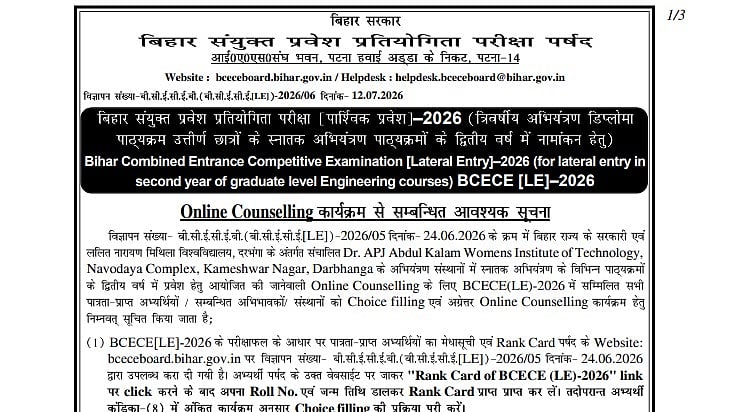
The Bihar Combined Entrance Competitive Examination Board (BCECEB) has announced the online counselling schedule for BCECE (LE) 2026. This marks the beginning of the admission process for eligible diploma holders seeking lateral entry into the second year of undergraduate engineering courses in Bihar.
The counselling process is scheduled to start with online choice filling on July 13, 2026, and the last date to submit and lock choices is July 21, 2026. Candidates who have qualified in BCECE (LE) 2026 can participate in the counselling process through the board's official website.
The counselling is being conducted for admission to engineering colleges under the Government of Bihar, including Dr. APJ Abdul Kalam Women's Institute of Technology, Darbhanga, and other participating institutions. The important dates for the counselling process are as follows: Rank Card Availability has already been released, Seat Matrix was published on July 10, 2026, and Round 1 Seat Allotment Result will be announced on July 25, 2026.
To be eligible for the counselling process, candidates must have qualified in BCECE (LE) 2026, have been issued a valid Rank Card by BCECEB, and have passed the required educational qualification prescribed in the prospectus by the date of document verification. They must also wish to seek admission into the second year (lateral entry) of undergraduate engineering programmes.
The BCECEB has stated that a Mop-Up (Round 3) counselling will be conducted if seats remain vacant after the completion of the first two rounds of counselling. Candidates who fail to meet the prescribed eligibility conditions at the time of counselling or document verification will not be considered for admission.
Eligible candidates can complete the counselling process by following a series of steps, including visiting the official BCECEB website, logging in using their Registration Number and Password, selecting preferred colleges and engineering branches, arranging choices in their preferred order, reviewing and editing choices, and locking final choices before the deadline.
Choice locking instructions have also been provided, with candidates noting that choice locking and unlocking will be done through OTP verification. The OTP will be sent to the candidate's registered mobile number.
The BCECE (LE) 2026 counselling process provides an opportunity for eligible diploma holders to pursue undergraduate engineering courses in Bihar. The process is designed to ensure that candidates are allocated seats in their preferred colleges and branches, based on their merit and preferences.
In recent years, the demand for engineering courses in Bihar has increased, with many candidates seeking admission to top engineering colleges in the state. The BCECE (LE) 2026 counselling process is expected to be highly competitive, with candidates competing for limited seats in top colleges.
The Bihar Combined Entrance Competitive Examination Board (BCECEB) is responsible for conducting the BCECE (LE) examination and counselling process. The board ensures that the process is fair, transparent, and merit-based, with candidates being allocated seats based on their performance in the examination and their preferences.
In conclusion, the BCECE (LE) 2026 counselling process has begun, with online choice filling starting on July 13, 2026. Eligible diploma holders can apply for lateral entry into undergraduate engineering courses in Bihar, with the process being conducted by the Bihar Combined Entrance Competitive Examination Board (BCECEB). The counselling process is expected to be highly competitive, with candidates competing for limited seats in top colleges.
The significance of this counselling process lies in the fact that it provides an opportunity for eligible diploma holders to pursue undergraduate engineering courses in Bihar. The process is designed to ensure that candidates are allocated seats in their preferred colleges and branches, based on their merit and preferences. This can have a positive impact on the state's education sector, with more candidates being able to pursue engineering courses and contribute to the state's economic development.