India To Cross 50 GWdc Solar Capacity In 2026
India adds 34 GWdc solar capacity in H1 2026, on track to record 50 GWdc this year.
'%3E%3Crect%20width%3D'96'%20height%3D'96'%20fill%3D'%231A5276'%2F%3E%3Ccircle%20cx%3D'30'%20cy%3D'24'%20r%3D'44'%20fill%3D'%23fff'%20opacity%3D'.12'%2F%3E%3Ccircle%20cx%3D'60'%20cy%3D'74'%20r%3D'40'%20fill%3D'%23000'%20opacity%3D'.10'%2F%3E%3C%2Fg%3E%3Cg%20fill%3D'%23fff'%3E%3Cpath%20d%3D'M31%2041%20L48%2031%20L65%2041%20Z'%2F%3E%3Crect%20x%3D'33'%20y%3D'43'%20width%3D'4'%20height%3D'17'%2F%3E%3Crect%20x%3D'41'%20y%3D'43'%20width%3D'4'%20height%3D'17'%2F%3E%3Crect%20x%3D'51'%20y%3D'43'%20width%3D'4'%20height%3D'17'%2F%3E%3Crect%20x%3D'59'%20y%3D'43'%20width%3D'4'%20height%3D'17'%2F%3E%3Crect%20x%3D'30'%20y%3D'62'%20width%3D'36'%20height%3D'4'%20rx%3D'1'%2F%3E%3C%2Fg%3E%3C%2Fsvg%3E)
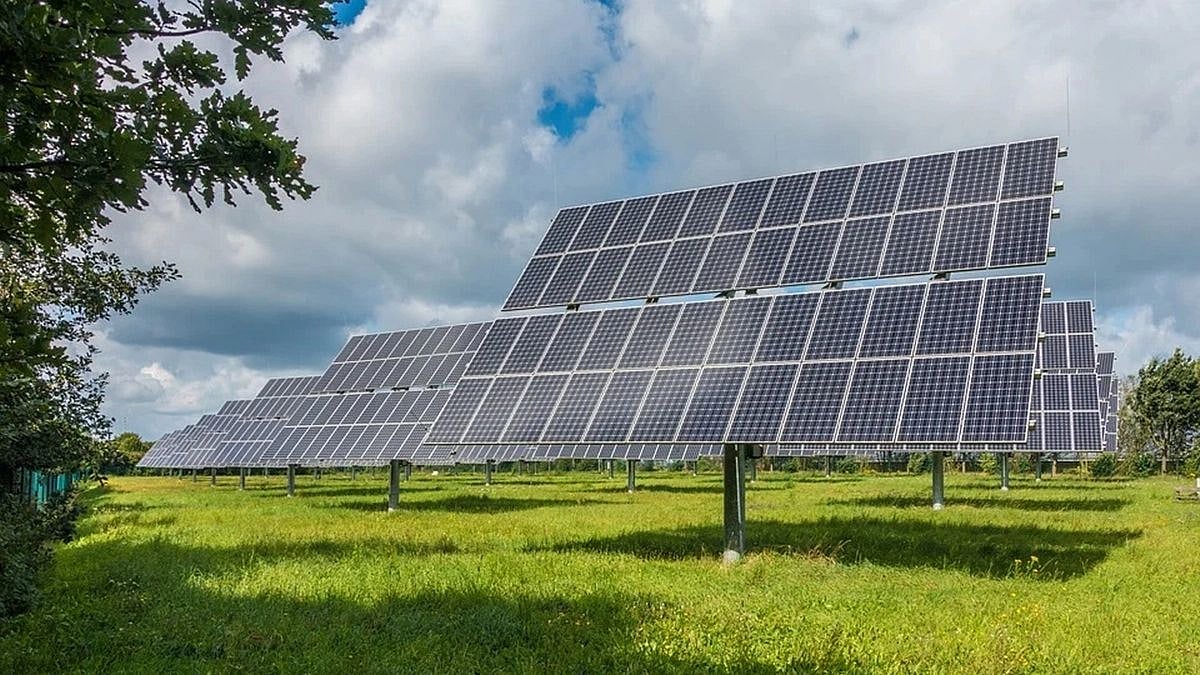
India has added 34 GWdc of solar capacity in the first half of 2026, which is 38% above the levels in the first half of 2025. This surge in solar capacity addition is expected to continue, with the country on track to record 50 GWdc of solar capacity by the end of 2026.
The rapid addition of solar capacity in India is driven by the Approved List of Models and Manufacturers-II (ALMM-II) mandate, which aims to build a fully integrated domestic solar supply chain. However, the mandate has also created a supply crunch, leading to higher system prices.
According to a report by Wood Mackenzie, India's solar capacity addition in 2026 is expected to exceed 50 GWdc, surpassing the previous record of 49 GWdc set in 2025. The report also notes that the near-term cost impact of the ALMM-II mandate is unavoidable, and developers will need to navigate a difficult transition period before prices stabilize.
The phased removal of waivers for inter-state transmission charges has also driven the accelerated build-out of solar capacity in the first half of 2026. However, the momentum is expected to slow in the second half of 2026 due to cell capacity constraints and rising module prices.
The Ministry of New and Renewable Energy (MNRE) has agreed to waive the ALMM-II mandate for projects approaching completion, requiring applicants to have submitted applications by July 23, 2026. This waiver is expected to provide some upside to the solar capacity addition figures.
India's solar imports have also shifted from China to Southeast Asia, with Indonesian cell imports nearly tripling in early 2026. The country imported 5 GW of wafers and 20 GW of cells in the first five months of 2026, with wafer imports climbing 86% year-on-year to support domestic cell production.
The report notes that prices are expected to stabilize through 2029 as additional cell capacity comes online, but the transition will require policy consistency and timely execution by manufacturers.
The growth of India's solar sector is a significant development, with the country aiming to reduce its dependence on fossil fuels and increase its use of renewable energy. The surge in solar capacity addition is expected to continue, driven by government policies and incentives.
In the long term, the growth of India's solar sector is expected to have a positive impact on the environment and the economy. The sector is expected to create new job opportunities and stimulate economic growth, while also reducing India's carbon footprint.
Overall, India's solar sector is poised for significant growth in the coming years, driven by government policies and incentives. The country's aim to reduce its dependence on fossil fuels and increase its use of renewable energy is expected to have a positive impact on the environment and the economy.
The solar sector's growth is also expected to contribute to India's economic development, with the sector expected to attract significant investments in the coming years. The government's policies and incentives are expected to play a crucial role in driving the growth of the sector.
In conclusion, India's solar sector is expected to continue its rapid growth in the coming years, driven by government policies and incentives. The sector's growth is expected to have a positive impact on the environment and the economy, and is poised to play a significant role in India's economic development.
Frequently asked questions
What is the expected solar capacity addition in India in 2026?
India is expected to add over 50 GWdc of solar capacity in 2026.
What is driving the growth of India's solar sector?
The growth of India's solar sector is driven by government policies and incentives, including the ALMM-II mandate.