Pune SIR Verification Ends With 68.34% Forms Digitised
Pune's electoral roll verification ends with 68.34% digitisation. 31.65% forms marked uncollectable.
'%3E%3Crect%20width%3D'96'%20height%3D'96'%20fill%3D'%23B3261E'%2F%3E%3Ccircle%20cx%3D'30'%20cy%3D'24'%20r%3D'44'%20fill%3D'%23fff'%20opacity%3D'.12'%2F%3E%3Ccircle%20cx%3D'60'%20cy%3D'74'%20r%3D'40'%20fill%3D'%23000'%20opacity%3D'.10'%2F%3E%3C%2Fg%3E%3Cg%20fill%3D'%23fff'%3E%3Crect%20x%3D'29'%20y%3D'49'%20width%3D'8'%20height%3D'19'%20rx%3D'1'%2F%3E%3Crect%20x%3D'39'%20y%3D'40'%20width%3D'9'%20height%3D'28'%20rx%3D'1'%2F%3E%3Crect%20x%3D'50'%20y%3D'45'%20width%3D'8'%20height%3D'23'%20rx%3D'1'%2F%3E%3Crect%20x%3D'60'%20y%3D'53'%20width%3D'7'%20height%3D'15'%20rx%3D'1'%2F%3E%3Crect%20x%3D'41'%20y%3D'34'%20width%3D'5'%20height%3D'6'%2F%3E%3C%2Fg%3E%3C%2Fsvg%3E)
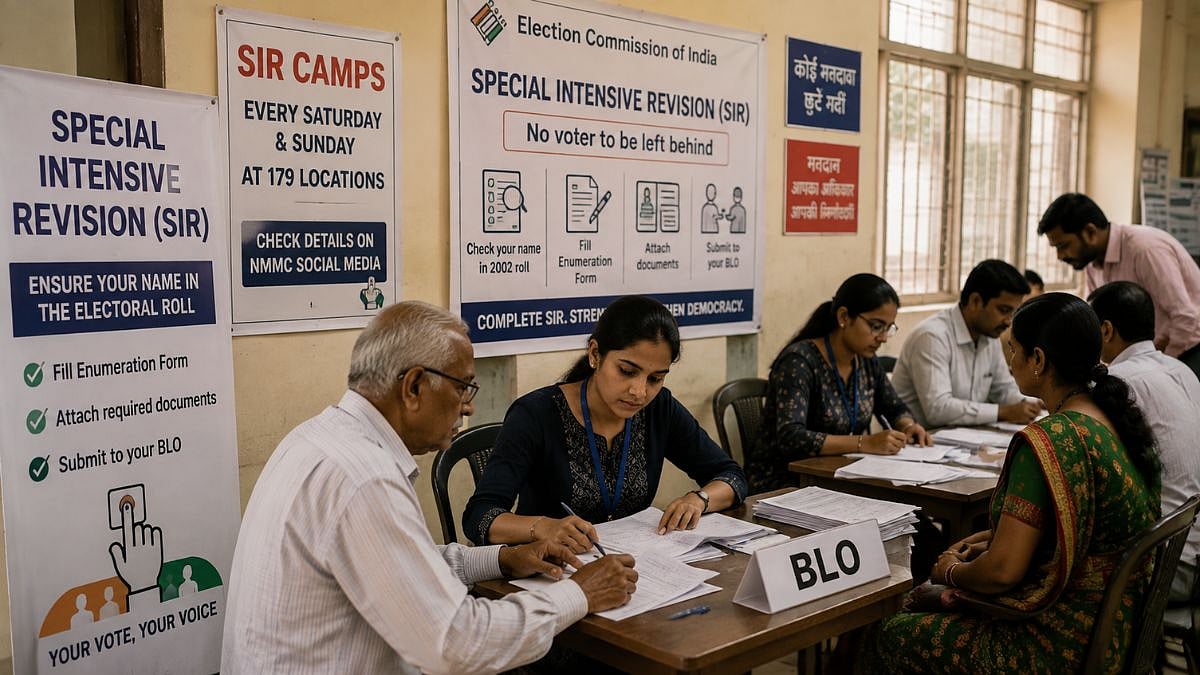
The Special Intensive Revision (SIR) of electoral rolls in Pune district concluded on Monday, with 68.34% of the 90.80 lakh Elector Forms (EFs) digitised. A total of 62,05,639 forms were digitised, while 28,74,023 were marked 'uncollectable'.
The district had 90,80,173 electors, with 90,80,022 EFs distributed, accounting for 100% distribution. The data shows a clear constituency-wise variation in digitisation rates.
Baramati recorded the highest digitisation at 88.22%, followed by Ambegaon at 86.95%, Junnar at 85.75%, and Khed-Alandi at 85.20%. In contrast, Khadakwasala recorded the lowest digitisation at 53.29%, with 3,18,184 forms digitised and 2,78,807 marked uncollectable.
Kothrud followed at 53.63%, with 2,40,284 forms digitised and 2,07,771 uncollectable. Hadapsar recorded 54.07% digitisation, with 3,52,255 forms digitised and 2,98,842 marked uncollectable. Other constituencies, such as Shivajinagar, Pimpri (SC), Parvati, and Pune Cantonment (SC), also recorded digitisation rates below 60%.
The figures indicate that the highest proportion of uncollectable forms is concentrated in several constituencies with large elector populations. Khadakwasala had 46.69% of forms marked uncollectable, Kothrud 46.37%, and Hadapsar 45.87%.
The sheer volume of forms involved is also significant in the larger constituencies. Chinchwad, which has 6,87,448 electors, had 4,16,987 forms digitised, while 2,70,461 were marked uncollectable. Bhosari had 6,35,114 electors, of which 4,63,470 forms were digitised and 1,71,644 were uncollectable.
In Vadgaonsheri, 3,14,124 of 5,18,754 forms were digitised, while 2,04,630 were uncollectable. The variation in digitisation rates across constituencies highlights the challenges in the electoral roll verification process.
The SIR verification process aimed to ensure the accuracy and completeness of the electoral rolls. The significant gap between digitised and uncollectable forms underscores the need for further efforts to engage with voters and ensure their participation in the electoral process.
The outcome of the SIR verification process will have implications for the electoral landscape in Pune district. As the process concludes, attention will turn to the next steps in ensuring the integrity and effectiveness of the electoral rolls.
In the broader context, the SIR verification process is part of ongoing efforts to strengthen the electoral system in India. The experience and lessons learned from the process in Pune district will inform and improve similar initiatives elsewhere in the country.
The completion of the SIR verification process marks an important milestone in the electoral cycle. As the electoral landscape continues to evolve, the accuracy and completeness of the electoral rolls will remain a critical factor in ensuring the integrity of the democratic process.
Frequently asked questions
What was the total number of electors in Pune district?
The district had 90,80,173 electors.
Which constituency recorded the highest digitisation rate?
Baramati recorded the highest digitisation at 88.22%.