WMO Warns of Growing Health Risks from Heatwaves, Wildfires
Rising wildfires and heatwaves worsen air quality, posing serious health risks. WMO report highlights growing threat.
'%3E%3Crect%20width%3D'96'%20height%3D'96'%20fill%3D'%23B3261E'%2F%3E%3Ccircle%20cx%3D'30'%20cy%3D'24'%20r%3D'44'%20fill%3D'%23fff'%20opacity%3D'.12'%2F%3E%3Ccircle%20cx%3D'60'%20cy%3D'74'%20r%3D'40'%20fill%3D'%23000'%20opacity%3D'.10'%2F%3E%3C%2Fg%3E%3Cg%20fill%3D'%23fff'%3E%3Crect%20x%3D'29'%20y%3D'49'%20width%3D'8'%20height%3D'19'%20rx%3D'1'%2F%3E%3Crect%20x%3D'39'%20y%3D'40'%20width%3D'9'%20height%3D'28'%20rx%3D'1'%2F%3E%3Crect%20x%3D'50'%20y%3D'45'%20width%3D'8'%20height%3D'23'%20rx%3D'1'%2F%3E%3Crect%20x%3D'60'%20y%3D'53'%20width%3D'7'%20height%3D'15'%20rx%3D'1'%2F%3E%3Crect%20x%3D'41'%20y%3D'34'%20width%3D'5'%20height%3D'6'%2F%3E%3C%2Fg%3E%3C%2Fsvg%3E)
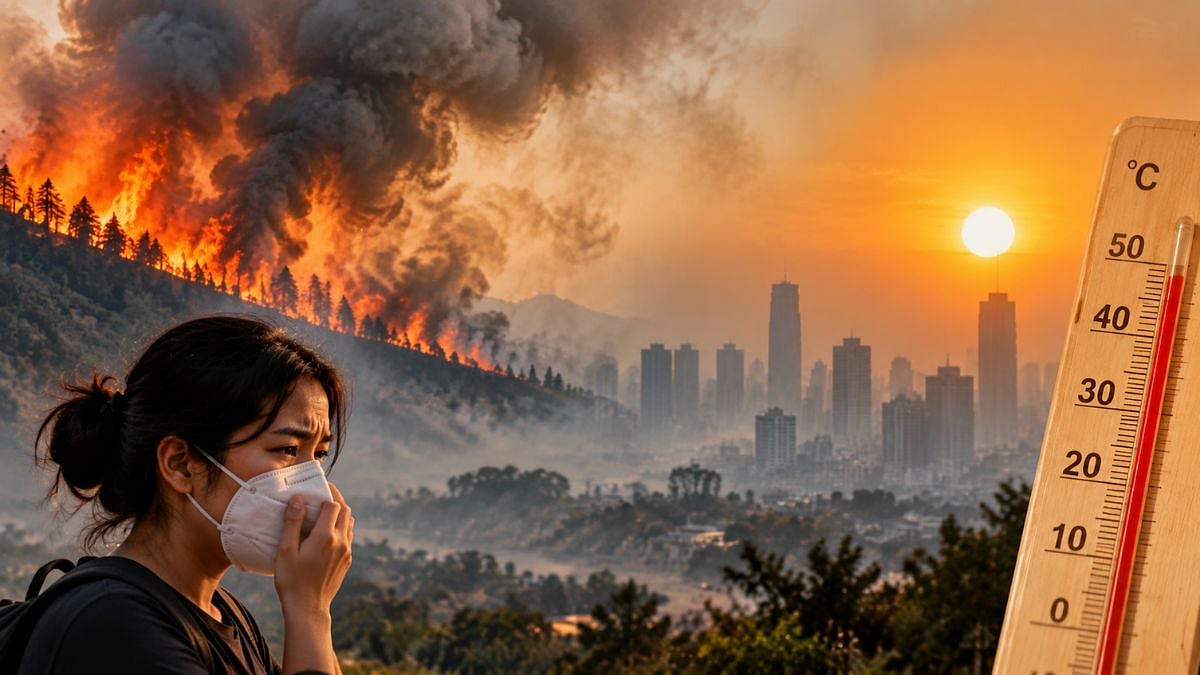
The World Meteorological Organization (WMO) has warned that rising wildfires and increasingly intense heatwaves are undermining improvements in air quality worldwide, creating serious health risks. According to a new report from the WMO, regions that have succeeded in reducing pollution from vehicles and industrial activity are increasingly being exposed to wildfire smoke.
The report, published annually to coincide with the UN's International Day of Clean Air, warns that increasingly severe wildfires are producing toxic smoke with significant consequences for human health. Wildfire smoke contains high concentrations of fine particulate matter and can cause oxidative stress in the human body.
Lorenzo Labrador, a scientific officer at the WMO, stated that air quality and climate cannot be treated as separate subjects, and that they are deeply intertwined and have to be treated together. The report highlights the trend of increasing wildfires as an urgent and growing public health threat, driven by a feedback loop between climate change and fire-conducive weather conditions.
The WMO report also links wildfire smoke exposure to increased asthma attacks, hospitalisations for chronic obstructive pulmonary disease (COPD), spiked respiratory medication use, as well as impacts on mental health and birth outcomes. One study cited by the WMO found that a tripling of wildfires since the 1990s contributed to almost 100,000 deaths annually between 2010 and 2018.
In addition to the threat from wildfire smoke, the report also highlights the threat from ground-level ozone, which increases during intense and prolonged heatwaves. Ozone is a powerful oxidant that can cause inflammation and circulatory problems, and eventually heart problems. In heavily polluted regions, about one in five deaths from chronic obstructive pulmonary disease is attributed to long-term exposure to ozone.
The WMO also examined anomalies in concentrations of PM2.5, microscopic particles and droplets that remain suspended in the air. PM2.5 poses a serious health threat because it can penetrate deep into the lungs and enter the bloodstream. The combination of particulate matter and air forms aerosols, which can influence the climate.
The report's findings have significant implications for public health, particularly in regions prone to wildfires and heatwaves. It is essential to address the intertwined issues of air quality and climate change to mitigate the growing health risks associated with these events.
In conclusion, the WMO report serves as a warning about the growing health risks posed by heatwaves and wildfires. It is crucial to take immediate action to reduce pollution and address the climate crisis to prevent further deterioration of air quality and protect public health.
The WMO's warning comes at a time when the world is experiencing increasingly frequent and severe heatwaves and wildfires, highlighting the need for urgent action to address the climate crisis and protect public health. The report's findings emphasize the importance of treating air quality and climate as intertwined issues that require a comprehensive and coordinated approach.
Ultimately, the WMO report highlights the need for a concerted effort to address the growing health risks posed by heatwaves and wildfires. By taking immediate action to reduce pollution and address the climate crisis, we can mitigate the worst impacts of these events and protect public health.
Frequently asked questions
What are the health risks associated with wildfire smoke?
Wildfire smoke contains high concentrations of fine particulate matter and can cause oxidative stress in the human body, leading to increased asthma attacks, hospitalisations for COPD, and other health problems.
How does ground-level ozone affect human health?
Ozone is a powerful oxidant that can cause inflammation and circulatory problems, and eventually heart problems, with long-term exposure contributing to about one in five deaths from chronic obstructive pulmonary disease in heavily polluted regions.