400-Year-Old Polish Grave Holds Dark Secret
Ancient grave in Poland reveals a young woman's mysterious burial. Discover the dark reason behind her internment.
'%3E%3Crect%20width%3D'96'%20height%3D'96'%20fill%3D'%23B3261E'%2F%3E%3Ccircle%20cx%3D'30'%20cy%3D'24'%20r%3D'44'%20fill%3D'%23fff'%20opacity%3D'.12'%2F%3E%3Ccircle%20cx%3D'60'%20cy%3D'74'%20r%3D'40'%20fill%3D'%23000'%20opacity%3D'.10'%2F%3E%3C%2Fg%3E%3Cg%20fill%3D'%23fff'%3E%3Crect%20x%3D'29'%20y%3D'49'%20width%3D'8'%20height%3D'19'%20rx%3D'1'%2F%3E%3Crect%20x%3D'39'%20y%3D'40'%20width%3D'9'%20height%3D'28'%20rx%3D'1'%2F%3E%3Crect%20x%3D'50'%20y%3D'45'%20width%3D'8'%20height%3D'23'%20rx%3D'1'%2F%3E%3Crect%20x%3D'60'%20y%3D'53'%20width%3D'7'%20height%3D'15'%20rx%3D'1'%2F%3E%3Crect%20x%3D'41'%20y%3D'34'%20width%3D'5'%20height%3D'6'%2F%3E%3C%2Fg%3E%3C%2Fsvg%3E)
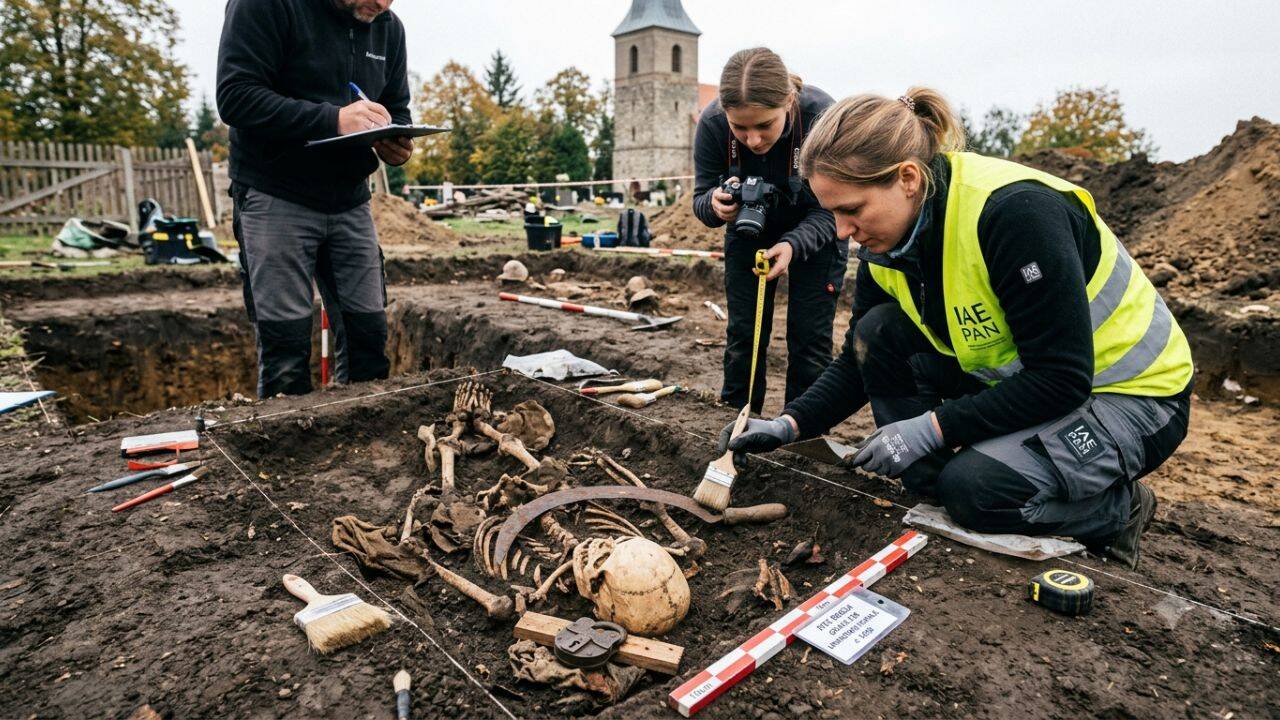
A 400-year-old grave in Poland has been unearthed, revealing the remains of a young woman. The discovery has shed light on a dark practice that was prevalent in Eastern Europe during the 17th and 18th centuries.
The young woman, whose name and age are unknown, was buried with a sickle placed across her chest and a stake driven through her leg. This unusual burial practice was a common method used to prevent the deceased from rising from the dead and terrorizing the living.
In many Eastern European cultures, it was believed that certain individuals, often those who died under mysterious or unnatural circumstances, could return from the dead as vampires or revenants. To prevent this from happening, people would use various methods to restrain or incapacitate the corpse, such as tying it down, weighing it down with heavy objects, or even dismembering it.
The discovery of the young woman's grave has provided valuable insights into the superstitions and fears of people living in Poland during the 17th century. It highlights the deep-seated fear of death and the supernatural that was prevalent in many Eastern European cultures.
The grave was discovered by a team of archaeologists who were excavating a site in Poland. The team found the remains of the young woman, along with several other graves, all of which dated back to the 17th century.
The discovery has sparked interest among historians and archaeologists, who are eager to learn more about the lives and beliefs of people living in Poland during this time period. It has also raised questions about the origins of vampire folklore and the ways in which people have sought to protect themselves from perceived supernatural threats throughout history.
In conclusion, the discovery of the 400-year-old Polish grave has revealed a dark and fascinating aspect of Eastern European culture and history. It highlights the importance of understanding and respecting the beliefs and practices of people from the past, even if they may seem strange or unfamiliar to us today.
The study of the grave and its contents will continue, with researchers hoping to uncover more information about the young woman and the circumstances surrounding her death. As more is learned about this mysterious grave, it is likely that it will shed even more light on the superstitions and fears of people living in Poland during the 17th century.
Frequently asked questions
Why was the young woman buried with a stake through her leg?
The young woman was buried with a stake through her leg to prevent her from rising from the dead and terrorizing the living, as was believed to be a possibility in Eastern European cultures.
What does the discovery of the grave reveal about Eastern European culture?
The discovery of the grave reveals a deep-seated fear of death and the supernatural that was prevalent in many Eastern European cultures, and highlights the importance of understanding and respecting the beliefs and practices of people from the past.