Young Indians Ditch Traditional Offices For Coworking Spaces
Coworking spaces gain popularity, offering experience-led work environments and flexibility.
'%3E%3Crect%20width%3D'96'%20height%3D'96'%20fill%3D'%23B3261E'%2F%3E%3Ccircle%20cx%3D'30'%20cy%3D'24'%20r%3D'44'%20fill%3D'%23fff'%20opacity%3D'.12'%2F%3E%3Ccircle%20cx%3D'60'%20cy%3D'74'%20r%3D'40'%20fill%3D'%23000'%20opacity%3D'.10'%2F%3E%3C%2Fg%3E%3Cg%20fill%3D'%23fff'%3E%3Crect%20x%3D'29'%20y%3D'49'%20width%3D'8'%20height%3D'19'%20rx%3D'1'%2F%3E%3Crect%20x%3D'39'%20y%3D'40'%20width%3D'9'%20height%3D'28'%20rx%3D'1'%2F%3E%3Crect%20x%3D'50'%20y%3D'45'%20width%3D'8'%20height%3D'23'%20rx%3D'1'%2F%3E%3Crect%20x%3D'60'%20y%3D'53'%20width%3D'7'%20height%3D'15'%20rx%3D'1'%2F%3E%3Crect%20x%3D'41'%20y%3D'34'%20width%3D'5'%20height%3D'6'%2F%3E%3C%2Fg%3E%3C%2Fsvg%3E)
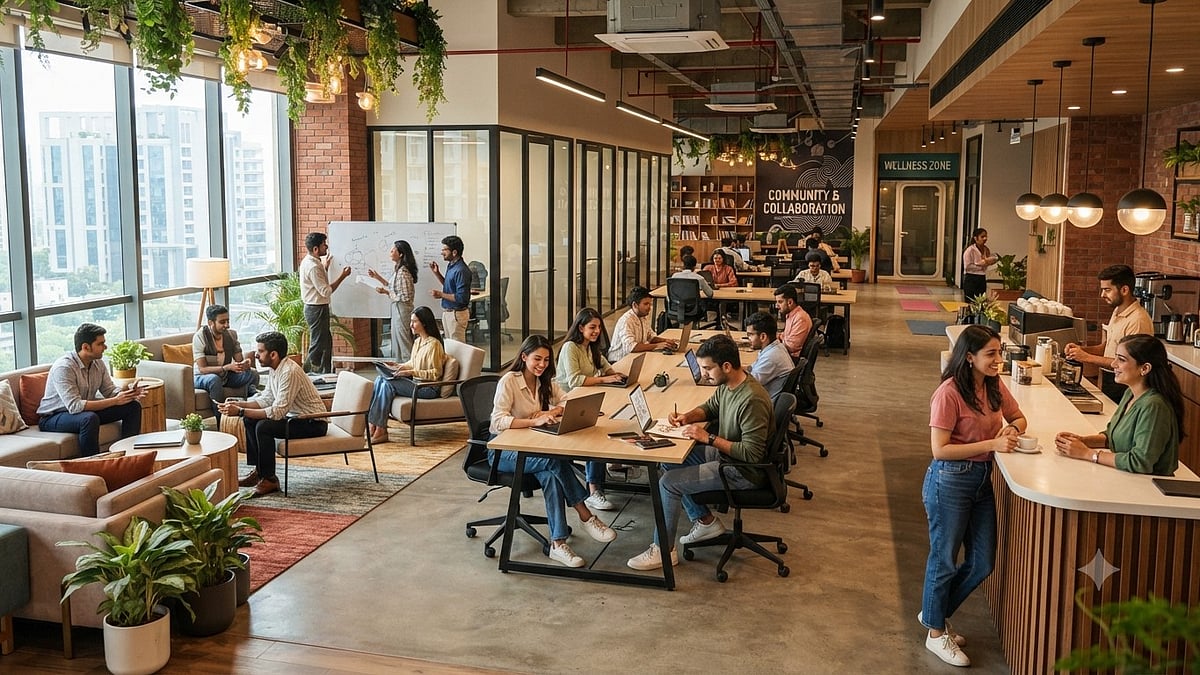
A decade ago, the choice of office was largely determined by employers. However, for many young professionals today, the workplace has become a crucial lifestyle decision that affects their daily commute, fitness routine, and overall well-being.
The modern workplace is no longer judged solely by its location or the number of desks it houses. Instead, it is evaluated by its ability to improve one's everyday life. This shift in perspective has led to the evolution of coworking spaces from shared offices to experience-led work environments.
For millennials and Gen Z, work is no longer expected to dominate their lives. Instead, it should fit into their lifestyle, minimizing commuting time, supporting focused work without isolation, and enabling meaningful interactions. The office has become central to the employee experience, much like customer experience is crucial in hospitality and retail.
The rise of premium coworking spaces reflects this changing expectation. These spaces are designed to be enjoyable, with comfortable lounges, community cafés, wellness zones, quiet pods, and collaborative spaces. They recognize that productivity is deeply influenced by how people feel, which is often overlooked in traditional workplaces.
One of the biggest advantages of coworking spaces is their flexibility, which extends beyond work schedules. For many professionals, especially in India's growing Tier II and Tier III cities, the ability to work closer to home has become a quality-of-life decision. Reducing long daily commutes can create more time for family, fitness, hobbies, or simply unwinding before the next workday begins.
Work-life balance is often discussed in terms of policies, but geography plays an equally important role. The work environment matters, especially for younger professionals who are grappling with workplace stress. According to Deloitte India's 2025 Gen Z and Millennial Survey, 36% of Gen Z professionals and 39% of millennials said their jobs contributed significantly to their stress or anxiety.
While no workplace can eliminate stress entirely, the right work environment can reduce some of its everyday triggers, such as long commutes, social isolation, and uninspiring surroundings. Coworking spaces also address the need to belong to a professional community, which can be lacking in remote work arrangements.
In conclusion, the shift towards coworking spaces reflects a changing expectation among young professionals in India. They are seeking work environments that prioritize their well-being, flexibility, and productivity. As the demand for coworking spaces continues to grow, it is likely that traditional offices will need to adapt to meet the evolving needs of their employees.
The rise of coworking spaces has significant implications for the future of work in India. With more professionals seeking flexible and experience-led work environments, it is likely that the traditional office model will need to evolve. This could lead to a more productive and happy workforce, which would have a positive impact on the overall economy.
In the end, the decision to choose a coworking space over a traditional office is a personal one. However, for many young professionals in India, the benefits of coworking spaces, including flexibility, community, and a focus on well-being, make them an attractive option.
The growth of coworking spaces in India is a trend that is likely to continue in the coming years. As more professionals seek out flexible and experience-led work environments, it is likely that the demand for coworking spaces will increase. This could lead to the development of new and innovative coworking spaces that prioritize the needs of their members.
Overall, the shift towards coworking spaces reflects a changing expectation among young professionals in India. They are seeking work environments that prioritize their well-being, flexibility, and productivity, and are willing to ditch traditional offices to achieve this.
Frequently asked questions
What is driving the growth of coworking spaces in India?
The growth of coworking spaces in India is driven by the desire for flexibility, community, and a focus on well-being among young professionals.
How do coworking spaces differ from traditional offices?
Coworking spaces differ from traditional offices in that they offer a more flexible and experience-led work environment, with amenities such as comfortable lounges, community cafés, and wellness zones.