Supreme Court Issues Notice On PIL Against Paper Leaks
PIL seeks property confiscation and money laundering law in paper leak cases. Supreme Court issues notice to Central government and States.
'%3E%3Crect%20width%3D'96'%20height%3D'96'%20fill%3D'%23B3261E'%2F%3E%3Ccircle%20cx%3D'30'%20cy%3D'24'%20r%3D'44'%20fill%3D'%23fff'%20opacity%3D'.12'%2F%3E%3Ccircle%20cx%3D'60'%20cy%3D'74'%20r%3D'40'%20fill%3D'%23000'%20opacity%3D'.10'%2F%3E%3C%2Fg%3E%3Cg%20fill%3D'%23fff'%3E%3Crect%20x%3D'29'%20y%3D'49'%20width%3D'8'%20height%3D'19'%20rx%3D'1'%2F%3E%3Crect%20x%3D'39'%20y%3D'40'%20width%3D'9'%20height%3D'28'%20rx%3D'1'%2F%3E%3Crect%20x%3D'50'%20y%3D'45'%20width%3D'8'%20height%3D'23'%20rx%3D'1'%2F%3E%3Crect%20x%3D'60'%20y%3D'53'%20width%3D'7'%20height%3D'15'%20rx%3D'1'%2F%3E%3Crect%20x%3D'41'%20y%3D'34'%20width%3D'5'%20height%3D'6'%2F%3E%3C%2Fg%3E%3C%2Fsvg%3E)
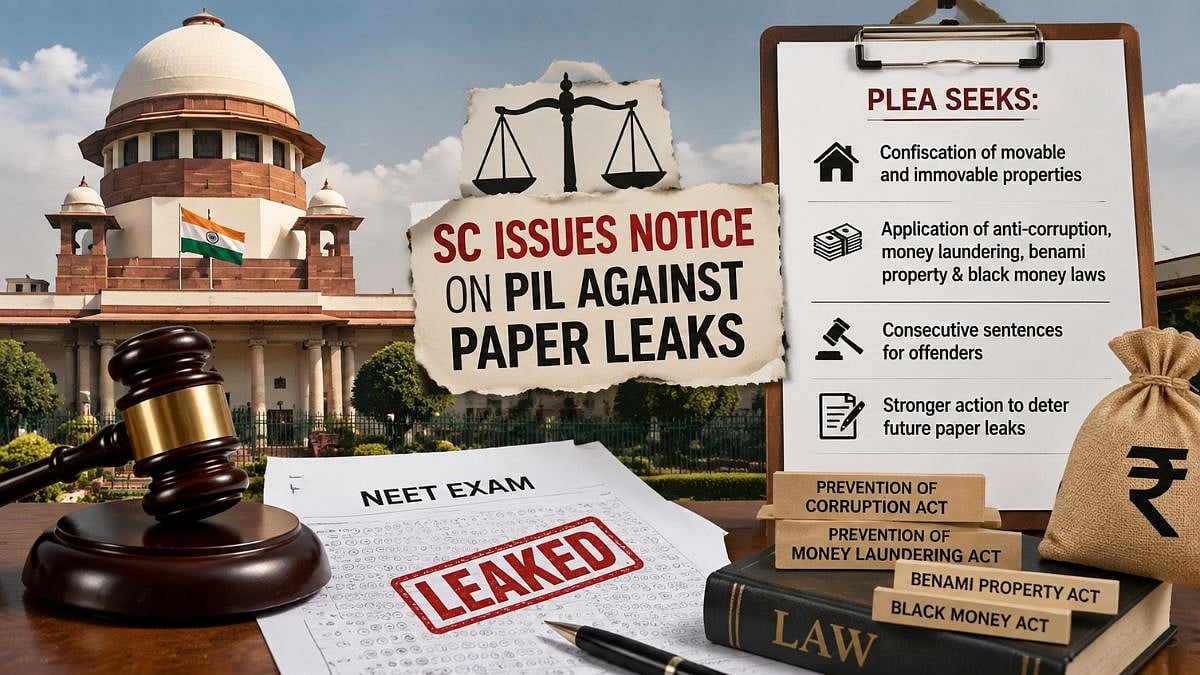
The Supreme Court on Tuesday issued a notice to the Central government and the States regarding a public interest litigation (PIL) that seeks stronger action against those involved in paper leaks.
The PIL, filed by Bharatiya Janata Party (BJP) leader and advocate Ashwini Kumar Upadhyay, demands the confiscation of movable and immovable properties of offenders and their family members, as well as the application of anti-corruption, money laundering, benami property, and black money laws.
A bench of Justices PS Narasimha and Alok Aradhe issued the notice after briefly hearing Upadhyay, who appeared as petitioner-in-person. The petition was filed in response to the recent NEET paper leak and the alleged repeated failures by authorities to prevent, investigate, and effectively prosecute those responsible for such offenses.
Upadhyay has sought directions to the Centre and the States to assess the entire property of paper leak offenders and their family members and take appropriate action under various laws. The petition also seeks a declaration that sentences imposed in paper leak cases should run consecutively rather than concurrently to deter such offenses in the future.
The plea contends that repeated paper leaks and the authorities' failure to effectively deal with them violate the fundamental rights of students under Articles 14, 16, and 21 of the Constitution. It says such leaks cause candidates and their families financial hardship, loss of educational and employment opportunities, and serious psychological distress.
During the hearing, Upadhyay dropped one of his demands, which sought directions to the Centre and the States to formulate a 'Standard Questionnaire' and 'Special Investigation Procedure' for time-bound investigations and speedy trials in paper leak cases. He said this demand had become unnecessary following changes to the law in 2026 that introduced a framework for time-bound investigation of such cases.
The Supreme Court then issued notice on the surviving prayers. The petition reflects the wider concern over the impact of paper leaks on candidates, particularly when examinations determine access to education and employment. Its demand to trace and confiscate assets seeks to move the focus beyond punishment alone and target the alleged financial benefits arising from such offenses.
The issue of paper leaks has been a persistent problem in India, with many cases reported in recent years. The Supreme Court's decision to issue a notice in this case is a significant development, as it indicates that the court is taking the issue seriously and is willing to consider stronger measures to prevent and punish paper leaks.
The case will now proceed to the next stage, where the Central government and the States will be required to respond to the notice. The outcome of the case will be closely watched, as it has the potential to impact the way paper leaks are dealt with in India.
In conclusion, the Supreme Court's decision to issue a notice in this case is a positive step towards addressing the issue of paper leaks in India. The case highlights the need for stronger measures to prevent and punish paper leaks, and the Supreme Court's decision will be closely watched by all stakeholders.
The petition has sparked a wider debate about the need for stronger laws and measures to prevent paper leaks. Many experts believe that the current laws and regulations are not sufficient to deter paper leaks, and that stronger measures are needed to prevent and punish such offenses.
The Supreme Court's decision will have significant implications for the education sector in India, where paper leaks have been a persistent problem. The case will be closely watched by students, parents, and educators, who are all eager to see stronger measures being taken to prevent paper leaks and ensure the integrity of examinations.
The issue of paper leaks is not just a matter of academic integrity, but also has significant implications for the future of students and the country as a whole. The Supreme Court's decision will be a crucial step towards addressing this issue and ensuring that the education system in India is fair and transparent.
Frequently asked questions
What is the PIL seeking in the paper leak cases?
The PIL is seeking stronger action against those involved in paper leaks, including confiscation of their movable and immovable properties and application of anti-corruption, money laundering, benami property, and black money laws.
Why was the PIL filed?
The PIL was filed in response to the recent NEET paper leak and the alleged repeated failures by authorities to prevent, investigate, and effectively prosecute those responsible for such offenses.