MP CM Asks Congress to Clarify Stand on Uniform Civil Code
Madhya Pradesh CM Mohan Yadav receives final UCC report, urges Congress to clarify stance. Report recommends excluding Scheduled Tribes.
'%3E%3Crect%20width%3D'96'%20height%3D'96'%20fill%3D'%231A5276'%2F%3E%3Ccircle%20cx%3D'30'%20cy%3D'24'%20r%3D'44'%20fill%3D'%23fff'%20opacity%3D'.12'%2F%3E%3Ccircle%20cx%3D'60'%20cy%3D'74'%20r%3D'40'%20fill%3D'%23000'%20opacity%3D'.10'%2F%3E%3C%2Fg%3E%3Cg%20fill%3D'%23fff'%3E%3Cpath%20d%3D'M31%2041%20L48%2031%20L65%2041%20Z'%2F%3E%3Crect%20x%3D'33'%20y%3D'43'%20width%3D'4'%20height%3D'17'%2F%3E%3Crect%20x%3D'41'%20y%3D'43'%20width%3D'4'%20height%3D'17'%2F%3E%3Crect%20x%3D'51'%20y%3D'43'%20width%3D'4'%20height%3D'17'%2F%3E%3Crect%20x%3D'59'%20y%3D'43'%20width%3D'4'%20height%3D'17'%2F%3E%3Crect%20x%3D'30'%20y%3D'62'%20width%3D'36'%20height%3D'4'%20rx%3D'1'%2F%3E%3C%2Fg%3E%3C%2Fsvg%3E)
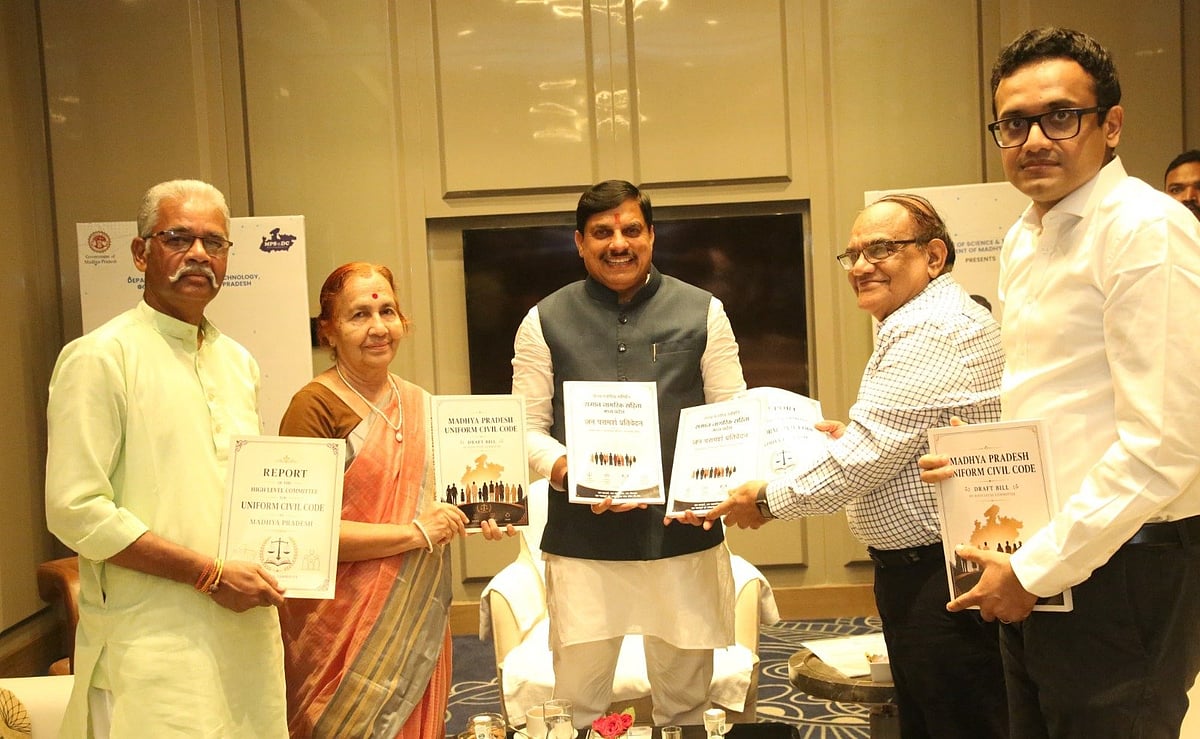
A high-level committee formed by the Madhya Pradesh government has submitted its final report on the Uniform Civil Code (UCC) to Chief Minister Dr Mohan Yadav. The report, which was submitted on Monday, is a significant step towards implementing the UCC in the state.
The committee, which was tasked with preparing the UCC, has recommended that Scheduled Tribes (STs) should be kept out of the proposed code. The report is divided into three parts, with the first part containing the committee's recommendations after studying international, national, and state laws, as well as existing customs and practices.
Chief Minister Mohan Yadav thanked the committee for completing its work within the given time and stated that the state government is committed to bringing the UCC at the earliest. He also urged the Congress to make its stand on the UCC clear, saying that the party should clearly state its position on the issue.
The committee received over 9.58 lakh suggestions through district-level meetings, state-level discussions, and the official website. The feedback has been analyzed based on gender, community, and different subjects. The proposed UCC Bill has four parts, 404 sections, and seven schedules, and has been prepared according to Madhya Pradesh's social, cultural, and economic conditions.
While preparing the draft, the committee focused on ensuring gender equality, respecting existing customs and traditions, and following constitutional provisions. The report will now be presented in the state assembly, with the UCC Bill likely to be introduced in the upcoming assembly session starting from July 20.
The implementation of the UCC has been a long-standing demand of the BJP, and the party has been pushing for its implementation across the country. The UCC aims to provide a uniform set of laws for all citizens, regardless of their religion or community, and is seen as a major step towards promoting national integration and unity.
The Congress, on the other hand, has been cautious in its approach to the UCC, with some leaders expressing concerns about the potential impact on minority communities. The party's stance on the issue is likely to be closely watched, given the sensitive nature of the topic.
The submission of the UCC report is a significant development in the ongoing debate over the implementation of the UCC in India. The report's recommendations and the subsequent introduction of the UCC Bill in the state assembly are likely to have far-reaching implications for the state and the country as a whole.
In the context of Indian politics, the UCC has been a contentious issue, with different parties and communities having varying opinions on the matter. The implementation of the UCC is seen as a major challenge, given the diversity of Indian society and the need to balance individual rights with community interests.
Overall, the submission of the UCC report and the subsequent introduction of the UCC Bill in the state assembly mark an important step towards promoting national integration and unity in India. The outcome of this process will be closely watched, given the potential implications for the country's social, cultural, and economic fabric.
The significance of this development cannot be overstated, as it has the potential to impact the lives of millions of people across the country. The UCC, if implemented, could provide a uniform set of laws for all citizens, promoting equality, justice, and national integration. As such, it is essential to approach this issue with caution and sensitivity, taking into account the diverse perspectives and concerns of different communities and stakeholders.
In conclusion, the submission of the UCC report and the subsequent introduction of the UCC Bill in the state assembly are significant developments in the ongoing debate over the implementation of the UCC in India. The outcome of this process will have far-reaching implications for the country, and it is essential to approach this issue with caution, sensitivity, and a deep understanding of the complex social, cultural, and economic dynamics at play.