Drones Launch Air-to-Air Missiles
US Air Force tests drone missile launch, redefining air combat. Autonomous drones play key role in modern warfare.
'%3E%3Crect%20width%3D'96'%20height%3D'96'%20fill%3D'%234A235A'%2F%3E%3Ccircle%20cx%3D'30'%20cy%3D'24'%20r%3D'44'%20fill%3D'%23fff'%20opacity%3D'.12'%2F%3E%3Ccircle%20cx%3D'60'%20cy%3D'74'%20r%3D'40'%20fill%3D'%23000'%20opacity%3D'.10'%2F%3E%3C%2Fg%3E%3Cg%20fill%3D'none'%20stroke%3D'%23fff'%20stroke-width%3D'3'%3E%3Ccircle%20cx%3D'48'%20cy%3D'48'%20r%3D'16'%2F%3E%3Cellipse%20cx%3D'48'%20cy%3D'48'%20rx%3D'6.5'%20ry%3D'16'%2F%3E%3Cline%20x1%3D'32'%20y1%3D'42'%20x2%3D'64'%20y2%3D'42'%2F%3E%3Cline%20x1%3D'32'%20y1%3D'54'%20x2%3D'64'%20y2%3D'54'%2F%3E%3C%2Fg%3E%3C%2Fsvg%3E)
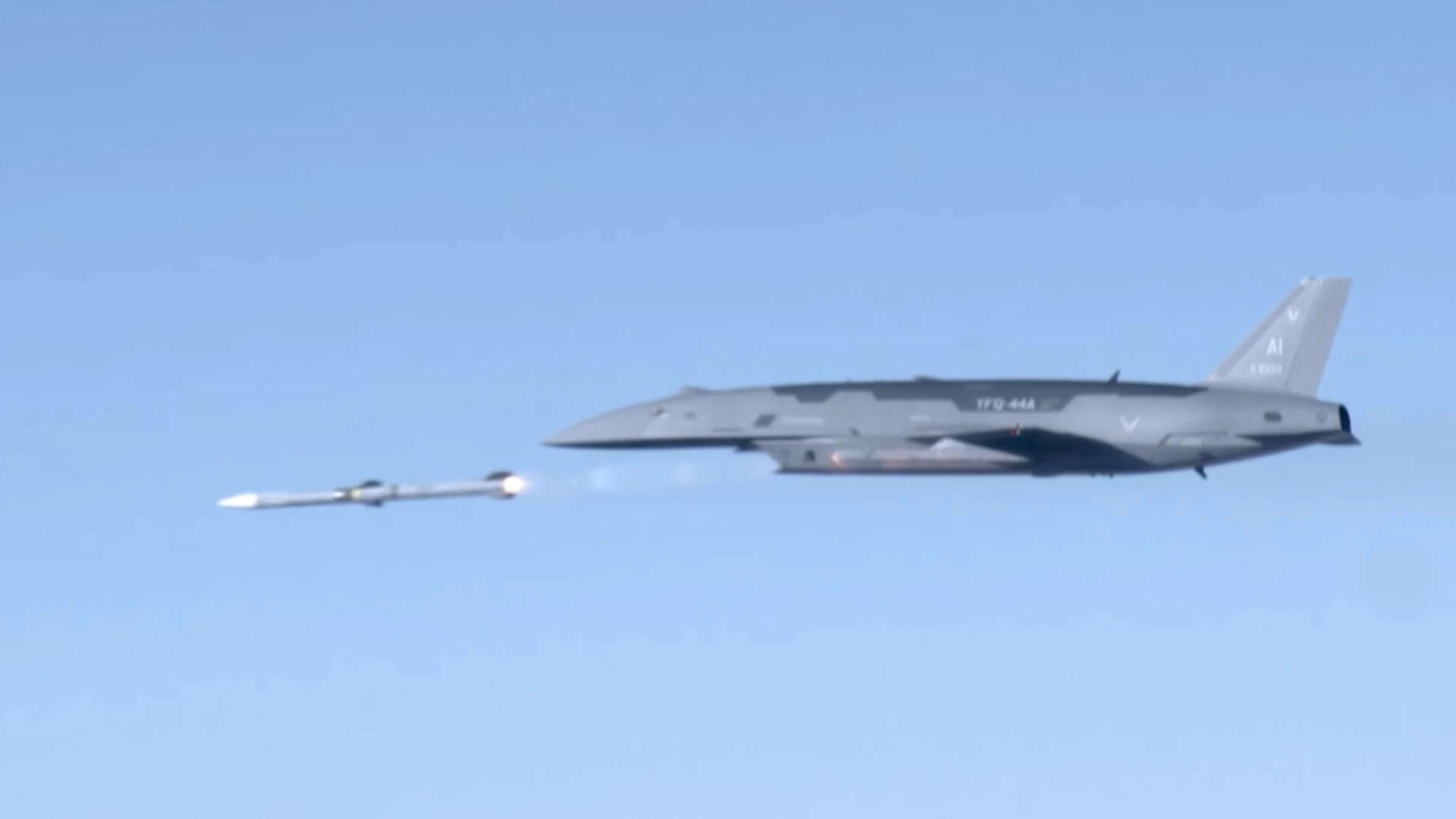
The US Air Force has achieved a significant milestone in unmanned combat capabilities with the successful launch of a live air-to-air missile from a drone. The YFQ-44A Fury drone, a Collaborative Combat Aircraft, fired an AMRAAM missile in a historic test, marking the first time a US unmanned aircraft has launched a live missile.
The test was enabled by Anduril's Lattice software, which allowed for autonomous mission execution and target engagement. This breakthrough demonstrates the potential for unmanned systems to play a central role in modern air combat.
Other countries, including Turkey and Australia, are also developing similar unmanned combat drone capabilities. These autonomous platforms are being designed to operate alongside manned aircraft, providing enhanced situational awareness and precision strike capabilities.
The use of unmanned systems in combat is not new, but the ability to launch air-to-air missiles from a drone represents a significant advancement. It has the potential to rewrite the rules of air combat, enabling more flexible and effective mission execution.
The development of autonomous combat drones is a key aspect of modern warfare, with many nations investing heavily in these technologies. The US Air Force's successful test is a significant step forward in this area, demonstrating the potential for unmanned systems to enhance air combat capabilities.
The YFQ-44A Fury drone is a Collaborative Combat Aircraft, designed to operate alongside manned aircraft and provide enhanced situational awareness and precision strike capabilities. The drone's ability to launch air-to-air missiles is a significant advancement, enabling it to engage targets in a more effective and efficient manner.
The test was a significant success, demonstrating the potential for unmanned systems to play a central role in modern air combat. The use of autonomous drones in combat has the potential to enhance mission execution, providing more flexible and effective capabilities.
The development of unmanned combat drones is a rapidly evolving field, with many nations investing heavily in these technologies. The US Air Force's successful test is a significant step forward in this area, demonstrating the potential for unmanned systems to enhance air combat capabilities.
In the context of modern warfare, the ability to launch air-to-air missiles from a drone represents a significant advancement. It has the potential to rewrite the rules of air combat, enabling more flexible and effective mission execution. The use of unmanned systems in combat is likely to continue to evolve, with autonomous drones playing an increasingly central role in modern warfare scenarios.
The significance of this development cannot be overstated, as it has the potential to fundamentally change the nature of air combat. The ability to launch air-to-air missiles from a drone enables more flexible and effective mission execution, providing a significant advantage on the battlefield. As the development of unmanned combat drones continues to evolve, it is likely that we will see significant advancements in air combat capabilities, enabling more effective and efficient mission execution.
In conclusion, the US Air Force's successful test of a drone-launched air-to-air missile is a significant milestone in the development of unmanned combat capabilities. The use of autonomous drones in combat has the potential to enhance mission execution, providing more flexible and effective capabilities. As the development of unmanned combat drones continues to evolve, it is likely that we will see significant advancements in air combat capabilities, enabling more effective and efficient mission execution.