Indore's Cleanliness Model Attracts Australian Delegation
Australian delegation visits Indore to study waste management system. Delegation explores citizen-led waste segregation initiatives.
'%3E%3Crect%20width%3D'96'%20height%3D'96'%20fill%3D'%231B5E20'%2F%3E%3Ccircle%20cx%3D'30'%20cy%3D'24'%20r%3D'44'%20fill%3D'%23fff'%20opacity%3D'.12'%2F%3E%3Ccircle%20cx%3D'60'%20cy%3D'74'%20r%3D'40'%20fill%3D'%23000'%20opacity%3D'.10'%2F%3E%3C%2Fg%3E%3Cg%3E%3Ccircle%20cx%3D'48'%20cy%3D'48'%20r%3D'15'%20fill%3D'%23fff'%2F%3E%3Cpath%20d%3D'M43%2034%20Q50%2048%2043%2062'%20fill%3D'none'%20stroke%3D'%238a94a6'%20stroke-width%3D'2.4'%2F%3E%3Cpath%20d%3D'M47%2033%20Q54%2048%2047%2063'%20fill%3D'none'%20stroke%3D'%238a94a6'%20stroke-width%3D'1.8'%20stroke-dasharray%3D'1.5%203'%2F%3E%3C%2Fg%3E%3C%2Fsvg%3E)
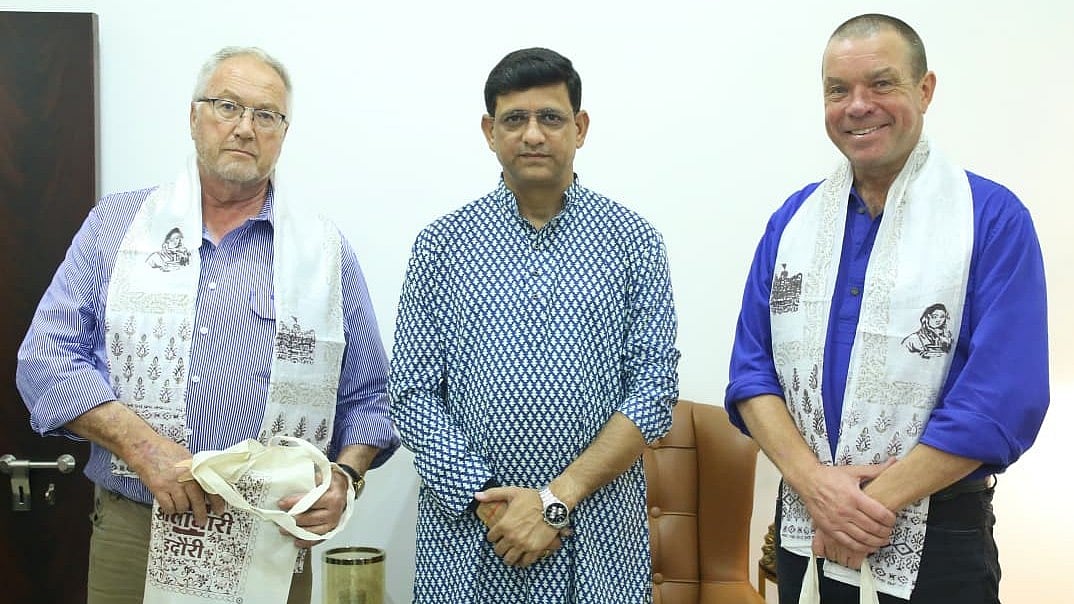
A high-level Australian delegation, led by Member of Parliament Roy Butler, visited Indore on Tuesday to study the city's solid waste management system. The delegation included senior policy adviser John Clements and Irfan Malik, CEO of inQ Innovation, and aimed to explore the scope for promoting citizen-led waste segregation initiatives in Australia.
The team studied Indore's end-to-end waste management system, including source-level segregation, door-to-door collection, and waste processing. They observed the door-to-door collection mechanism, household waste segregation, and compartment-based collection vehicles. The delegates also interacted with residents to understand how public awareness and behavioural change have contributed to Indore's cleanliness.
At the Rajshahi garbage transfer station, the delegation reviewed waste transportation, vehicle management, and monitoring systems. They also visited the Integrated Waste Processing Facility, where municipal officials explained the city's waste processing and environmental initiatives. The delegation later met Municipal Commissioner Kshitij Singhal and senior officials to discuss waste segregation, citizen participation, and technology-driven monitoring.
The visitors also called on Mayor Pushyamitra Bhargav, who said Indore's cleanliness success rests on citizen participation, effective waste segregation, and dedicated sanitation workers. He reiterated the city's willingness to share its expertise with cities worldwide. The Australian delegation described Indore's integrated waste management system as efficient and exemplary, particularly praising its source segregation and Bio-CNG production.
The visit comes as Delhi is set to pilot the 'Indore model' of waste management in one municipal zone. A high-level MCD delegation arrived in Indore on Tuesday for a two-day study visit to learn from the city's door-to-door waste collection, source-level segregation, and processing plants. The visit follows discussions between Indore Mayor Pushyamitra Bhargav and the Delhi L-G during the Mayor's recent visit to the national capital.
Indore's cleanliness model has gained international recognition, and the city has consistently topped the Centre's annual cleanliness survey. The city's success can be attributed to its effective waste management system, which includes source-level segregation, door-to-door collection, and scientific waste processing. The Australian delegation's visit highlights the potential for Indore's model to be replicated in other countries, and the city's willingness to share its expertise with the world.
The visit also underscores the importance of citizen participation and public awareness in maintaining a clean and healthy environment. Indore's success story serves as a model for other cities in India and around the world, and its expertise can be leveraged to address the global challenge of waste management. As cities around the world struggle to manage their waste, Indore's cleanliness model offers a beacon of hope and a potential solution to this pressing problem.
In conclusion, the Australian delegation's visit to Indore highlights the city's expertise in waste management and its potential to be replicated in other countries. The visit also underscores the importance of citizen participation and public awareness in maintaining a clean and healthy environment. As the world grapples with the challenge of waste management, Indore's cleanliness model offers a valuable lesson and a potential solution to this pressing problem.
The success of Indore's cleanliness model has significant implications for Mumbai and other cities in India. It highlights the importance of effective waste management and citizen participation in maintaining a clean and healthy environment. As Mumbai and other cities in India struggle to manage their waste, Indore's model offers a potential solution and a valuable lesson in the importance of community-led initiatives and public awareness.
Overall, the Australian delegation's visit to Indore is a significant development in the city's efforts to share its expertise with the world. It highlights the potential for Indore's model to be replicated in other countries and underscores the importance of citizen participation and public awareness in maintaining a clean and healthy environment. As the world grapples with the challenge of waste management, Indore's cleanliness model offers a valuable lesson and a potential solution to this pressing problem.
Frequently asked questions
What is the Indore model of waste management?
The Indore model of waste management includes source-level segregation, door-to-door collection, and scientific waste processing.
Why did the Australian delegation visit Indore?
The Australian delegation visited Indore to study the city's solid waste management system and explore the scope for promoting citizen-led waste segregation initiatives in Australia.