Rijiju Defends NCPI Invite Amid Opposition Walkout
Union minister Kiren Rijiju defends invitation to NCPI, opposition parties walk out in protest.
'%3E%3Crect%20width%3D'96'%20height%3D'96'%20fill%3D'%231A5276'%2F%3E%3Ccircle%20cx%3D'30'%20cy%3D'24'%20r%3D'44'%20fill%3D'%23fff'%20opacity%3D'.12'%2F%3E%3Ccircle%20cx%3D'60'%20cy%3D'74'%20r%3D'40'%20fill%3D'%23000'%20opacity%3D'.10'%2F%3E%3C%2Fg%3E%3Cg%20fill%3D'%23fff'%3E%3Cpath%20d%3D'M31%2041%20L48%2031%20L65%2041%20Z'%2F%3E%3Crect%20x%3D'33'%20y%3D'43'%20width%3D'4'%20height%3D'17'%2F%3E%3Crect%20x%3D'41'%20y%3D'43'%20width%3D'4'%20height%3D'17'%2F%3E%3Crect%20x%3D'51'%20y%3D'43'%20width%3D'4'%20height%3D'17'%2F%3E%3Crect%20x%3D'59'%20y%3D'43'%20width%3D'4'%20height%3D'17'%2F%3E%3Crect%20x%3D'30'%20y%3D'62'%20width%3D'36'%20height%3D'4'%20rx%3D'1'%2F%3E%3C%2Fg%3E%3C%2Fsvg%3E)
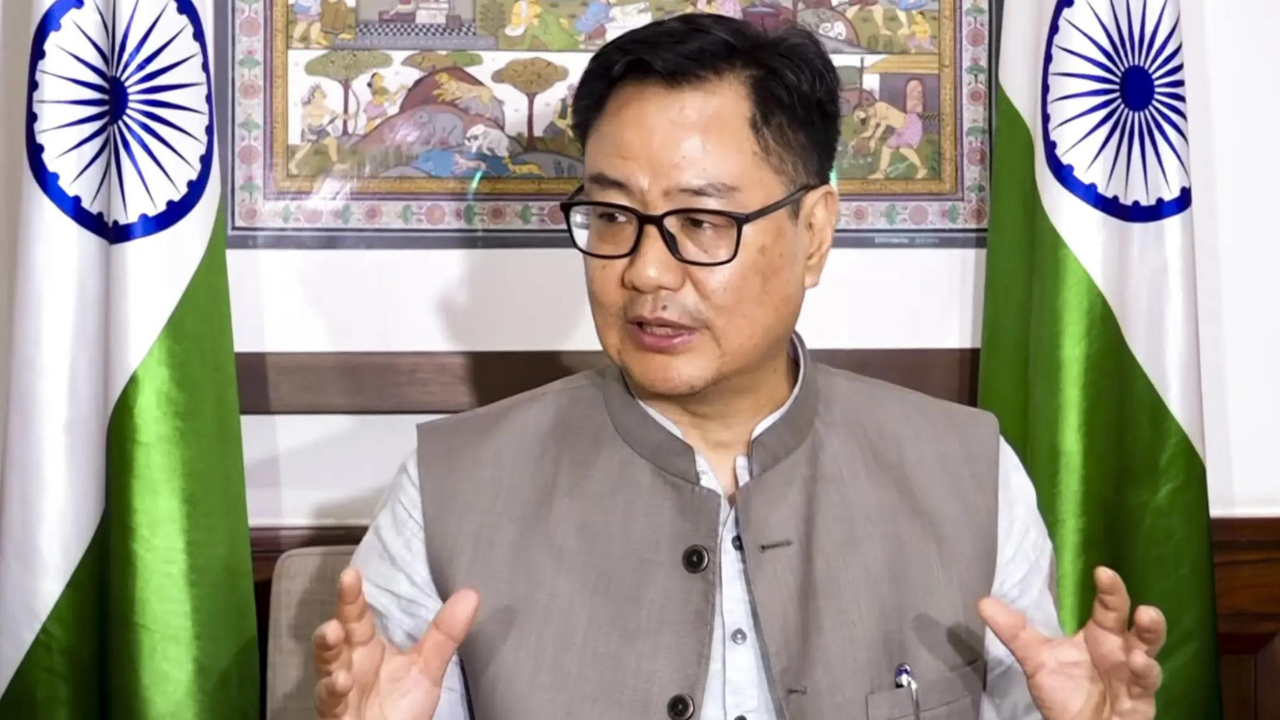
Union Minister Kiren Rijiju has defended the government's decision to invite the Nationalist Citizens Party of India (NCPI) to an all-party meeting, sparking a symbolic walkout from opposition parties. The opposition's protest was in support of the Trinamool Congress (TMC), from which the NCPI MPs had rebelled.
The walkout was a show of solidarity with the TMC, which had objected to the NCPI's invitation to the meeting. However, Rijiju stated that the government had followed parliamentary norms in extending the invitation. He pointed out that the NCPI had sought recognition and the government could not ignore this request.
The all-party meeting was held ahead of the upcoming Monsoon Session of Parliament, which is set to begin on Monday. The session will see the introduction of eight new bills, and the government is hoping for cooperation from all parties to ensure their smooth passage. Rijiju emphasized that all parties have the right to express their views and cooperate for the benefit of the nation.
The NCPI's recognition request is significant, as it highlights the complexities of Indian politics. The party's rebellion from the TMC has created a rift, and the government's decision to invite them to the all-party meeting has further exacerbated tensions. However, Rijiju's defense of the invitation suggests that the government is keen to engage with all parties, regardless of their affiliations.
The Monsoon Session is expected to be a busy one, with several key bills on the agenda. The government will be hoping to push through these bills with the cooperation of opposition parties. However, the opposition's walkout over the NCPI invitation suggests that tensions may run high during the session.
The role of the NCPI in the upcoming session will be closely watched. As a rebel faction of the TMC, their actions may have significant implications for the party's dynamics. The government's decision to engage with them may be seen as a strategic move to weaken the TMC's opposition.
In the context of Indian politics, the NCPI's recognition request and the government's response highlight the complexities of coalition building and party alliances. The upcoming Monsoon Session will be a test of the government's ability to navigate these complexities and push through its legislative agenda.
The significance of the opposition's walkout should not be underestimated. It highlights the deep-seated tensions between the government and the opposition, and suggests that the upcoming session may be marked by controversy and disagreement. However, Rijiju's emphasis on cooperation and dialogue offers a glimmer of hope for a productive session.
In conclusion, the government's decision to invite the NCPI to the all-party meeting has sparked a controversy that may have significant implications for the upcoming Monsoon Session. While the opposition's walkout suggests that tensions may run high, the government's emphasis on cooperation and dialogue offers a way forward. As the session begins, all eyes will be on the government's ability to navigate the complexities of Indian politics and push through its legislative agenda.
The Monsoon Session will be a crucial test of the government's strength and the opposition's resolve. With several key bills on the agenda, the session has the potential to be a defining moment in the country's political landscape. As the drama unfolds, one thing is certain - the upcoming session will be closely watched by all stakeholders, and its outcome will have significant implications for the country's future.
What the walkout and the NCPI's recognition request mean for Mumbai or India is that the country's political landscape is becoming increasingly complex. The rise of rebel factions and the government's response to them will have significant implications for the country's governance and stability. As the Monsoon Session begins, it is clear that the country is at a crossroads, and the decisions made in the coming days will shape its future for years to come.