Supreme Court Flags Issues In Anti-Defection Law
Supreme Court seeks Centre's response on Kapil Sibal's plea, flags enormous issues in anti-defection law.
'%3E%3Crect%20width%3D'96'%20height%3D'96'%20fill%3D'%231A5276'%2F%3E%3Ccircle%20cx%3D'30'%20cy%3D'24'%20r%3D'44'%20fill%3D'%23fff'%20opacity%3D'.12'%2F%3E%3Ccircle%20cx%3D'60'%20cy%3D'74'%20r%3D'40'%20fill%3D'%23000'%20opacity%3D'.10'%2F%3E%3C%2Fg%3E%3Cg%20fill%3D'%23fff'%3E%3Cpath%20d%3D'M31%2041%20L48%2031%20L65%2041%20Z'%2F%3E%3Crect%20x%3D'33'%20y%3D'43'%20width%3D'4'%20height%3D'17'%2F%3E%3Crect%20x%3D'41'%20y%3D'43'%20width%3D'4'%20height%3D'17'%2F%3E%3Crect%20x%3D'51'%20y%3D'43'%20width%3D'4'%20height%3D'17'%2F%3E%3Crect%20x%3D'59'%20y%3D'43'%20width%3D'4'%20height%3D'17'%2F%3E%3Crect%20x%3D'30'%20y%3D'62'%20width%3D'36'%20height%3D'4'%20rx%3D'1'%2F%3E%3C%2Fg%3E%3C%2Fsvg%3E)
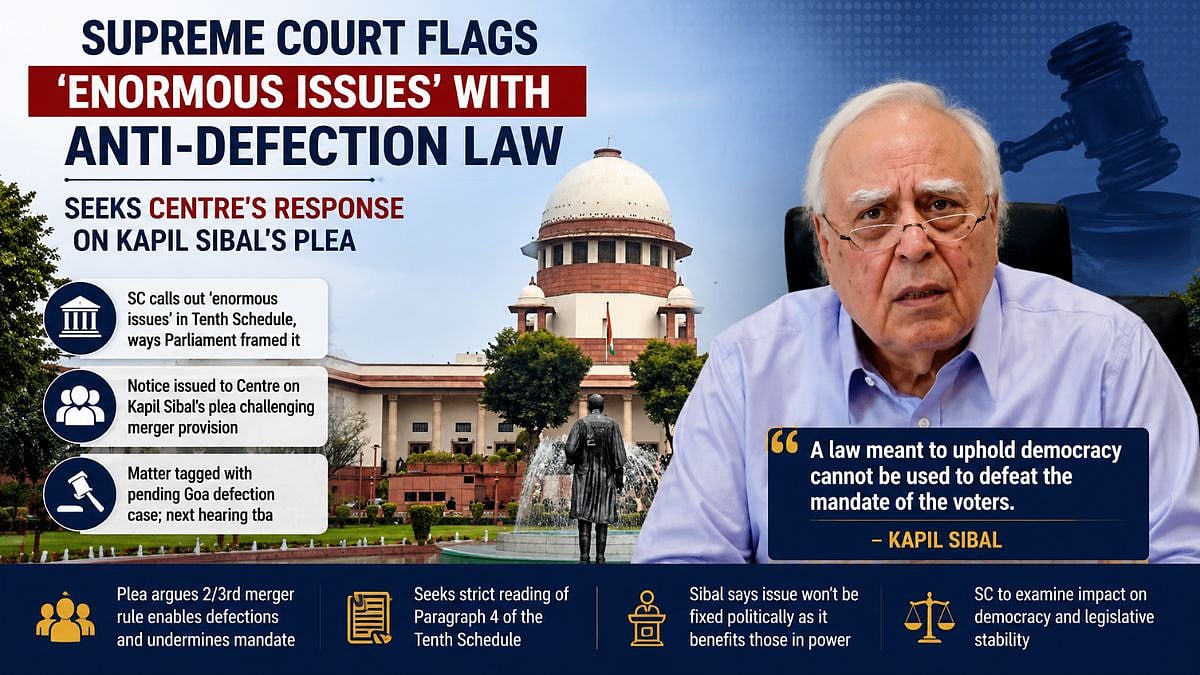
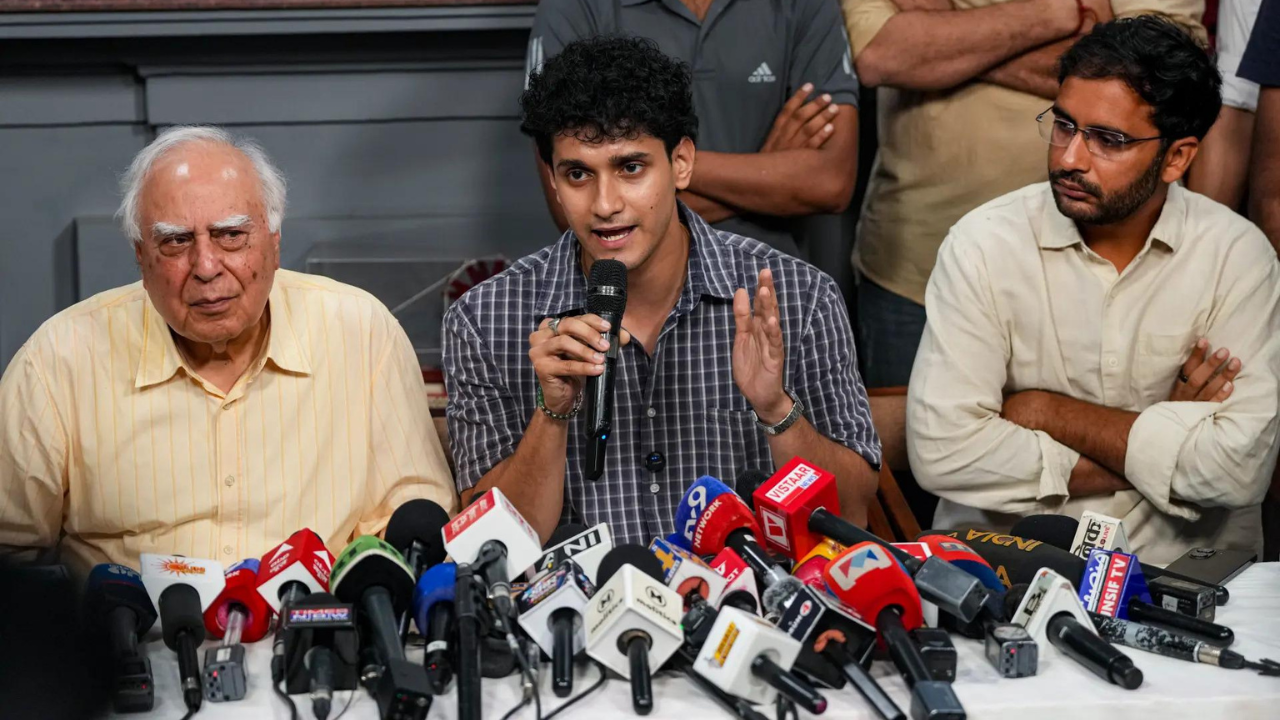
The Supreme Court on Monday observed that there are enormous issues with the anti-defection law under the Tenth Schedule of the Constitution. A Bench of Justices P.S. Narasimha and Alok Aradhe issued a notice to the Union government on Senior Advocate and Independent Rajya Sabha MP Kapil Sibal's petition, which questions the interpretation of the Tenth Schedule.
The petition challenges the interpretation of Paragraph 4 of the Tenth Schedule, which permits two-thirds of a legislature party to avoid disqualification by claiming a merger with another political party. Sibal argued that such a deemed merger should not be allowed unless the original political party itself decides to merge.
The court's observation comes amid recent instances of MPs from various parties joining the Bharatiya Janata Party (BJP) and other political parties by invoking the merger provision. According to Sibal, this has serious consequences for India's democratic system because it allows the composition of legislatures to change after elections.
During the hearing, the Bench remarked that while the Supreme Court had upheld the Tenth Schedule in the past, many of the problems now being witnessed stem from the law as framed by Parliament itself. The court acknowledged that several issues arise from the law and decided to issue notice on the plea.
Sibal argued that lawmakers, like courts, can also make mistakes. He said the issue may never be resolved politically because the present interpretation benefits those in power. The Bench acknowledged that such concerns are ideally meant to be addressed on the floor of the House.
The petition comes amid a pending case related to defections in Goa, which the court has tagged with Sibal's matter. Sibal pointed out that the issue has huge repercussions on India's polity because a minority can become a majority, and vice versa, through such defections.
In his petition, Sibal has sought a declaration that Paragraph 4 of the Tenth Schedule should not be interpreted to mean that two-thirds of a legislature party can avoid disqualification through a deemed merger when the parent political party has not merged or even attempted to do so. The plea argues that the current interpretation has serious consequences for India's democratic system.
The Supreme Court's decision to examine Sibal's plea is significant, as it raises important questions about the interpretation of the anti-defection law and its impact on India's democratic system. The court's observation that there are enormous issues with the law highlights the need for a re-examination of the Tenth Schedule and its provisions.
The case is likely to have far-reaching implications for Indian politics, as it challenges the current interpretation of the anti-defection law. The Supreme Court's decision will be closely watched, as it has the potential to impact the composition of legislatures and the stability of governments.
In conclusion, the Supreme Court's observation that there are enormous issues with the anti-defection law is a significant development in Indian politics. The court's decision to examine Sibal's plea raises important questions about the interpretation of the law and its impact on India's democratic system. The case is likely to have far-reaching implications for Indian politics, and its outcome will be closely watched by politicians, lawyers, and citizens alike.
The Supreme Court's move to seek the Centre's response on Sibal's plea is a step towards addressing the issues with the anti-defection law. The court's decision will be crucial in determining the future of Indian politics and the stability of governments. As the case progresses, it will be important to watch how the court navigates the complex issues surrounding the anti-defection law and its interpretation.
Ultimately, the Supreme Court's decision will have a significant impact on India's democratic system. The court's observation that there are enormous issues with the anti-defection law highlights the need for a re-examination of the Tenth Schedule and its provisions. The case is a reminder that the interpretation of the law is crucial in ensuring the stability and integrity of India's democratic system.
Frequently asked questions
What is the anti-defection law in India?
The anti-defection law is a provision in the Indian Constitution that regulates the switching of parties by elected representatives.
What is the Tenth Schedule of the Constitution?
The Tenth Schedule is a provision in the Indian Constitution that deals with the anti-defection law and regulates the switching of parties by elected representatives.