Mount Ararat Glacier Surveyed for Ice Core
Scientists map shrinking ice cap, plan to drill first ice core. Climate and human history records at risk.
'%3E%3Crect%20width%3D'96'%20height%3D'96'%20fill%3D'%23B3261E'%2F%3E%3Ccircle%20cx%3D'30'%20cy%3D'24'%20r%3D'44'%20fill%3D'%23fff'%20opacity%3D'.12'%2F%3E%3Ccircle%20cx%3D'60'%20cy%3D'74'%20r%3D'40'%20fill%3D'%23000'%20opacity%3D'.10'%2F%3E%3C%2Fg%3E%3Cg%20fill%3D'%23fff'%3E%3Crect%20x%3D'29'%20y%3D'49'%20width%3D'8'%20height%3D'19'%20rx%3D'1'%2F%3E%3Crect%20x%3D'39'%20y%3D'40'%20width%3D'9'%20height%3D'28'%20rx%3D'1'%2F%3E%3Crect%20x%3D'50'%20y%3D'45'%20width%3D'8'%20height%3D'23'%20rx%3D'1'%2F%3E%3Crect%20x%3D'60'%20y%3D'53'%20width%3D'7'%20height%3D'15'%20rx%3D'1'%2F%3E%3Crect%20x%3D'41'%20y%3D'34'%20width%3D'5'%20height%3D'6'%2F%3E%3C%2Fg%3E%3C%2Fsvg%3E)
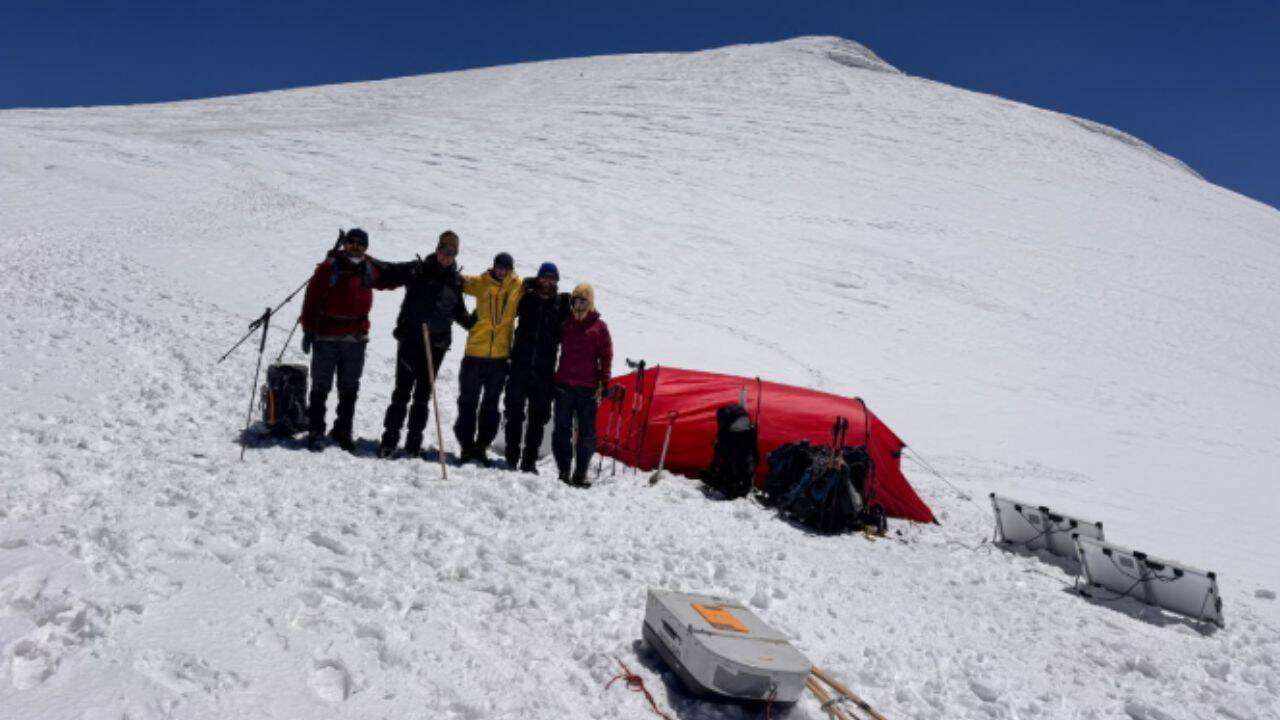
A team of German and Turkish researchers has successfully completed a scientific survey of the glacier on Mount Ararat, the highest peak in Turkey. The survey aimed to identify the best location for extracting the mountain's first ice core, which could provide valuable insights into thousands of years of climate and human history.
The research team mapped the glacier, which is situated above 5,000 meters, to determine the optimal site for drilling. This ice core is expected to contain a wealth of information about environmental conditions and archaeological events in the region. However, the team is racing against time, as the glacier is shrinking due to climate change, threatening to erase this valuable record.
Mount Ararat, located in eastern Turkey, is a significant cultural and historical landmark. The mountain is believed to be the final resting place of Noah's Ark, according to biblical legend. The glacier on Mount Ararat is one of the few remaining in the region, and its ice core could provide crucial information about the climate and human activities in the area over the past few thousand years.
The German-Turkish research team is composed of scientists from various disciplines, including glaciology, climatology, and archaeology. They are working together to extract the ice core and analyze its contents, which could reveal new information about the region's climate, vegetation, and human settlement patterns.
The survey and subsequent ice core extraction are significant not only for the scientific community but also for the preservation of cultural and historical heritage. The ice core could contain information about past civilizations, migrations, and environmental events, which would be lost forever if the glacier melts.
The research team's efforts are part of a larger initiative to study and preserve the world's glaciers, which are rapidly disappearing due to climate change. The extraction of the ice core from Mount Ararat's glacier will provide valuable insights into the region's past and help scientists better understand the impacts of climate change on glaciers and human societies.
In the coming months, the research team will begin drilling the ice core, which will be a complex and challenging process. The team will have to navigate the difficult terrain and harsh weather conditions on Mount Ararat to reach the glacier and extract the ice core. Once the ice core is extracted, it will be analyzed in laboratories using various techniques, including radiocarbon dating and stable isotope analysis.
The results of the analysis will be significant for the scientific community, as they will provide new information about the climate and human history in the region. The study of the ice core could also have implications for our understanding of climate change and its impacts on human societies.
In conclusion, the survey of the glacier on Mount Ararat and the planned extraction of its ice core are significant scientific endeavors that could reveal valuable information about the region's climate and human history. The research team's efforts will contribute to our understanding of the past and help us better prepare for the challenges of climate change in the future.
Frequently asked questions
What is the significance of the glacier on Mount Ararat?
The glacier on Mount Ararat is significant because it contains a record of thousands of years of climate and human history, which could be lost forever if it melts.
Why is the research team racing against time to extract the ice core?
The research team is racing against time because the glacier is shrinking due to climate change, threatening to erase the valuable record it contains.