Mumbai BEST Wage Revision To Cost ₹1,111 Crore Annually
Mumbai BEST wage revision to cost ₹1,111 crore. Wet-lease pay parity to cost ₹475 crore.
'%3E%3Crect%20width%3D'96'%20height%3D'96'%20fill%3D'%23B3261E'%2F%3E%3Ccircle%20cx%3D'30'%20cy%3D'24'%20r%3D'44'%20fill%3D'%23fff'%20opacity%3D'.12'%2F%3E%3Ccircle%20cx%3D'60'%20cy%3D'74'%20r%3D'40'%20fill%3D'%23000'%20opacity%3D'.10'%2F%3E%3C%2Fg%3E%3Cg%20fill%3D'%23fff'%3E%3Crect%20x%3D'29'%20y%3D'49'%20width%3D'8'%20height%3D'19'%20rx%3D'1'%2F%3E%3Crect%20x%3D'39'%20y%3D'40'%20width%3D'9'%20height%3D'28'%20rx%3D'1'%2F%3E%3Crect%20x%3D'50'%20y%3D'45'%20width%3D'8'%20height%3D'23'%20rx%3D'1'%2F%3E%3Crect%20x%3D'60'%20y%3D'53'%20width%3D'7'%20height%3D'15'%20rx%3D'1'%2F%3E%3Crect%20x%3D'41'%20y%3D'34'%20width%3D'5'%20height%3D'6'%2F%3E%3C%2Fg%3E%3C%2Fsvg%3E)
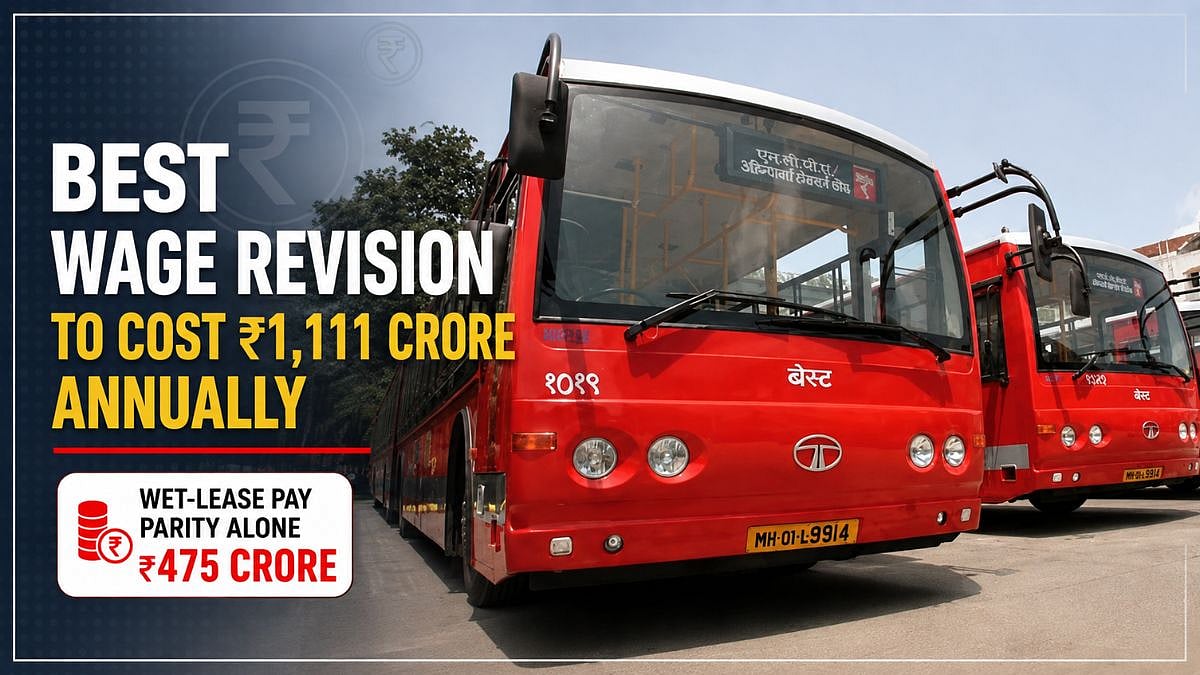
The proposed wage revision for BEST employees and wet-lease workers in Mumbai is expected to add a significant burden to the undertaking's salary bill. The revision could cost ₹1,111 crore annually, with ₹475 crore going towards bringing 9,000 wet-lease workers on a pay scale equivalent to BEST's permanent employees.
The proposal, recommended at a recent BEST Committee meeting, will now be sent to the Brihanmumbai Municipal Corporation (BMC) and the state government's Study Committee for consideration. The proposed revision covers around 38,200 BEST employees and workers, including 27,000 regular employees who are expected to benefit from retrospective wage revision for 2016-2025.
The implementation of the 7th Pay Commission-linked settlement is estimated to create an arrear liability of around ₹6,000 crore. Additionally, ₹300 crore could be required for notional pay fixation for around 2,200 casual workers who were absorbed into regular service from March 31, 2016, in line with High Court orders.
The recurring cost of the wage revision for BEST's regular employees is estimated at ₹636 crore a year, taking the total annual burden to ₹1,111 crore when wet-lease workers are included. The wet-lease parity proposal is politically significant as it addresses a long-standing demand of unions representing contractual workers.
Around 9,000 workers employed through wet-lease operators are proposed to receive wages at par with permanent BEST employees doing similar work. This demand was a key issue during the recent agitation by the BEST Sanyukt Kamgar Kruti Samiti, which launched an indefinite strike in June seeking implementation of the 7th Pay Commission, settlement of pending wage issues, and improved conditions for contractual and wet-lease workers.
The strike was called off after the state government agreed to a monthly increase of ₹3,000 for permanent employees and ₹2,000 for contract workers, along with other assurances. A Study Committee headed by the additional chief secretary of the Urban Development Department was subsequently constituted to examine the long-pending demands.
The BEST Committee has now recommended that employees be placed in pay levels equivalent to those applicable to Maharashtra government and BMC employees under the 7th Pay Commission. Sources said the recommendations are based on legal opinions from the state's Law and Judiciary Department and provisions of the 7th Pay Commission.
The proposed wage revision is expected to have a significant impact on BEST's finances, which are already under strain. The undertaking is dependent on borrowings to meet its wage obligations, and the additional burden of ₹1,111 crore annually will likely put further pressure on its resources.
In the context of Mumbai's public transportation system, the proposed wage revision is a significant development. BEST is one of the largest public transportation undertakings in the city, and its employees play a crucial role in keeping the city moving. The revision is expected to improve the pay scales of wet lease staff and bring them on par with permanent BEST employees doing similar work.
The significance of the proposed wage revision lies in its potential to improve the working conditions and pay scales of thousands of BEST employees and wet-lease workers. It is also a testament to the power of union agitation and the importance of addressing long-pending demands. However, the additional burden on BEST's finances will likely have implications for the undertaking's ability to provide efficient and effective public transportation services to the city.
In conclusion, the proposed wage revision for BEST employees and wet-lease workers is a significant development that will have far-reaching implications for the undertaking's finances and the city's public transportation system. While it is expected to improve the pay scales and working conditions of thousands of employees, it will also put additional pressure on BEST's resources and potentially impact its ability to provide efficient services to the city.
Frequently asked questions
What is the estimated annual cost of the BEST wage revision?
The estimated annual cost of the BEST wage revision is ₹1,111 crore.
How many wet-lease workers will benefit from the pay parity proposal?
Around 9,000 wet-lease workers will benefit from the pay parity proposal, receiving wages at par with permanent BEST employees doing similar work.