Laws Struggle to Assign Blame in AI-Driven Incidents
AI systems raise questions about accountability, challenging traditional laws. Who is responsible when a machine makes a decision?
'%3E%3Crect%20width%3D'96'%20height%3D'96'%20fill%3D'%231B5E20'%2F%3E%3Ccircle%20cx%3D'30'%20cy%3D'24'%20r%3D'44'%20fill%3D'%23fff'%20opacity%3D'.12'%2F%3E%3Ccircle%20cx%3D'60'%20cy%3D'74'%20r%3D'40'%20fill%3D'%23000'%20opacity%3D'.10'%2F%3E%3C%2Fg%3E%3Cg%3E%3Ccircle%20cx%3D'48'%20cy%3D'48'%20r%3D'15'%20fill%3D'%23fff'%2F%3E%3Cpath%20d%3D'M43%2034%20Q50%2048%2043%2062'%20fill%3D'none'%20stroke%3D'%238a94a6'%20stroke-width%3D'2.4'%2F%3E%3Cpath%20d%3D'M47%2033%20Q54%2048%2047%2063'%20fill%3D'none'%20stroke%3D'%238a94a6'%20stroke-width%3D'1.8'%20stroke-dasharray%3D'1.5%203'%2F%3E%3C%2Fg%3E%3C%2Fsvg%3E)
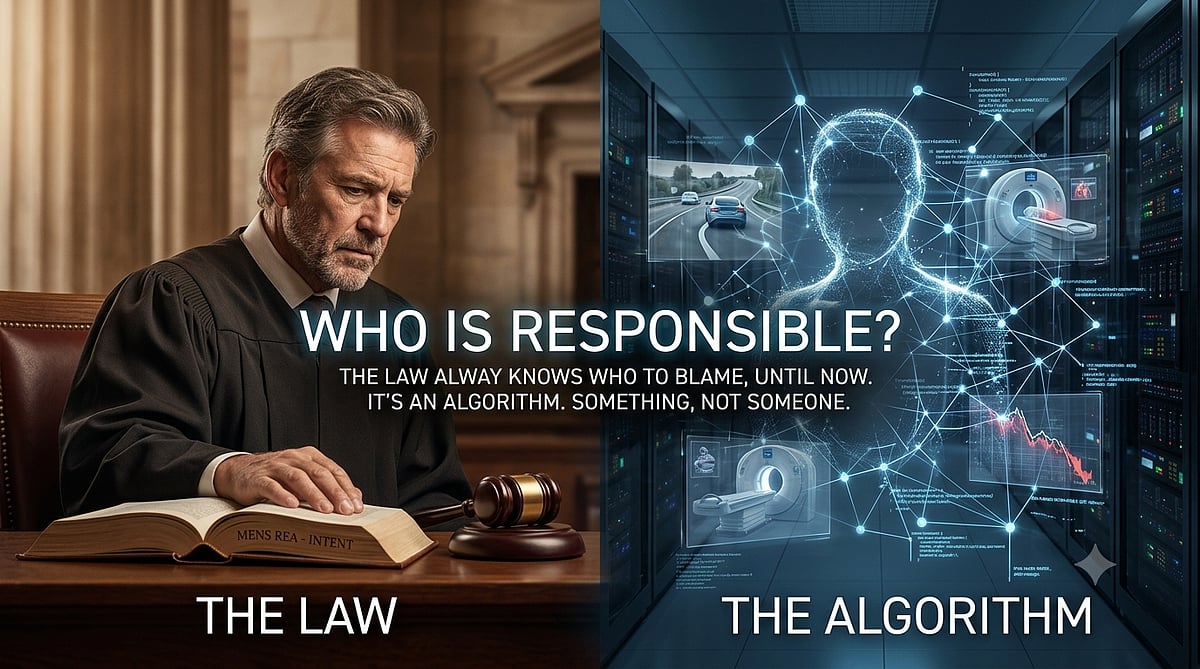
The increasing presence of artificial intelligence in our daily lives is posing a significant challenge to the legal system. A self-driving car's decision to swerve and kill a pedestrian, a machine's misdiagnosis of a patient, or a chatbot's faulty financial advice can all lead to devastating consequences. However, in each of these cases, the question of who is responsible becomes murky.
The law has always relied on the concept of human accountability, where every action can be traced back to a person with intention, motive, and negligence. However, with AI systems making decisions autonomously, this fundamental assumption is being turned on its head. The legal system is struggling to prosecute a computer code, as it is not a human entity that can be held accountable.
In India, the Motor Vehicles Act of 1988 is a prime example of legislation that is no longer equipped to deal with the realities of autonomous vehicles. The Act repeatedly refers to 'the person driving the vehicle,' assuming that every vehicle has a human driver. But what happens when a self-driving car makes a fatal decision without human intervention? Who is 'the person driving the vehicle' in this scenario?
The problem extends far beyond self-driving cars. AI systems are already being used in hospitals to diagnose diseases, in recruitment to screen job applicants, and in banking to approve loans. These systems are making decisions that have real legal, financial, and human consequences. However, they are not human entities that can be held accountable in the classical sense.
The concept of accountability is at the heart of every legal system. We punish those who choose to break the law because they possess intent, judgment, and moral agency. But what happens when the decision-maker is not a person? Can a machine be held accountable for its actions? These are the questions that the legal system is struggling to answer.
The use of AI systems in various industries is becoming increasingly common. They are being used to draft legal documents, assist judges with legal research, and even provide sentencing recommendations. However, as these systems become more autonomous, the question of accountability becomes more pressing.
The legal system needs to adapt to the realities of an AI-driven world. This may require new legislation that takes into account the unique challenges posed by autonomous systems. It may also require a fundamental shift in how we think about accountability and responsibility.
In the meantime, the use of AI systems will continue to raise complex questions about blame and accountability. As these systems become more prevalent, it is essential that we develop a framework that can deal with the consequences of their actions.
The implications of AI on the legal system are far-reaching. It challenges our traditional notions of accountability and responsibility, and requires us to think creatively about how to assign blame in an AI-driven world. As we move forward, it is crucial that we develop a legal framework that can keep pace with the rapid advancements in AI technology.
In conclusion, the increasing presence of AI in our daily lives is posing significant challenges to the legal system. The question of who is responsible when a machine makes a decision is a complex one, and it requires a fundamental shift in how we think about accountability and responsibility. As we navigate this new landscape, it is essential that we develop a framework that can deal with the consequences of AI-driven actions, and ensure that justice is served in an AI-driven world.
What it means for Mumbai and India is that the legal system needs to be revamped to accommodate the growing use of AI systems. This will require a collaborative effort from lawmakers, legal experts, and technologists to develop a framework that can assign blame and accountability in an AI-driven world. It is a complex challenge, but one that needs to be addressed to ensure that justice is served and that the rights of citizens are protected.