Bees Inspire New Solar Panel Design
New solar panels mimic bee honeycombs, boosting power output. Innovative design redirects reflected light, increasing efficiency.
'%3E%3Crect%20width%3D'96'%20height%3D'96'%20fill%3D'%23B3261E'%2F%3E%3Ccircle%20cx%3D'30'%20cy%3D'24'%20r%3D'44'%20fill%3D'%23fff'%20opacity%3D'.12'%2F%3E%3Ccircle%20cx%3D'60'%20cy%3D'74'%20r%3D'40'%20fill%3D'%23000'%20opacity%3D'.10'%2F%3E%3C%2Fg%3E%3Cg%20fill%3D'%23fff'%3E%3Crect%20x%3D'29'%20y%3D'49'%20width%3D'8'%20height%3D'19'%20rx%3D'1'%2F%3E%3Crect%20x%3D'39'%20y%3D'40'%20width%3D'9'%20height%3D'28'%20rx%3D'1'%2F%3E%3Crect%20x%3D'50'%20y%3D'45'%20width%3D'8'%20height%3D'23'%20rx%3D'1'%2F%3E%3Crect%20x%3D'60'%20y%3D'53'%20width%3D'7'%20height%3D'15'%20rx%3D'1'%2F%3E%3Crect%20x%3D'41'%20y%3D'34'%20width%3D'5'%20height%3D'6'%2F%3E%3C%2Fg%3E%3C%2Fsvg%3E)
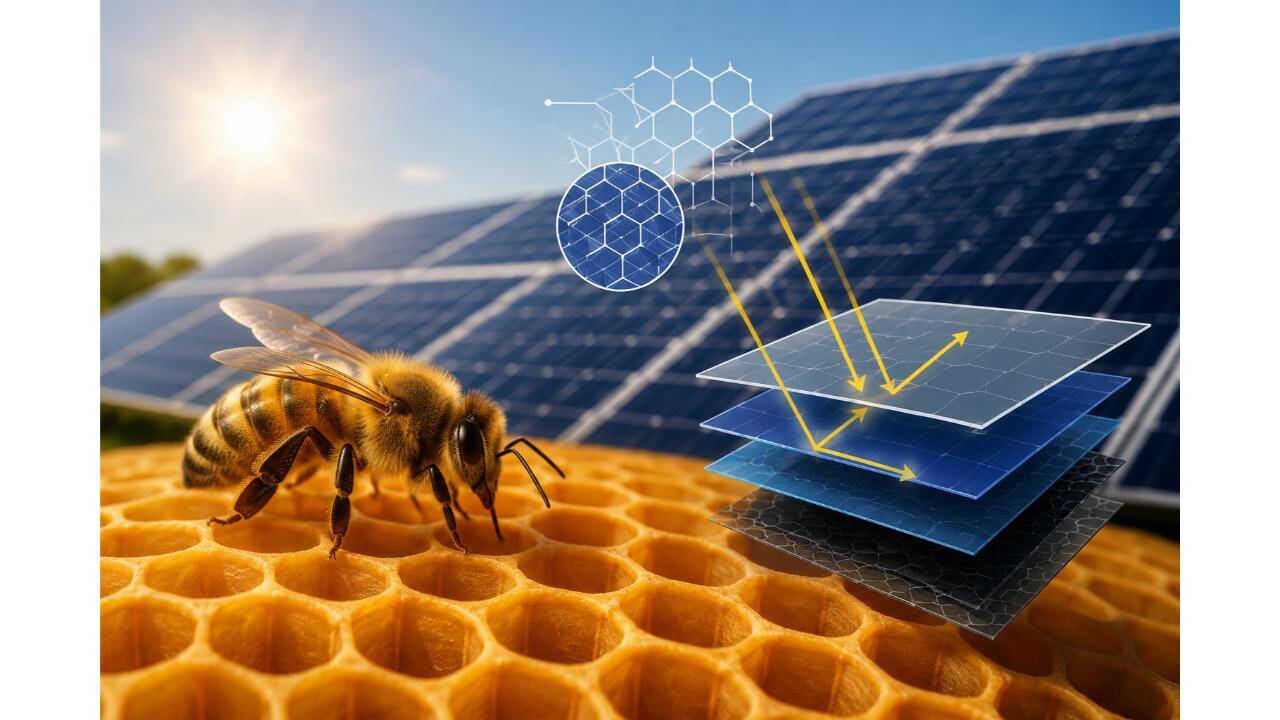
Engineers have developed a groundbreaking new solar panel design, drawing inspiration from the intricate structure of bee honeycombs. This innovative three-dimensional concave structure has the ability to redirect reflected light back into the panel, significantly increasing power output compared to conventional flat panels.
The researchers behind this breakthrough report that the new design has shown notable improvements in efficiency, making it a promising solution to one of the biggest shortcomings of traditional solar panels. The unique structure of the panels, which mimics the hexagonal cells of bee honeycombs, allows for a more efficient absorption of sunlight.
One of the key advantages of this new design is its flexibility, made possible by the use of a flexible metamaterial. This means that the panels can be integrated into curved surfaces, such as those found on vehicles, expanding the potential applications of solar power beyond traditional rooftop installations.
The development of this new solar panel design is a significant step forward in the field of renewable energy. As the world continues to shift towards more sustainable sources of power, innovations like this will play a crucial role in making solar energy more efficient and accessible.
The use of biomimicry, or the practice of drawing inspiration from nature to solve complex problems, has led to numerous breakthroughs in recent years. The study of bee honeycombs, in particular, has yielded valuable insights into the design of efficient structures.
In the context of solar energy, the ability to redirect reflected light back into the panel is a major advantage. Traditional flat panels often suffer from energy loss due to reflection, which can significantly reduce their overall efficiency. The new design, with its three-dimensional concave structure, is able to mitigate this loss, resulting in a more efficient and effective solar panel.
As researchers continue to refine and improve this design, it is likely that we will see a significant increase in the adoption of solar energy. The potential applications of this technology are vast, ranging from curved rooftop installations to integrated vehicle designs.
The impact of this innovation will be felt not only in the field of renewable energy but also in the broader context of sustainable development. As the world continues to grapple with the challenges of climate change, the development of more efficient and effective solar panels will play a critical role in reducing our reliance on fossil fuels and mitigating the effects of global warming.
In conclusion, the new solar panel design inspired by bee honeycombs is a significant breakthrough in the field of renewable energy. With its flexible metamaterial and three-dimensional concave structure, this innovation has the potential to expand the applications of solar power and increase its efficiency, making it a promising solution for a more sustainable future.