Pakistan Cleric Bans Bitcoin Trading
A top Islamic scholar declares cryptocurrency trading 'haram', sparking sell-off. Investors in Pakistan, India, and UAE affected.
'%3E%3Crect%20width%3D'96'%20height%3D'96'%20fill%3D'%234A235A'%2F%3E%3Ccircle%20cx%3D'30'%20cy%3D'24'%20r%3D'44'%20fill%3D'%23fff'%20opacity%3D'.12'%2F%3E%3Ccircle%20cx%3D'60'%20cy%3D'74'%20r%3D'40'%20fill%3D'%23000'%20opacity%3D'.10'%2F%3E%3C%2Fg%3E%3Cg%20fill%3D'none'%20stroke%3D'%23fff'%20stroke-width%3D'3'%3E%3Ccircle%20cx%3D'48'%20cy%3D'48'%20r%3D'16'%2F%3E%3Cellipse%20cx%3D'48'%20cy%3D'48'%20rx%3D'6.5'%20ry%3D'16'%2F%3E%3Cline%20x1%3D'32'%20y1%3D'42'%20x2%3D'64'%20y2%3D'42'%2F%3E%3Cline%20x1%3D'32'%20y1%3D'54'%20x2%3D'64'%20y2%3D'54'%2F%3E%3C%2Fg%3E%3C%2Fsvg%3E)
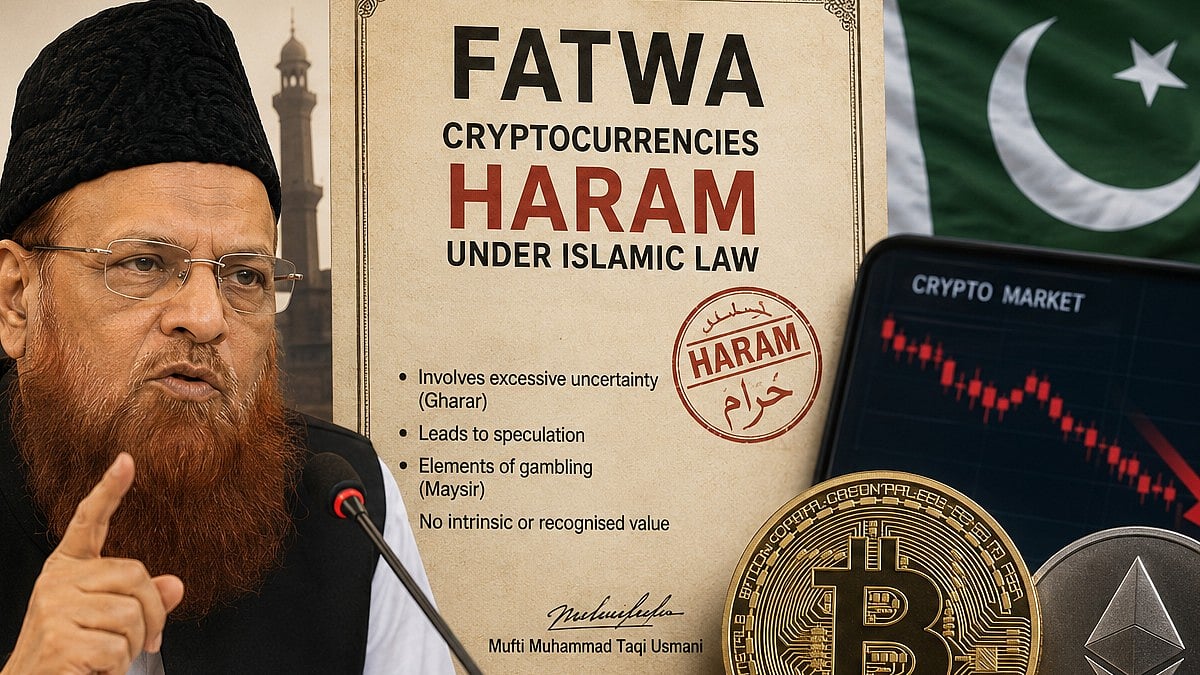
A prominent Islamic scholar in Pakistan, Mufti Muhammad Taqi Usmani, has issued a fatwa declaring cryptocurrency trading 'haram' or forbidden under Islamic law. This move has triggered a sell-off among investors in Pakistan, India, and the United Arab Emirates. The fatwa, which is a non-binding religious opinion, states that cryptocurrencies such as Bitcoin and Ethereum fail to meet the requirements of legitimate wealth under Sharia law due to excessive uncertainty, speculative behavior, and gambling-like elements.
Mufti Usmani is a globally respected authority on Islamic finance, and his views carry significant weight among Muslim investors. The fatwa was issued at a sensitive time for Pakistan, which has been promoting itself as a crypto-friendly destination over the past year. The government has established the Pakistan Crypto Council and introduced the Pakistan Virtual Assets Regulatory Authority (PVARA) to regulate digital assets and encourage blockchain innovation.
Despite the fatwa, cryptocurrency trading has not become illegal in Pakistan. The country's regulatory framework remains separate from religious guidance, and the fatwa does not amount to a government ban or court order. However, market participants have reported that some religious investors in Pakistan, India, and the UAE have liquidated their cryptocurrency holdings following the announcement.
Industry experts have warned that the impact could widen if more Islamic scholars endorse similar positions. The fatwa has not triggered a broad global cryptocurrency sell-off, but analysts believe it could influence investor sentiment across Muslim-majority countries. Supporters of digital assets argue that stronger regulation, rather than prohibition, is the most effective way to address concerns surrounding fraud, money laundering, and consumer protection while encouraging financial innovation.
The Pakistan government's efforts to promote cryptocurrency trading and blockchain innovation may face a setback due to the fatwa. The government had hoped to position Pakistan as a hub for digital assets, but the fatwa may deter some investors from participating in the market. However, it is worth noting that the fatwa is not a legally enforceable order, and the government's regulatory framework remains in place.
In recent years, Pakistan has made significant efforts to develop its cryptocurrency market. The government has introduced policies aimed at regulating digital assets and encouraging blockchain innovation. The Pakistan Crypto Council has also been established to promote the development of the cryptocurrency industry in the country.
The impact of the fatwa on the global cryptocurrency market is still uncertain. While it has triggered a sell-off among some investors, it is not clear whether it will have a broader impact on the market. Analysts will be watching closely to see how the situation develops and whether other Islamic scholars endorse similar positions.
In conclusion, the fatwa issued by Mufti Usmani has significant implications for the cryptocurrency market in Pakistan and other Muslim-majority countries. While it is not a legally enforceable order, it carries significant weight among Muslim investors and may influence investor sentiment. The Pakistan government's efforts to promote cryptocurrency trading and blockchain innovation may face a setback due to the fatwa, but it is still unclear what the long-term impact will be.
The situation highlights the complex relationship between religion and finance in Muslim-majority countries. While some investors may be deterred from participating in the cryptocurrency market due to religious concerns, others may continue to invest and trade in digital assets. As the situation develops, it will be important to watch how governments and regulatory bodies respond to the fatwa and its impact on the cryptocurrency market.
Ultimately, the fatwa issued by Mufti Usmani serves as a reminder of the importance of considering the social and cultural context in which financial markets operate. As the cryptocurrency market continues to evolve, it will be important to take into account the diverse perspectives and values of investors and regulators around the world.