New Jersey Seawall Fails to Save Beach
Seawall protects properties but erodes beach
'%3E%3Crect%20width%3D'96'%20height%3D'96'%20fill%3D'%231B5E20'%2F%3E%3Ccircle%20cx%3D'30'%20cy%3D'24'%20r%3D'44'%20fill%3D'%23fff'%20opacity%3D'.12'%2F%3E%3Ccircle%20cx%3D'60'%20cy%3D'74'%20r%3D'40'%20fill%3D'%23000'%20opacity%3D'.10'%2F%3E%3C%2Fg%3E%3Cg%3E%3Ccircle%20cx%3D'48'%20cy%3D'48'%20r%3D'15'%20fill%3D'%23fff'%2F%3E%3Cpath%20d%3D'M43%2034%20Q50%2048%2043%2062'%20fill%3D'none'%20stroke%3D'%238a94a6'%20stroke-width%3D'2.4'%2F%3E%3Cpath%20d%3D'M47%2033%20Q54%2048%2047%2063'%20fill%3D'none'%20stroke%3D'%238a94a6'%20stroke-width%3D'1.8'%20stroke-dasharray%3D'1.5%203'%2F%3E%3C%2Fg%3E%3C%2Fsvg%3E)
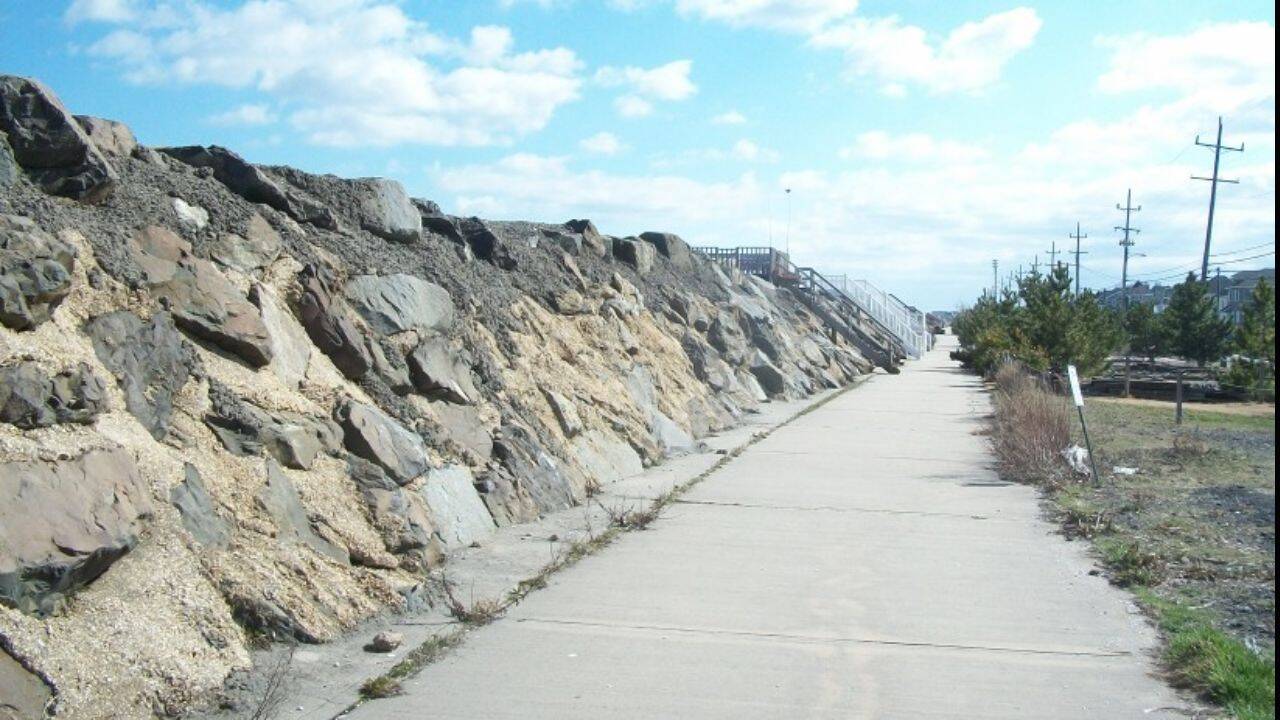
A seawall built in New Jersey to prevent erosion has had an unexpected consequence: the disappearance of the beach it was meant to protect. The construction of the seawall has safeguarded properties in the area, but it has also disrupted the natural flow of sand, causing the sandy shoreline to vanish.
The seawall works by redirecting the energy from waves downwards, which in turn has stripped away the sand from the beach. As a result, even during low tide, there is no beach visible. This is a classic example of the unintended consequences of hard engineering tactics in coastal management.
The natural flow of sand is essential for the health and stability of beaches and barrier islands. However, the construction of seawalls and other coastal defenses can disrupt this process, leading to erosion and loss of sand. In the case of New Jersey, the seawall has hindered the migration of barrier islands, which are essential for the protection of coastal communities.
Barrier islands are dynamic systems that migrate over time in response to changes in sea level and wave patterns. However, the construction of seawalls and other coastal defenses can prevent this migration, leading to erosion and loss of sand. The disappearance of the beach in New Jersey is a stark reminder of the importance of considering the long-term consequences of coastal management strategies.
The use of hard engineering tactics in coastal management is a common practice, but it is not without its risks. While seawalls and other coastal defenses can provide protection for properties and communities, they can also have unintended consequences, such as erosion and loss of sand. In order to mitigate these risks, it is essential to consider the natural dynamics of coastal systems and to adopt more sustainable and adaptive management strategies.
In recent years, there has been a growing recognition of the importance of soft engineering tactics in coastal management. These tactics, such as beach nourishment and dune restoration, work with the natural dynamics of coastal systems, rather than trying to control them. By adopting more sustainable and adaptive management strategies, it may be possible to prevent the erosion of beaches and the loss of sand, while also protecting properties and communities.
The disappearance of the beach in New Jersey is a reminder of the complexities and challenges of coastal management. It highlights the need for a more nuanced and sustainable approach to coastal management, one that takes into account the natural dynamics of coastal systems and the potential consequences of human interventions.
The incident serves as a lesson for other coastal cities and towns, including those in India, to consider the long-term effects of their coastal management strategies and to adopt more sustainable approaches to protect their beaches and communities.
Frequently asked questions
What happened to the beach in New Jersey?
The beach disappeared due to erosion caused by the construction of a seawall.
Why did the seawall fail to save the beach?
The seawall disrupted the natural flow of sand and hindered the migration of barrier islands, leading to erosion and loss of sand.