MP Cabinet Approves Uniform Civil Code Bill
Madhya Pradesh cabinet clears UCC Bill, exempts Tribals. Bill to be tabled in Assembly.
'%3E%3Crect%20width%3D'96'%20height%3D'96'%20fill%3D'%231A5276'%2F%3E%3Ccircle%20cx%3D'30'%20cy%3D'24'%20r%3D'44'%20fill%3D'%23fff'%20opacity%3D'.12'%2F%3E%3Ccircle%20cx%3D'60'%20cy%3D'74'%20r%3D'40'%20fill%3D'%23000'%20opacity%3D'.10'%2F%3E%3C%2Fg%3E%3Cg%20fill%3D'%23fff'%3E%3Cpath%20d%3D'M31%2041%20L48%2031%20L65%2041%20Z'%2F%3E%3Crect%20x%3D'33'%20y%3D'43'%20width%3D'4'%20height%3D'17'%2F%3E%3Crect%20x%3D'41'%20y%3D'43'%20width%3D'4'%20height%3D'17'%2F%3E%3Crect%20x%3D'51'%20y%3D'43'%20width%3D'4'%20height%3D'17'%2F%3E%3Crect%20x%3D'59'%20y%3D'43'%20width%3D'4'%20height%3D'17'%2F%3E%3Crect%20x%3D'30'%20y%3D'62'%20width%3D'36'%20height%3D'4'%20rx%3D'1'%2F%3E%3C%2Fg%3E%3C%2Fsvg%3E)
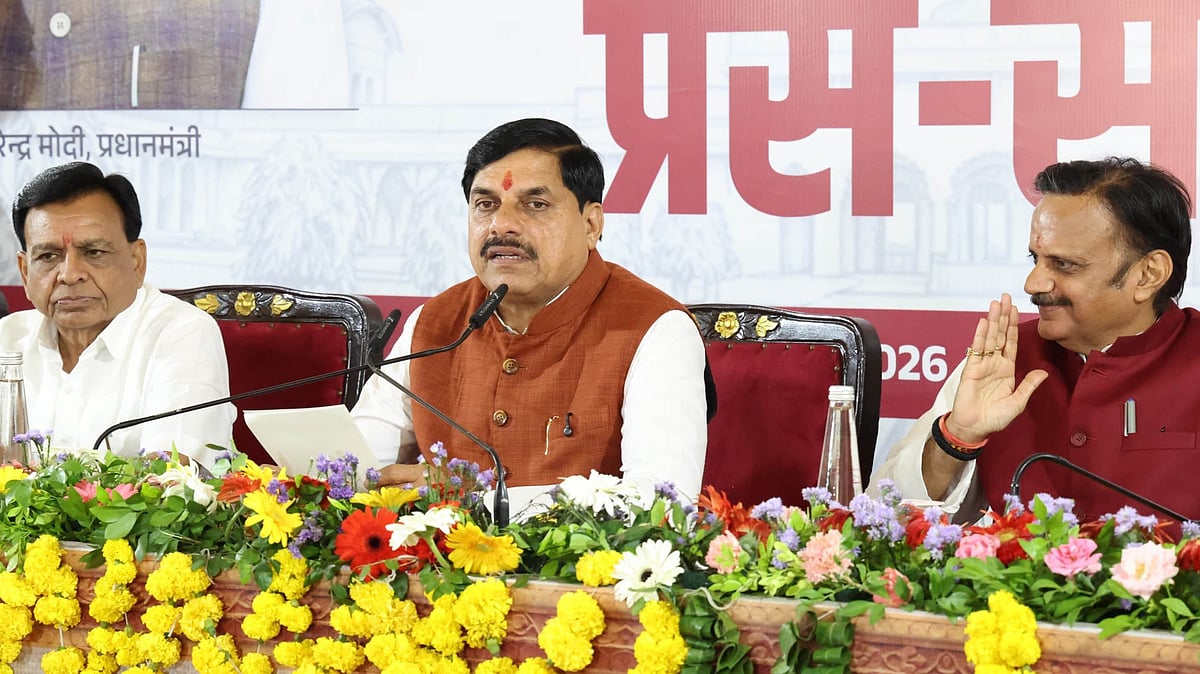
The Madhya Pradesh cabinet has unanimously approved the Uniform Civil Code (UCC) Bill, 2026, which will now be tabled in the state Assembly for final approval. The bill aims to bring uniformity in civil laws across the state, exempting Tribals from its purview.
The cabinet meeting, held at the historic fort of Jagdishpur on the outskirts of Bhopal, saw the approval of the UCC Bill along with eight other important bills. Chief Minister Mohan Yadav addressed the media after the meeting, stating that the UCC committee had held meetings in 51 districts and 10 divisions to seek suggestions from the public.
The committee received around 10 lakh suggestions from the public, with over 80% of Muslim women and 40% of Muslims supporting the implementation of the UCC Bill. A significant 92.20% of people were in favor of equal rights for men and women in all communities, while 93.54% supported the UCC.
The UCC Bill has four pillars, one of which is marriage. The bill proposes that only one marriage will be recognized, and a second marriage will be prohibited until a legal divorce is obtained. The marriageable age for boys will be 21 years, and 18 years for girls, with both having equal rights in property.
The bill also proposes to do away with 'talaq' and ensures that men and women have equal rights in property. Registration of live-in relationships will be mandatory within one month, with a minimum age limit of 21 years for boys and 18 years for girls. If a married man enters into a live-in relationship, he will face a punishment of five years.
The state government, under the leadership of Prime Minister Narendra Modi, aims to bring a law that ensures equality for all, regardless of religion. The UCC respects all religions and does not aim to degrade any religion, allowing everyone to practice their religion freely.
In addition to the UCC Bill, the cabinet also approved eight other bills, including the MP Repeal Bill, 2026, and the MP Fire Safety and Emergency Service Bill. A sum of Rs 776.13 crore has been sanctioned for the upgradation of 73 health institutions.
The Congress party had skipped the state-level discussion on the UCC, according to the Chief Minister. The UCC Bill will now be tabled in the state Assembly, where it will undergo further discussion and approval before becoming a law.
The approval of the UCC Bill is a significant step towards bringing uniformity in civil laws across the state. The bill's provisions aim to ensure equal rights for men and women, regardless of their community or religion. The exemption of Tribals from the UCC is a notable aspect, recognizing the unique cultural and social practices of the community.
The UCC Bill's impact will be closely watched, as it has the potential to bring significant changes to the state's civil laws. The bill's emphasis on equal rights and the prohibition of second marriages without a legal divorce are notable provisions that aim to promote social justice and equality.
In conclusion, the approval of the UCC Bill by the Madhya Pradesh cabinet is a significant development that aims to bring uniformity and equality in civil laws across the state. The bill's provisions and exemptions will have a significant impact on the state's social and cultural landscape, and its implementation will be closely watched by the public and stakeholders alike.
The UCC Bill's significance extends beyond the state, as it reflects the broader national debate on uniform civil codes and social justice. The bill's emphasis on equal rights and the prohibition of discriminatory practices has the potential to inspire similar reforms across the country, promoting a more just and equitable society for all.
Overall, the approval of the UCC Bill is a notable step towards promoting social justice and equality in Madhya Pradesh, and its implementation will have far-reaching consequences for the state and the country as a whole.