FRTWA Pushes For Digital Donations At Religious Places
Digital donations, FRTWA urges, will improve transparency and accountability.

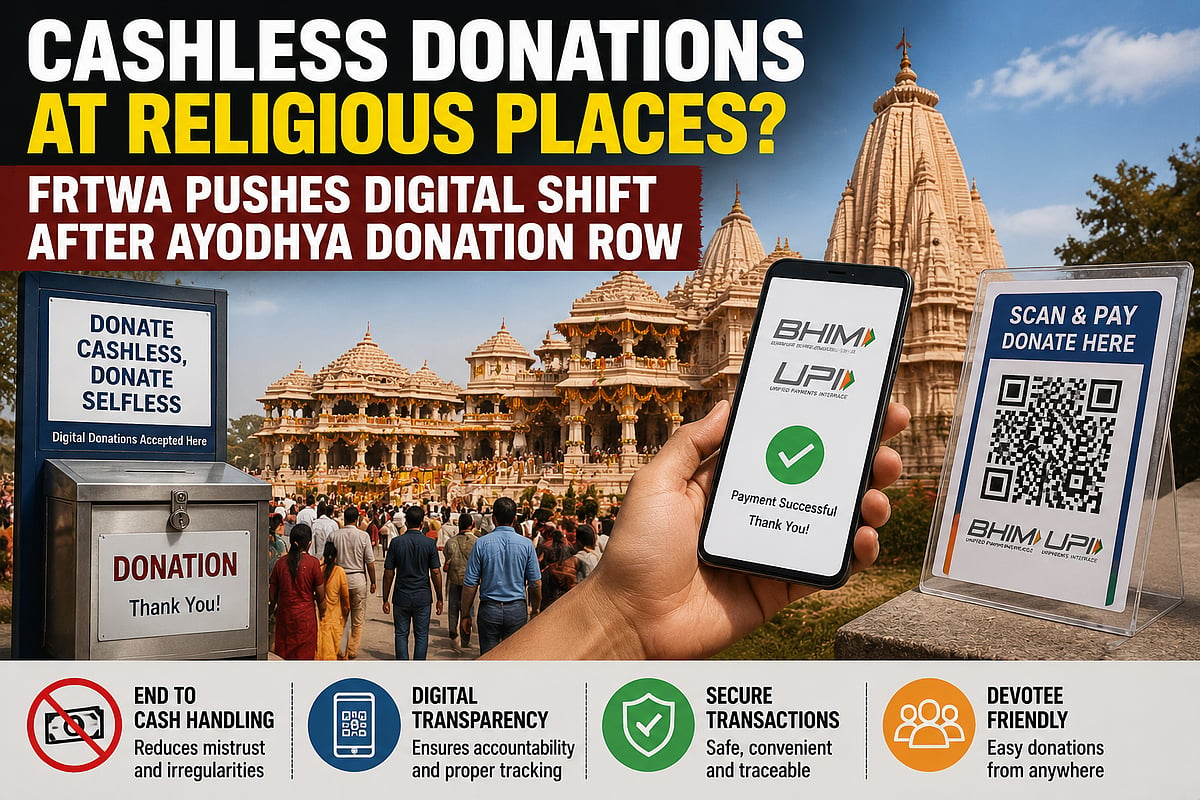
A recent investigation into allegations of staff siphoning off cash donations at the Ram Mandir in Ayodhya has sparked a debate on how money offered at places of worship should be collected and accounted for. The Federation of Retail Traders Welfare Association (FRTWA) has written to the Prime Minister's Office, urging the Centre to encourage all religious institutions to shift entirely to digital modes of receiving donations.
According to FRTWA president Viren Shah, digital donations would significantly improve transparency, create a reliable audit trail, and minimise the risk of financial irregularities. Shah cited the success of India's Digital India programme, which has transformed the country's payment ecosystem, making the Unified Payments Interface (UPI) one of the world's most successful digital payment platforms.
Shah suggested that every religious institution should prominently display UPI QR codes and provide facilities for donations through UPI, debit and credit cards, bank transfers, cheques, and demand drafts. He believes that reforming the system of religious donations would serve the larger national interest by ensuring greater financial accountability while discouraging the use of unaccounted money.
However, religious institutions have raised concerns about making digital donations compulsory. Hemant Jadhav, manager of Mumbai's Mumbadevi Temple, said that while digital payment facilities are already available and increasingly popular, donors should continue to have the freedom to choose how they contribute. Jadhav argued that making it compulsory for all donations to temples and other religious places to be made online is wrong and that the choice should be left to the donors.
The FRTWA's push for digital donations is aimed at creating a more transparent and accountable system. Shah believes that digital donations will create a proper audit trail for every contribution, reduce the handling and storage of large amounts of cash, and minimise the risk of diversion or siphoning wherever substantial cash collections are involved. He also believes that greater transparency would strengthen public confidence in charitable and religious institutions while furthering the objectives of the Digital India mission.
The issue has sparked a debate on the role of technology in religious donations. While some argue that digital donations are the way forward, others believe that traditional cash offerings have spiritual significance and should not be replaced. The FRTWA's proposal is likely to be considered by the Centre, which has been promoting digital payments as part of its Digital India programme.
In the meantime, religious institutions are likely to continue to face scrutiny over their donation systems. The recent allegations of staff siphoning off cash donations at the Ram Mandir in Ayodhya have highlighted the need for greater transparency and accountability in the way donations are collected and accounted for. The FRTWA's push for digital donations is a step in this direction, but it remains to be seen whether it will be adopted by all religious institutions.
The proposal has also raised questions about the impact on small donations. Many people who visit religious institutions may not have access to digital payment facilities or may prefer to make small cash donations. The FRTWA's proposal may need to be modified to take into account the needs of these donors. Nevertheless, the push for digital donations is a significant step towards creating a more transparent and accountable system for religious donations in India.
The Centre is likely to consider the FRTWA's proposal in the coming weeks. If adopted, it could have a significant impact on the way donations are collected and accounted for at religious institutions across the country. The proposal is also likely to be watched closely by other countries, which may be considering similar measures to promote transparency and accountability in religious donations.
In conclusion, the FRTWA's push for digital donations at religious places is a significant development that has sparked a debate on the role of technology in religious donations. While there are concerns about the impact on traditional cash offerings, the proposal has the potential to create a more transparent and accountable system for religious donations in India. The Centre's decision on the proposal will be closely watched in the coming weeks.
The FRTWA's proposal is part of a larger effort to promote digital payments in India. The government has been promoting digital payments as part of its Digital India programme, which aims to transform the country's payment ecosystem. The programme has already had a significant impact, with digital payments becoming increasingly popular across the country. The FRTWA's proposal is a step in this direction, and it remains to be seen whether it will be adopted by all religious institutions.
The proposal has also raised questions about the role of technology in promoting transparency and accountability in religious donations. While digital donations have the potential to create a more transparent and accountable system, there are also concerns about the impact on traditional cash offerings. The FRTWA's proposal is a significant development that has sparked a debate on the role of technology in religious donations.
In the end, the FRTWA's push for digital donations at religious places is a significant step towards creating a more transparent and accountable system for religious donations in India. The proposal has the potential to promote transparency and accountability, and it remains to be seen whether it will be adopted by all religious institutions. The Centre's decision on the proposal will be closely watched in the coming weeks, and it is likely to have a significant impact on the way donations are collected and accounted for at religious institutions across the country.