Mira Road Tensions Blamed on Administrative Lapses
Report attributes Bakri Eid tensions to ambiguity and misinformation. Hindu organisations reject findings.
'%3E%3Crect%20width%3D'96'%20height%3D'96'%20fill%3D'%23B3261E'%2F%3E%3Ccircle%20cx%3D'30'%20cy%3D'24'%20r%3D'44'%20fill%3D'%23fff'%20opacity%3D'.12'%2F%3E%3Ccircle%20cx%3D'60'%20cy%3D'74'%20r%3D'40'%20fill%3D'%23000'%20opacity%3D'.10'%2F%3E%3C%2Fg%3E%3Cg%20fill%3D'%23fff'%3E%3Crect%20x%3D'29'%20y%3D'49'%20width%3D'8'%20height%3D'19'%20rx%3D'1'%2F%3E%3Crect%20x%3D'39'%20y%3D'40'%20width%3D'9'%20height%3D'28'%20rx%3D'1'%2F%3E%3Crect%20x%3D'50'%20y%3D'45'%20width%3D'8'%20height%3D'23'%20rx%3D'1'%2F%3E%3Crect%20x%3D'60'%20y%3D'53'%20width%3D'7'%20height%3D'15'%20rx%3D'1'%2F%3E%3Crect%20x%3D'41'%20y%3D'34'%20width%3D'5'%20height%3D'6'%2F%3E%3C%2Fg%3E%3C%2Fsvg%3E)
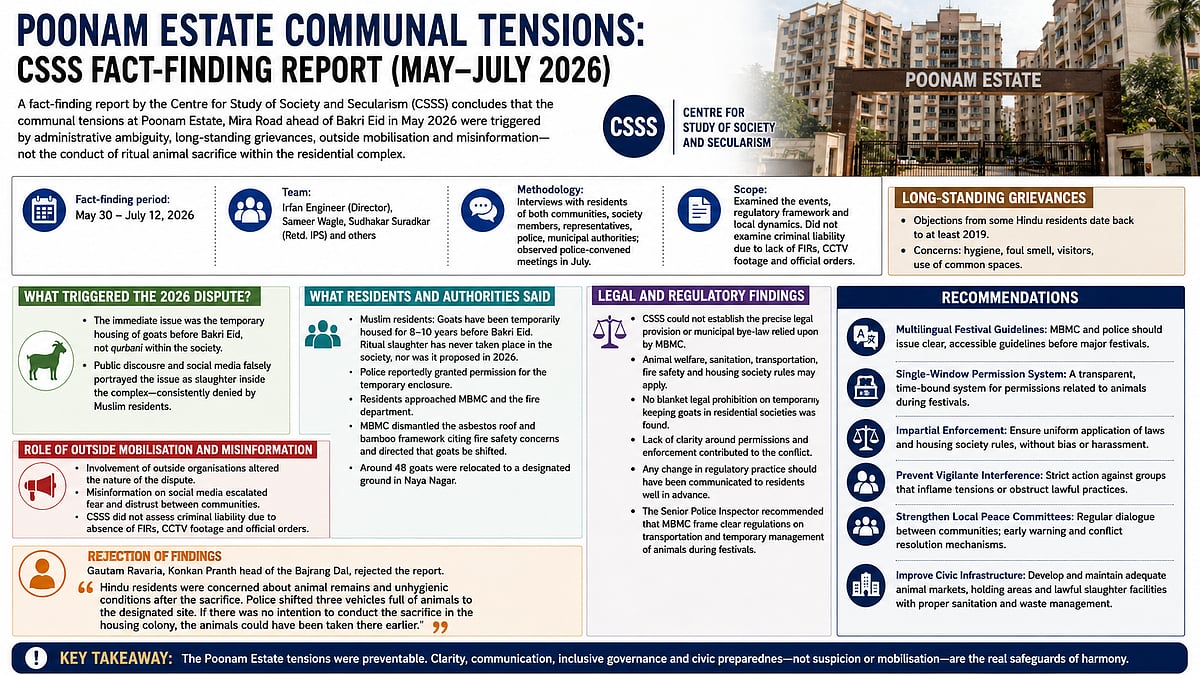
A fact-finding report by the Centre for Study of Society and Secularism (CSSS) has concluded that the communal tensions at the Poonam Estate housing complex in Mira Road ahead of Bakri Eid in May 2026 stemmed from administrative ambiguity, long-standing local grievances, outside mobilisation and misinformation.
The report notes that objections from some Hindu residents predated the 2026 controversy, dating back to at least 2019, and centred on concerns over hygiene, foul smell, visitors and the use of common spaces. However, the report states that the immediate dispute revolved around the temporary housing of goats before Bakri Eid and not qurbani within the society premises.
The CSSS team, comprising Director Irfan Engineer and others, interviewed residents from both communities, housing society members, political and community representatives, police officials and municipal authorities. According to the report, Muslim residents said goats had been temporarily housed within the society for eight to ten years before Bakri Eid and maintained that ritual slaughter had never taken place there nor was it proposed in 2026.
The report states that police had reportedly granted permission for the temporary enclosure, while residents had also approached the Mira-Bhayandar Municipal Corporation (MBMC) and the fire department. However, MBMC later dismantled the asbestos roof and bamboo framework of the enclosure citing fire safety concerns and directed that the goats be shifted. Around 48 goats were subsequently relocated to a designated ground in Naya Nagar.
The report criticised the lack of clarity surrounding permissions and enforcement, observing that any change in regulatory practice should have been communicated to residents well in advance. It also recorded that the Senior Police officials had convened meetings with residents to resolve the issue.
The CSSS report calls for a clearer regulatory framework to prevent such tensions in the future. It notes that animal welfare, sanitation, transportation, fire safety and housing society rules may apply, but found no blanket legal prohibition on temporarily keeping goats in residential societies.
Hindu organisations have rejected the findings, maintaining that preparations for animal sacrifice were underway within the housing society before police intervened. However, the report states that public discourse and social media portrayed the issue as involving slaughter inside the residential complex, a claim the fact-finding team said Muslim residents consistently denied.
The report highlights the need for better communication and coordination between residents, authorities and community leaders to prevent the spread of misinformation and promote communal harmony.
In conclusion, the Mira Road tensions ahead of Bakri Eid in May 2026 were a result of administrative lapses, long-standing local grievances and misinformation. The report's findings emphasize the need for a clearer regulatory framework and better communication to prevent such tensions in the future.
The incident has brought to the forefront the importance of addressing long-standing grievances and promoting communal harmony in residential societies. It is essential for authorities to take proactive steps to prevent the spread of misinformation and ensure that residents from all communities can live together in peace and harmony.
The report's recommendations are significant, as they highlight the need for a more nuanced approach to addressing communal tensions. By promoting better communication, coordination and understanding, it is possible to prevent such incidents in the future and promote a more harmonious and inclusive society.
The Mira Road incident is a reminder that communal harmony is essential for the well-being of society as a whole. It is crucial for residents, authorities and community leaders to work together to promote understanding, tolerance and respect for all communities.
In the end, the report's findings and recommendations serve as a reminder of the importance of addressing the root causes of communal tensions and promoting communal harmony in residential societies. By doing so, we can create a more inclusive and harmonious society, where residents from all communities can live together in peace and harmony.
Frequently asked questions
What was the cause of the Mira Road tensions ahead of Bakri Eid in May 2026?
The tensions were caused by administrative ambiguity, long-standing local grievances, outside mobilisation and misinformation.
What did the CSSS report recommend to prevent such tensions in the future?
The report called for a clearer regulatory framework and better communication to prevent the spread of misinformation and promote communal harmony.