Trump Renames Lake Ontario to Lake America
US President changes lake's name, Canada not bound by decision. Tensions rise between nations.
'%3E%3Crect%20width%3D'96'%20height%3D'96'%20fill%3D'%234A235A'%2F%3E%3Ccircle%20cx%3D'30'%20cy%3D'24'%20r%3D'44'%20fill%3D'%23fff'%20opacity%3D'.12'%2F%3E%3Ccircle%20cx%3D'60'%20cy%3D'74'%20r%3D'40'%20fill%3D'%23000'%20opacity%3D'.10'%2F%3E%3C%2Fg%3E%3Cg%20fill%3D'none'%20stroke%3D'%23fff'%20stroke-width%3D'3'%3E%3Ccircle%20cx%3D'48'%20cy%3D'48'%20r%3D'16'%2F%3E%3Cellipse%20cx%3D'48'%20cy%3D'48'%20rx%3D'6.5'%20ry%3D'16'%2F%3E%3Cline%20x1%3D'32'%20y1%3D'42'%20x2%3D'64'%20y2%3D'42'%2F%3E%3Cline%20x1%3D'32'%20y1%3D'54'%20x2%3D'64'%20y2%3D'54'%2F%3E%3C%2Fg%3E%3C%2Fsvg%3E)
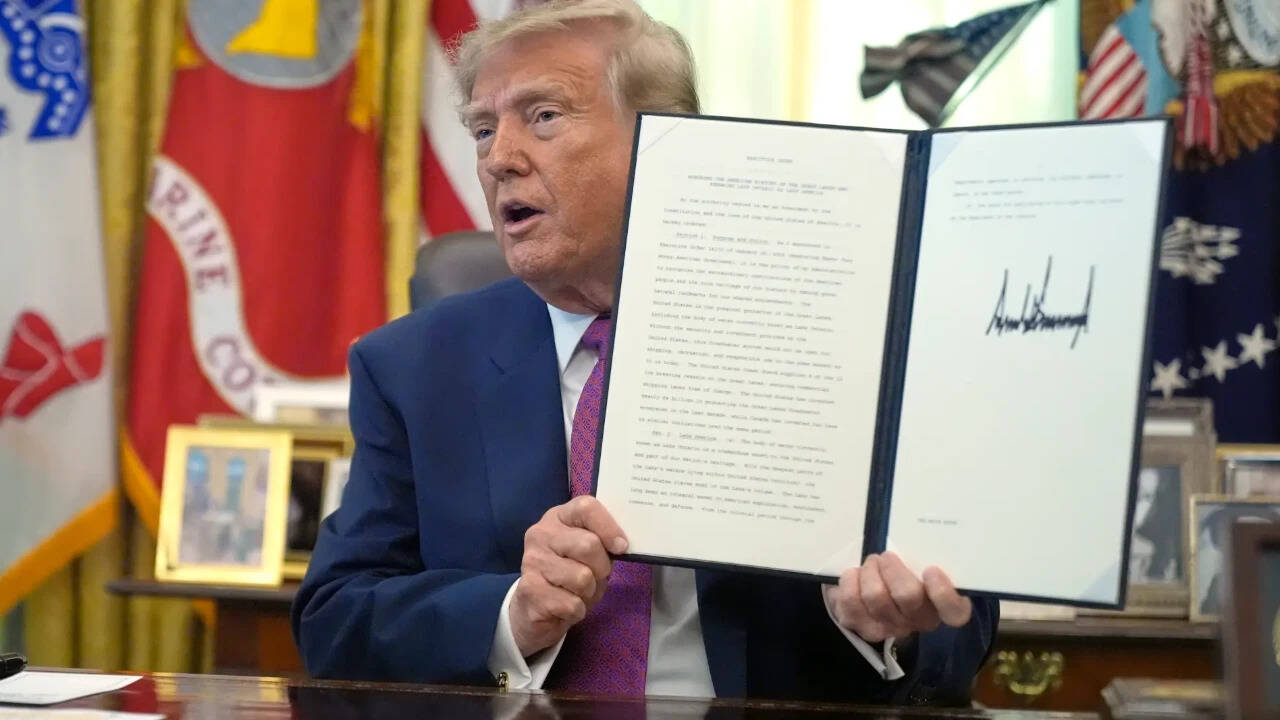
US President Donald Trump has signed an executive order renaming Lake Ontario to 'Lake America' for use by the US geographic naming service. The decision, made on Thursday, applies to how the body of water is officially identified by US authorities. However, Trump does not have the power to enforce the name change in Canada, which shares the lake with the United States.
The move is seen as a continuation of Trump's efforts to assert American identity and independence in geographic naming conventions. Earlier, he had renamed the Gulf of Mexico as the 'Gulf of America' for use by the US government. This decision had also been met with skepticism and criticism from other countries and experts.
Lake Ontario is one of the five Great Lakes, and its name has been in use for centuries. The lake is an important source of freshwater and a vital component of the ecosystem in the region. The name change is likely to have significant implications for mapping, navigation, and international cooperation on environmental and economic issues related to the lake.
The decision has been met with criticism and concern from Canadian officials and experts, who argue that the name change is unnecessary and could lead to confusion. Canada and the US have a long-standing relationship and cooperate on many issues related to the Great Lakes, including environmental protection and trade.
The renaming of Lake Ontario is also seen as a reflection of the ongoing tensions between the US and Canada. The two countries have had differences on trade, security, and environmental issues, and the name change is likely to exacerbate these tensions. The US and Canada have a complex and interdependent relationship, and the name change could have significant implications for their cooperation on regional and global issues.
In terms of international law and geographic naming conventions, the decision to rename Lake Ontario is not binding on Canada or other countries. The United Nations and other international organizations have established guidelines and conventions for naming geographic features, and these conventions prioritize the use of names that are widely accepted and used by local communities and countries.
The implications of the name change are still unclear, and it remains to be seen how Canada and other countries will respond to the decision. However, it is clear that the renaming of Lake Ontario is a significant development that reflects the ongoing tensions and differences between the US and Canada.
The decision to rename Lake Ontario is also likely to have significant implications for the US-Canada relationship and cooperation on regional and global issues. The two countries have a long-standing relationship and cooperate on many issues, including trade, security, and environmental protection. However, the name change could exacerbate existing tensions and create new challenges for cooperation and collaboration.
In conclusion, the renaming of Lake Ontario to 'Lake America' is a significant development that reflects the ongoing tensions and differences between the US and Canada. The decision has significant implications for mapping, navigation, and international cooperation on environmental and economic issues related to the lake. It remains to be seen how Canada and other countries will respond to the decision, but it is clear that the renaming of Lake Ontario is a major development that will have far-reaching consequences.
Frequently asked questions
Can Canada be forced to use the new name for Lake Ontario?
No, the decision to rename Lake Ontario only applies to the US geographic naming service, and Canada is not bound by the name change.
What are the implications of the name change for US-Canada relations?
The name change could exacerbate existing tensions and create new challenges for cooperation and collaboration between the two countries.