US Court Blocks Trump's $400 Million White House Ballroom Project
A US federal appeals court has halted construction of a $400 million ballroom at the White House. The court ruled that President Trump needs Congressional approval for the project.
'%3E%3Crect%20width%3D'96'%20height%3D'96'%20fill%3D'%234A235A'%2F%3E%3Ccircle%20cx%3D'30'%20cy%3D'24'%20r%3D'44'%20fill%3D'%23fff'%20opacity%3D'.12'%2F%3E%3Ccircle%20cx%3D'60'%20cy%3D'74'%20r%3D'40'%20fill%3D'%23000'%20opacity%3D'.10'%2F%3E%3C%2Fg%3E%3Cg%20fill%3D'none'%20stroke%3D'%23fff'%20stroke-width%3D'3'%3E%3Ccircle%20cx%3D'48'%20cy%3D'48'%20r%3D'16'%2F%3E%3Cellipse%20cx%3D'48'%20cy%3D'48'%20rx%3D'6.5'%20ry%3D'16'%2F%3E%3Cline%20x1%3D'32'%20y1%3D'42'%20x2%3D'64'%20y2%3D'42'%2F%3E%3Cline%20x1%3D'32'%20y1%3D'54'%20x2%3D'64'%20y2%3D'54'%2F%3E%3C%2Fg%3E%3C%2Fsvg%3E)
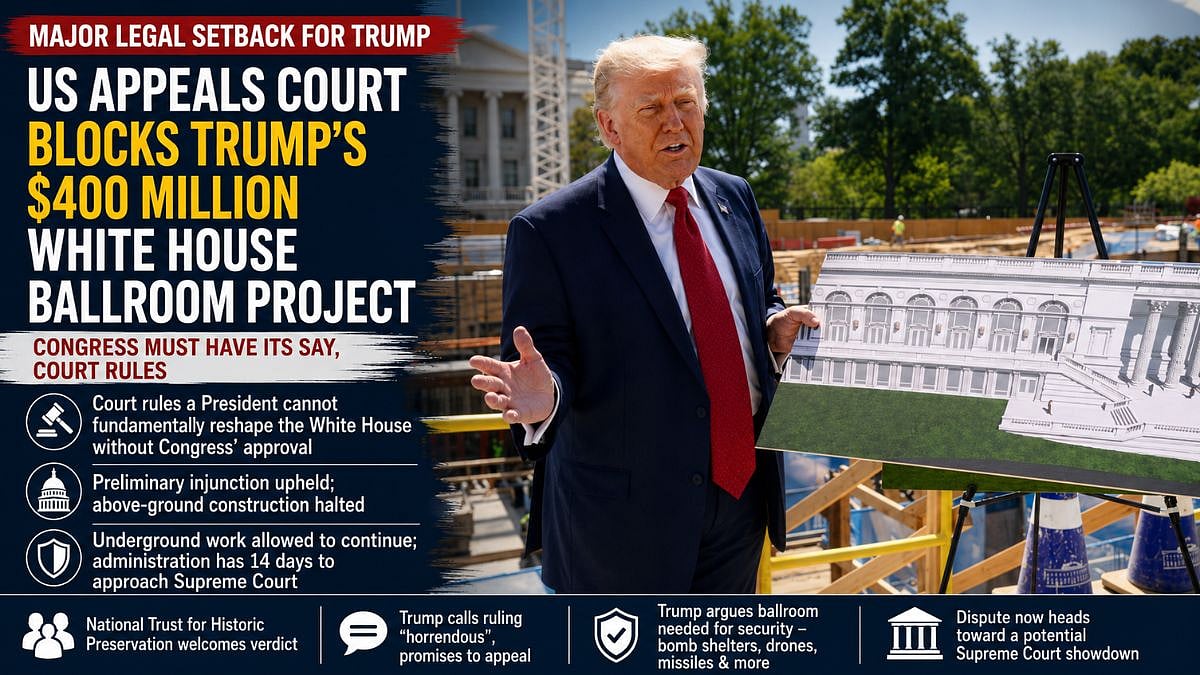
A US federal appeals court has ordered President Donald Trump's administration to stop construction of a $400 million ballroom at the White House. The court's decision is a major setback for Trump, who had argued that the project was necessary for security and functional upgrades.
The Washington-based US Court of Appeals for the District of Columbia Circuit ruled 2-1 that a President cannot make significant changes to the White House without approval from Congress. The court stated that each President is a temporary tenant, not the owner, of the White House.
The ruling upheld a preliminary injunction secured by the National Trust for Historic Preservation, which sued after the administration demolished the White House's East Wing and began building a 90,000-square-foot ballroom without seeking authorization from Congress. The court's majority wrote that whether or not a massive ballroom should be constructed is for Congress to decide and is not a matter for Executive self-help.
The appeals court put its ruling on hold for 14 days, giving the Trump administration time to approach the US Supreme Court. Trump has said that his administration will appeal to the Supreme Court, describing the planned structure as a military center and arguing that it is necessary for security.
Trump called the appeals court decision horrendous and politically motivated, saying it left him, White House officials, and visitors exposed to possible attacks. He argued that the ballroom project includes bomb shelters, medical facilities, protection from drones and missiles, and other security features that are all tied together as one big, expensive, and very complex unit.
The National Trust for Historic Preservation welcomed the decision, calling it a great day for the American people's right to voice their opinions about historic places they cherish, including the White House. The group's president, Brent Leggs, said that the decision shows that the White House belongs to the American people, not just the President.
The legal battle has turned what the administration presents as a security and functional upgrade into a larger constitutional dispute over how much authority a President has to make major changes to one of the country's most prominent government buildings without congressional approval.
The decision has significant implications for the balance of power between the Executive and Legislative branches of government. It highlights the importance of Congressional oversight and approval for major projects, especially those that involve historic buildings like the White House.
In conclusion, the US Court of Appeals' decision to block Trump's $400 million White House ballroom project is a significant development in the ongoing debate about the limits of presidential authority. The decision underscores the importance of Congressional approval for major projects and highlights the need for transparency and accountability in government decision-making.
The project's fate now rests with the US Supreme Court, which will decide whether to uphold or overturn the appeals court's decision. Regardless of the outcome, the decision has already sparked a national conversation about the role of the President and the importance of preserving historic buildings like the White House.
The controversy surrounding the ballroom project has also raised questions about the use of executive power and the need for Congressional oversight. As the case moves forward, it will be important to consider the potential implications for the balance of power in Washington and the impact on the White House and its historic significance.
Ultimately, the decision to block the ballroom project is a reminder that the White House belongs to the American people, not just the President. It highlights the importance of preserving historic buildings and ensuring that any changes are made with the approval of Congress and the input of the American people.
Frequently asked questions
Why did the US Court of Appeals block Trump's White House ballroom project?
The court ruled that the project requires Congressional approval, as it is a significant change to the White House.
What is the next step in the case?
The Trump administration will appeal to the US Supreme Court, which will decide whether to uphold or overturn the appeals court's decision.