India Marks 79 Years of Independence and Statecraft
India celebrates 79 years of independence, Nehru's midnight hour speech remembered, India's defence and foreign policy legacy
'%3E%3Crect%20width%3D'96'%20height%3D'96'%20fill%3D'%231A5276'%2F%3E%3Ccircle%20cx%3D'30'%20cy%3D'24'%20r%3D'44'%20fill%3D'%23fff'%20opacity%3D'.12'%2F%3E%3Ccircle%20cx%3D'60'%20cy%3D'74'%20r%3D'40'%20fill%3D'%23000'%20opacity%3D'.10'%2F%3E%3C%2Fg%3E%3Cg%20fill%3D'%23fff'%3E%3Cpath%20d%3D'M31%2041%20L48%2031%20L65%2041%20Z'%2F%3E%3Crect%20x%3D'33'%20y%3D'43'%20width%3D'4'%20height%3D'17'%2F%3E%3Crect%20x%3D'41'%20y%3D'43'%20width%3D'4'%20height%3D'17'%2F%3E%3Crect%20x%3D'51'%20y%3D'43'%20width%3D'4'%20height%3D'17'%2F%3E%3Crect%20x%3D'59'%20y%3D'43'%20width%3D'4'%20height%3D'17'%2F%3E%3Crect%20x%3D'30'%20y%3D'62'%20width%3D'36'%20height%3D'4'%20rx%3D'1'%2F%3E%3C%2Fg%3E%3C%2Fsvg%3E)
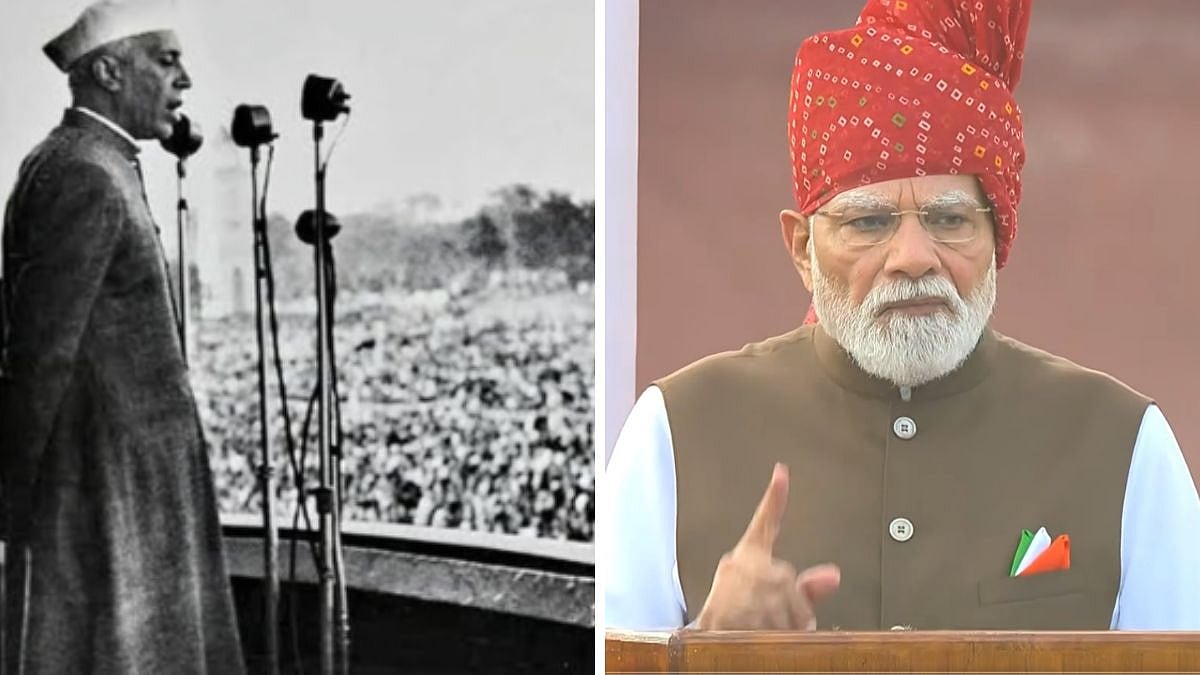
On August 15, 1947, India woke up to a new era of freedom and independence, after nearly two centuries of colonial rule. The country's first Prime Minister, Jawaharlal Nehru, declared India's independence in his iconic 'midnight hour' speech on August 14, 1947.
At the time of independence, India's defence was defined by the complex transition from a colonial military to a national force. The country's foreign policy prioritised integrating princely states and peaceful diplomacy. However, the partition of India and Pakistan led to a division of military assets, with India receiving roughly 70% of the army, 80% of the air force, and 60% of the navy.
Unlike Pakistan, India established firm civilian control over its armed forces under a democratic framework. The Defence Committee of the Cabinet, supported by a civilian-staffed Ministry of Defence and Armed Forces Headquarters, was responsible for decision-making. This fresh defence setup was tested by the First Kashmir War (1947-48), which shifted the military from internal security to active combat against Pakistan-backed tribal invaders.
The war marked a significant turning point in India's defence history, with the country demonstrating tactical excellence through the historic 'first fly-in' of the 1st Sikh battalion to Srinagar on October 27, 1947. The sacrifices of Brigadier Rajendra Singh and Major Somnath Sharma, the first recipient of the Param Vir Chakra, will always be remembered. The Army won a decisive victory at Shalateng in November 1947, bolstered by IAF air supply and precision strafing in Uri and Jammu.
In the following years, India continued to consolidate its defence and foreign policy. In December 1961, Operation Vijay, a 40-hour tri-service campaign, liberated Goa, Daman, and Diu, ending 450 years of Portuguese rule. The operation was triggered by Portuguese attacks on Indian vessels near Anjidiv island, and Prime Minister Nehru termed these enclaves 'ugly warts on the beautiful face of India'.
Today, India marks 79 years of independence and statecraft, with a strong and robust defence system. The country's foreign policy has evolved over the years, with a focus on peaceful diplomacy and regional cooperation. As India celebrates this milestone, it remembers the sacrifices of its brave soldiers and the vision of its leaders, who shaped the country's defence and foreign policy legacy.
The legacy of India's independence and statecraft continues to inspire the country's citizens, with a sense of pride and patriotism. The country's defence system has evolved over the years, with a focus on modernisation and technological advancements. As India looks to the future, it remains committed to its core values of democracy, secularism, and peaceful coexistence.
In conclusion, India's 79 years of independence and statecraft are a testament to the country's strength and resilience. From the midnight hour speech to the present day, India has come a long way, with a strong and robust defence system and a foreign policy that prioritises peaceful diplomacy and regional cooperation.
The country's defence history is a rich and complex one, with many significant events and milestones. The First Kashmir War, the liberation of Goa, Daman, and Diu, and the country's participation in various international peacekeeping missions are just a few examples of India's defence legacy. As India celebrates its independence, it remembers the sacrifices of its brave soldiers and the vision of its leaders, who shaped the country's defence and foreign policy legacy.
India's independence and statecraft have also had a significant impact on the country's economy and society. The country has made significant progress in various fields, including education, healthcare, and infrastructure development. However, there are still many challenges that need to be addressed, including poverty, inequality, and social injustice.
Overall, India's 79 years of independence and statecraft are a cause for celebration and reflection. The country has come a long way, with a strong and robust defence system and a foreign policy that prioritises peaceful diplomacy and regional cooperation. As India looks to the future, it remains committed to its core values of democracy, secularism, and peaceful coexistence.
Frequently asked questions
What was the significance of Nehru's midnight hour speech?
Nehru's midnight hour speech marked India's independence from colonial rule and marked the beginning of a new era of freedom and independence.
What was the outcome of the First Kashmir War?
The First Kashmir War resulted in a decisive victory for India, with the country demonstrating tactical excellence and securing a significant portion of the region.