Xi Jinping Urges Middle East to Resist External Interference
China's President Xi Jinping calls for Middle East security reshaping. Egypt and China deepen ties.
'%3E%3Crect%20width%3D'96'%20height%3D'96'%20fill%3D'%234A235A'%2F%3E%3Ccircle%20cx%3D'30'%20cy%3D'24'%20r%3D'44'%20fill%3D'%23fff'%20opacity%3D'.12'%2F%3E%3Ccircle%20cx%3D'60'%20cy%3D'74'%20r%3D'40'%20fill%3D'%23000'%20opacity%3D'.10'%2F%3E%3C%2Fg%3E%3Cg%20fill%3D'none'%20stroke%3D'%23fff'%20stroke-width%3D'3'%3E%3Ccircle%20cx%3D'48'%20cy%3D'48'%20r%3D'16'%2F%3E%3Cellipse%20cx%3D'48'%20cy%3D'48'%20rx%3D'6.5'%20ry%3D'16'%2F%3E%3Cline%20x1%3D'32'%20y1%3D'42'%20x2%3D'64'%20y2%3D'42'%2F%3E%3Cline%20x1%3D'32'%20y1%3D'54'%20x2%3D'64'%20y2%3D'54'%2F%3E%3C%2Fg%3E%3C%2Fsvg%3E)
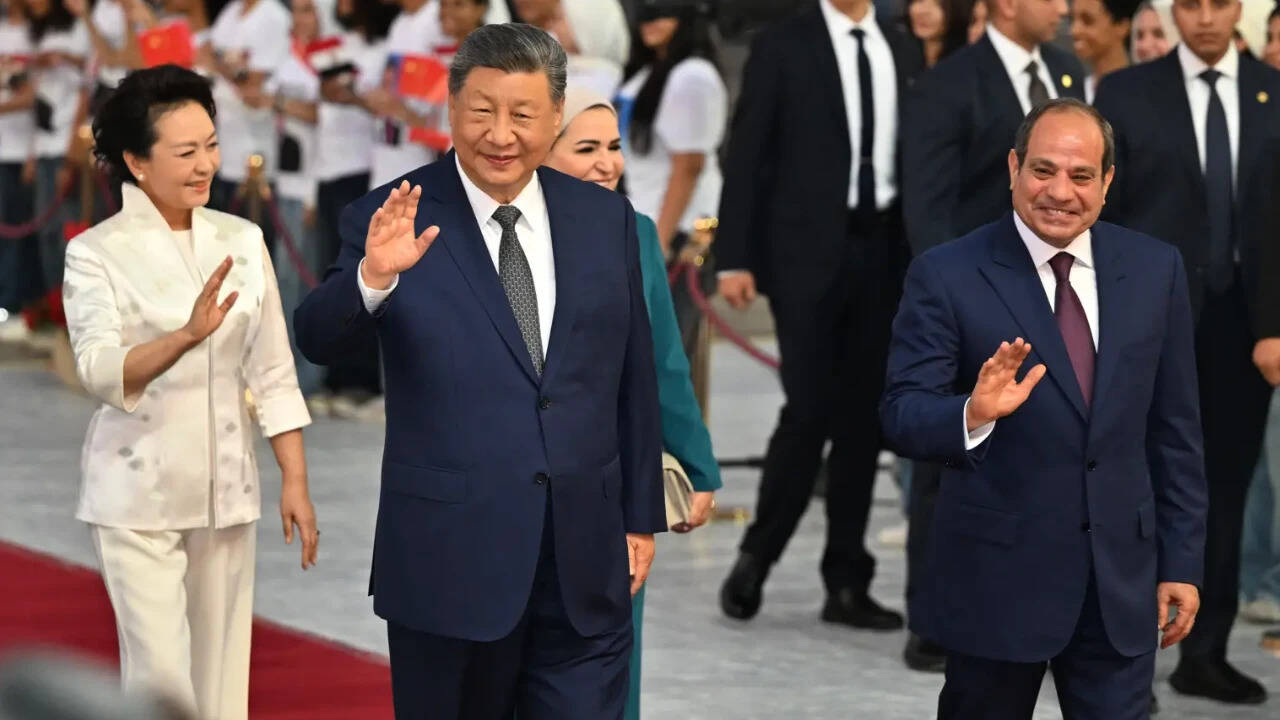
Chinese President Xi Jinping has urged Middle Eastern nations to take control of their own destiny and resist external interference. This call was made during talks with Egyptian President Abdel Fattah el-Sisi, where both leaders discussed the need to reshape the region's security order.
The meeting between Xi and Sisi resulted in an agreement to deepen security and economic cooperation between China and Egypt. This move is seen as part of China's efforts to expand its influence in the region and safeguard its vital shipping routes.
Egypt, on the other hand, is diversifying its international partnerships by strengthening its ties with Beijing. This strategic move is likely to have significant implications for the region's geopolitical landscape.
The Middle East has long been a region of strategic importance, with many global powers vying for influence. China's growing presence in the region is seen as a challenge to the traditional dominance of Western powers.
Xi's call for the Middle East to be the masters of their own destiny is likely to resonate with many nations in the region. For years, the Middle East has been plagued by external interference, with many countries suffering from the consequences of foreign intervention.
The talks between Xi and Sisi come at a time of heightened tensions in the region, particularly with the ongoing conflict in Iran. China's efforts to reshape the region's security order are likely to be closely watched by other global powers.
As China continues to expand its influence in the Middle East, it is likely to face challenges from other nations. However, Beijing's strategic partnerships with countries like Egypt are likely to play a crucial role in shaping the region's future.
The implications of Xi's call for the Middle East to resist external interference are far-reaching. If successful, it could lead to a more stable and secure region, with nations able to determine their own destiny. However, it could also lead to increased tensions with other global powers, particularly if they feel their interests are being threatened.
In conclusion, Xi's call for the Middle East to be the masters of their own destiny is a significant development in the region's geopolitics. As China continues to expand its influence, it is likely to have a major impact on the region's security order and the global balance of power.
Frequently asked questions
What is China's goal in the Middle East?
China seeks to expand its influence and safeguard vital shipping routes in the region.
What is the significance of China's partnership with Egypt?
Egypt is diversifying its international partnerships by strengthening ties with Beijing, which is likely to have significant implications for the region's geopolitical landscape.