IBM Shares Crash 25%
IBM's stock plummets, wiping out $70 billion. What triggered the fall?
'%3E%3Crect%20width%3D'96'%20height%3D'96'%20fill%3D'%230B6E4F'%2F%3E%3Ccircle%20cx%3D'30'%20cy%3D'24'%20r%3D'44'%20fill%3D'%23fff'%20opacity%3D'.12'%2F%3E%3Ccircle%20cx%3D'60'%20cy%3D'74'%20r%3D'40'%20fill%3D'%23000'%20opacity%3D'.10'%2F%3E%3C%2Fg%3E%3Cg%20fill%3D'none'%20stroke%3D'%23fff'%20stroke-width%3D'3.2'%20stroke-linecap%3D'round'%20stroke-linejoin%3D'round'%3E%3Cpolyline%20points%3D'31%2C59%2041%2C49%2049%2C54%2063%2C37'%2F%3E%3Cpolyline%20points%3D'55%2C37%2063%2C37%2063%2C45'%2F%3E%3C%2Fg%3E%3C%2Fsvg%3E)
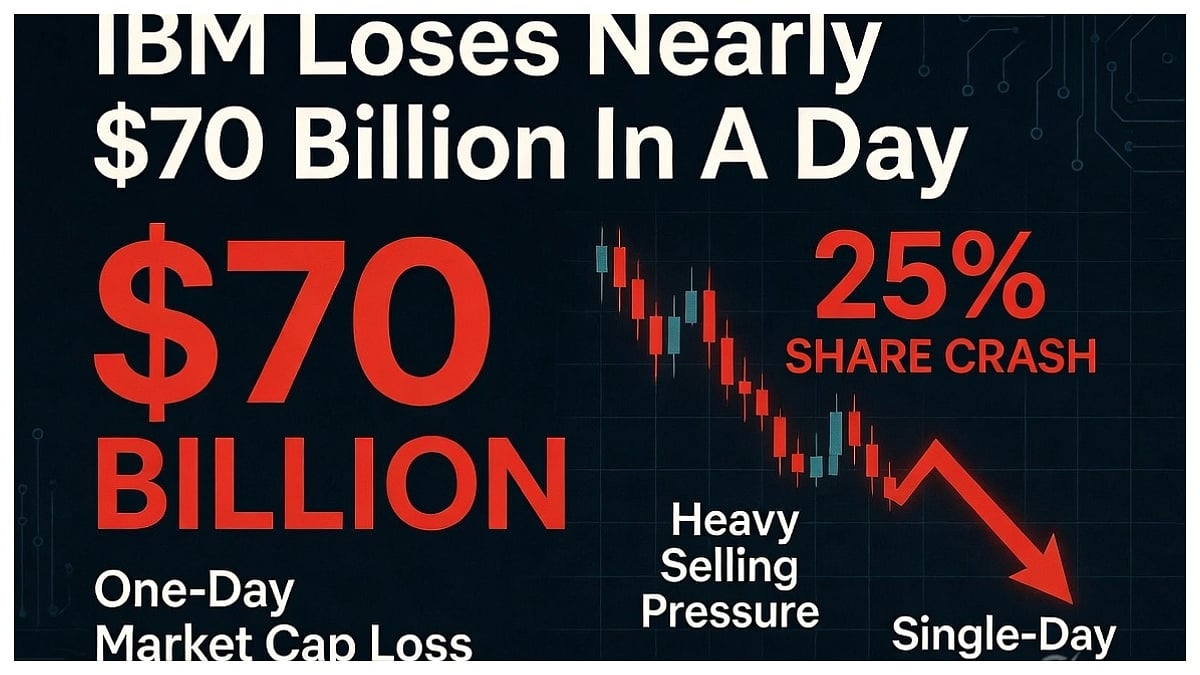
IBM experienced its largest stock market crash in 58 years, with shares plummeting 25% in a single trading session. This drastic decline resulted in the loss of nearly $70 billion in market value, marking one of the company's worst trading days on record. The sell-off occurred after IBM released a disappointing preliminary update for the June quarter, sparking concerns about its near-term growth prospects.
The company's revenue for the quarter ending June increased by just 1% year-on-year to $17.2 billion, falling short of market expectations. CEO Arvind Krishna acknowledged that IBM was slow to respond to changing market conditions, stating that the company 'faltered and did not adapt and move quickly enough' in a letter to investors.
One of the primary reasons behind the weak performance was the decline in IBM's infrastructure business, particularly its mainframe division. Revenue from this segment, which serves banks and large enterprises, decreased by 7% during the quarter. Although software revenue grew by 5%, it was still below analyst expectations.
The shift in technology budgets towards AI infrastructure also contributed to IBM's poor quarterly performance. Many large customers redirected their spending towards servers, storage systems, and memory chips in anticipation of price increases caused by global supply shortages. This reduced spending on IBM's higher-margin mainframe systems and related software.
On the other hand, IBM reported an increase in cybersecurity spending as businesses prepare for more advanced AI-powered cyber threats. The launch of Anthropic's Mythos AI model heightened concerns about cyberattacks, leading companies to strengthen their security measures instead of investing in other technology projects.
Despite the disappointing quarter, IBM reported some positive developments. Its Red Hat business posted an 11% revenue growth, while its server and storage business outside the mainframe segment jumped by 37%. The company also announced Lightwell, a $5 billion initiative aimed at improving open-source software security with support from major global banks.
The warning raised questions about the future of traditional software companies as AI changes customer spending patterns. However, IBM believes that growing demand for AI infrastructure, cybersecurity, and open-source software could support its long-term strategy.
The impact of IBM's stock crash was also felt in the Indian IT sector, with companies like TCS, Infosys, and HCL Tech hitting 52-week lows. The IT stocks sank as OpenAI's new AI venture sparked industry fears.
In conclusion, IBM's stock crash serves as a reminder of the rapidly changing technology landscape and the need for companies to adapt quickly to shifting market conditions. As AI continues to transform the industry, traditional software companies like IBM must evolve to remain competitive and relevant in the long term.
The implications of this crash are significant, not just for IBM but for the entire technology sector. It highlights the importance of investing in emerging technologies like AI and cybersecurity, and the need for companies to be agile and responsive to changing market conditions. As the technology landscape continues to evolve, it will be interesting to see how IBM and other traditional software companies navigate these challenges and opportunities.
The Indian IT sector, in particular, will be closely watching the developments in the global technology market. The sector has been experiencing a slowdown in recent times, and the crash of IBM's stock has added to the concerns. However, the growth in demand for AI infrastructure, cybersecurity, and open-source software could provide new opportunities for Indian IT companies to grow and expand their services.
Overall, the crash of IBM's stock is a significant event that highlights the challenges and opportunities facing the technology sector. It serves as a reminder of the need for companies to be adaptable, innovative, and responsive to changing market conditions in order to remain competitive and relevant in the long term.