Income Tax, Registration Depts Collaborate For Data-Driven Governance
Mumbai tax and registration departments join hands for data-driven governance. Over 200 officers participate in outreach programme.
'%3E%3Crect%20width%3D'96'%20height%3D'96'%20fill%3D'%23B3261E'%2F%3E%3Ccircle%20cx%3D'30'%20cy%3D'24'%20r%3D'44'%20fill%3D'%23fff'%20opacity%3D'.12'%2F%3E%3Ccircle%20cx%3D'60'%20cy%3D'74'%20r%3D'40'%20fill%3D'%23000'%20opacity%3D'.10'%2F%3E%3C%2Fg%3E%3Cg%20fill%3D'%23fff'%3E%3Crect%20x%3D'29'%20y%3D'49'%20width%3D'8'%20height%3D'19'%20rx%3D'1'%2F%3E%3Crect%20x%3D'39'%20y%3D'40'%20width%3D'9'%20height%3D'28'%20rx%3D'1'%2F%3E%3Crect%20x%3D'50'%20y%3D'45'%20width%3D'8'%20height%3D'23'%20rx%3D'1'%2F%3E%3Crect%20x%3D'60'%20y%3D'53'%20width%3D'7'%20height%3D'15'%20rx%3D'1'%2F%3E%3Crect%20x%3D'41'%20y%3D'34'%20width%3D'5'%20height%3D'6'%2F%3E%3C%2Fg%3E%3C%2Fsvg%3E)
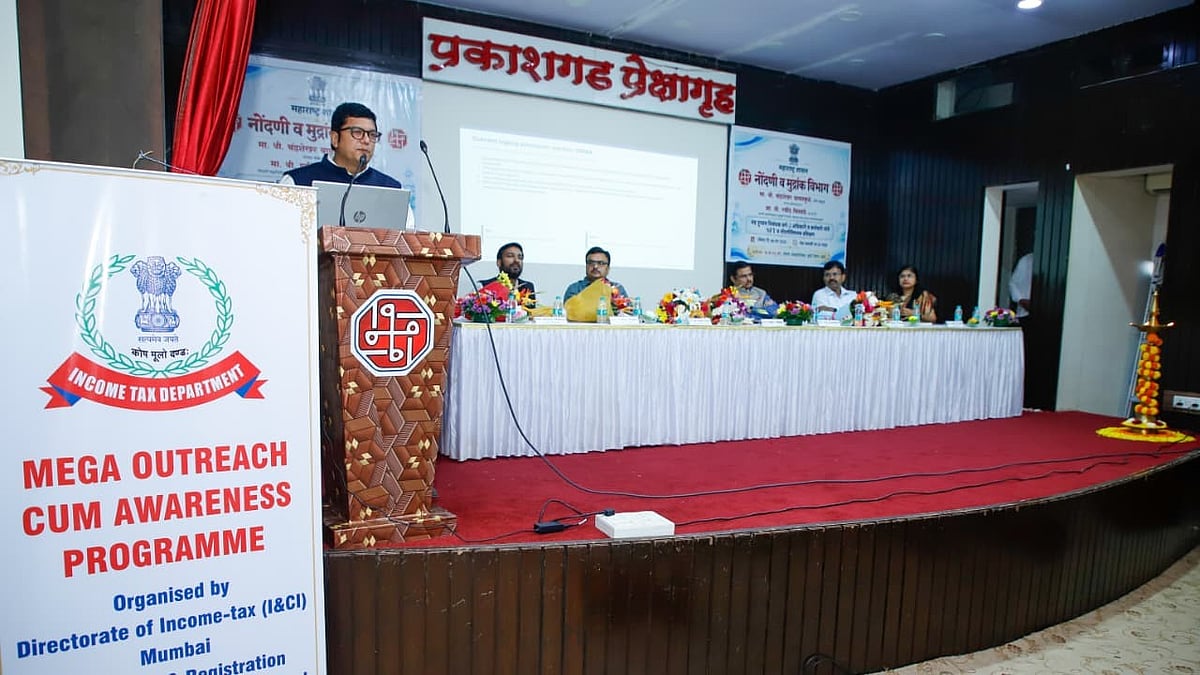
The Directorate of Income Tax (Intelligence & Criminal Investigation) in Mumbai has collaborated with the Stamp Duty and Registration Department to organise a Mega Outreach Programme. The programme, held at Prakashgad in Bandra (East), saw the participation of over 200 officers from Sub-Registrar Offices across Mumbai City and Mumbai Suburban Districts.
The programme aimed to provide detailed guidance on the Statement of Financial Transaction (SFT) and Form 165 under the new Income Tax Act, 2025. The focus was on accurate PAN reporting, transaction/stamp value, data validation, and rectification of reporting errors.
Dr. Santosh C. Mankoskar, Director of Income Tax (I&CI), Mumbai, addressed the gathering and stated that tax administration is becoming increasingly technology-enabled, information-driven, and risk-based. He emphasized the importance of accurate and reliable information in modern tax administration.
The Registration Department has also evolved from revenue collection to citizen-friendly registration, digitalisation, and now data-driven governance. Its role extends beyond registration and collection of stamp duty to being an important source and custodian of reliable economic information.
The programme included technical and operational sessions, where officials guided the participating officers on SFT reporting, Form 165, data validation, and accurate capture of PAN and transaction-related information. The sessions also addressed practical issues encountered in reporting.
The programme concluded with an interactive session, where queries raised by the officers were addressed. The emphasis was on strengthening coordination between the Income Tax Department and the Registration Department to ensure accurate, complete, and timely reporting of information.
The collaboration between the two departments is expected to promote voluntary tax compliance, enable effective risk analysis, widen the tax base, and strengthen transparent governance. This, in turn, will contribute to nation-building.
The Income Tax Department and the Registration Department have reiterated their commitment to data-driven governance, which will enable them to provide better services to citizens and promote economic growth.
The programme is a significant step towards achieving the goal of data-driven governance, which is essential for a modern and efficient tax administration system. It will also help to strengthen the relationship between the two departments and promote a culture of transparency and accountability.
In the coming days, the two departments are expected to work closely together to implement the lessons learned from the programme and to ensure that the benefits of data-driven governance are realised. This will involve ongoing training and support for officers, as well as the development of new systems and processes to support data-driven decision-making.
Overall, the collaboration between the Income Tax Department and the Registration Department is a positive step towards promoting data-driven governance and improving the efficiency of tax administration in Mumbai. It is expected to have a significant impact on the city's economy and will help to promote economic growth and development.
The programme has set an example for other cities to follow, and it is expected that similar collaborations will be seen in the future. The use of data-driven governance is becoming increasingly important in modern tax administration, and it is essential that departments work together to achieve this goal.
In conclusion, the Mega Outreach Programme organised by the Directorate of Income Tax (Intelligence & Criminal Investigation) and the Stamp Duty and Registration Department is a significant step towards promoting data-driven governance in Mumbai. It has provided a platform for officers to learn about the importance of accurate and reliable information in tax administration and has strengthened the relationship between the two departments.
The programme has also highlighted the importance of collaboration and coordination between different departments in achieving the goal of data-driven governance. It is expected that the lessons learned from the programme will be implemented in the coming days, and that the benefits of data-driven governance will be realised.
The city of Mumbai is expected to benefit significantly from the collaboration between the Income Tax Department and the Registration Department. The use of data-driven governance will help to promote economic growth and development, and will enable the city to become a more attractive destination for businesses and investors.
The programme has set a new standard for tax administration in Mumbai, and it is expected that other cities will follow suit. The use of data-driven governance is becoming increasingly important in modern tax administration, and it is essential that departments work together to achieve this goal.
In the future, it is expected that the Income Tax Department and the Registration Department will continue to work together to promote data-driven governance and to improve the efficiency of tax administration in Mumbai. This will involve ongoing training and support for officers, as well as the development of new systems and processes to support data-driven decision-making.
The collaboration between the two departments is a positive step towards promoting data-driven governance and improving the efficiency of tax administration in Mumbai. It is expected to have a significant impact on the city's economy and will help to promote economic growth and development.
Frequently asked questions
What was the purpose of the Mega Outreach Programme?
The programme aimed to provide guidance on Statement of Financial Transaction (SFT) and Form 165 under the new Income Tax Act, 2025.
Who participated in the programme?
Over 200 officers from Sub-Registrar Offices across Mumbai City and Mumbai Suburban Districts participated in the programme.