Allahabad HC Rejects Plea for Hijab in School
Hijab not essential to Islam, court rules. No evidence found.
'%3E%3Crect%20width%3D'96'%20height%3D'96'%20fill%3D'%231A5276'%2F%3E%3Ccircle%20cx%3D'30'%20cy%3D'24'%20r%3D'44'%20fill%3D'%23fff'%20opacity%3D'.12'%2F%3E%3Ccircle%20cx%3D'60'%20cy%3D'74'%20r%3D'40'%20fill%3D'%23000'%20opacity%3D'.10'%2F%3E%3C%2Fg%3E%3Cg%20fill%3D'%23fff'%3E%3Cpath%20d%3D'M31%2041%20L48%2031%20L65%2041%20Z'%2F%3E%3Crect%20x%3D'33'%20y%3D'43'%20width%3D'4'%20height%3D'17'%2F%3E%3Crect%20x%3D'41'%20y%3D'43'%20width%3D'4'%20height%3D'17'%2F%3E%3Crect%20x%3D'51'%20y%3D'43'%20width%3D'4'%20height%3D'17'%2F%3E%3Crect%20x%3D'59'%20y%3D'43'%20width%3D'4'%20height%3D'17'%2F%3E%3Crect%20x%3D'30'%20y%3D'62'%20width%3D'36'%20height%3D'4'%20rx%3D'1'%2F%3E%3C%2Fg%3E%3C%2Fsvg%3E)
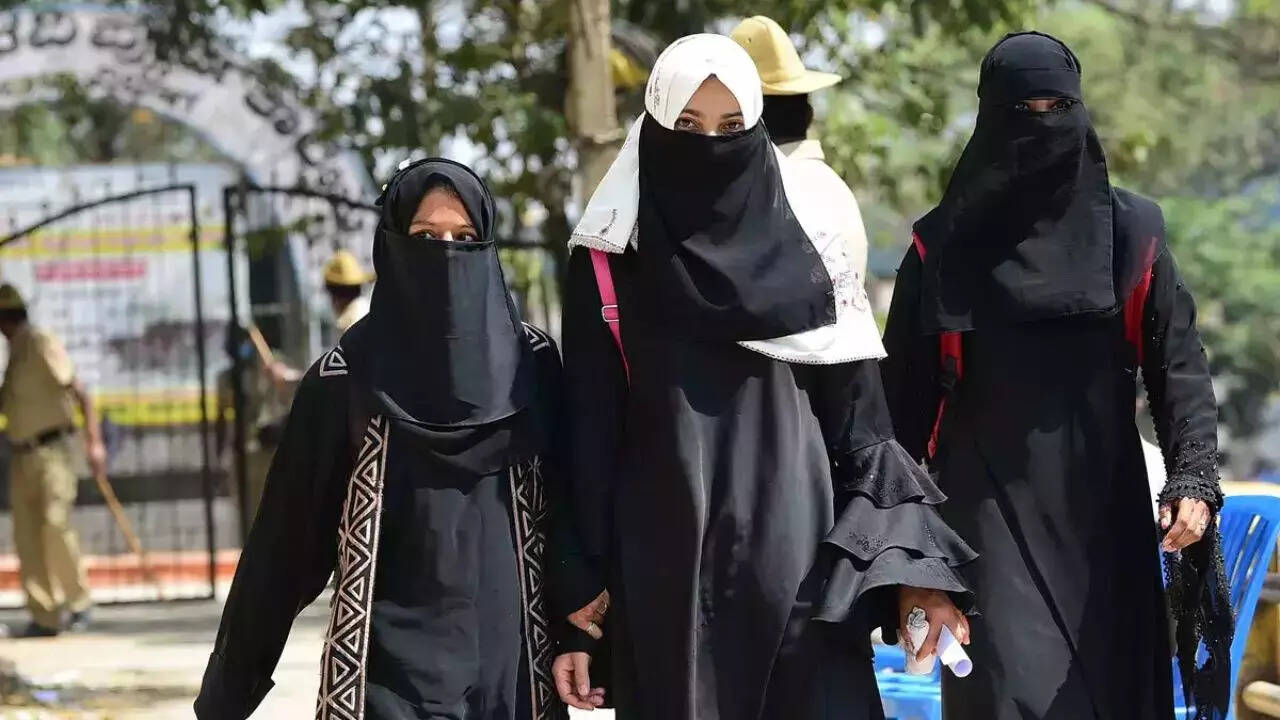
The Allahabad High Court has dismissed a plea from a student in Uttar Pradesh to allow her to wear a hijab with her school uniform. The court's decision was based on the finding that there is no evidence to suggest that wearing a headscarf is an essential religious practice in Islam.
The court took into consideration photographs of students from the same community, which showed that none of them wore headscarves. This observation led the bench to conclude that there was a lack of factual foundation to support the claim that wearing a hijab was a religious necessity.
The Allahabad High Court's decision is consistent with previous opinions from High Courts, which have also stated that headscarves are not integral to Islam. The court's ruling suggests that the practice of wearing a hijab is not a fundamental aspect of the Islamic faith.
The petitioner had argued that wearing a hijab was essential to her religious beliefs and that she should be allowed to wear it with her school uniform. However, the court was not convinced by this argument and dismissed the plea.
The decision has significant implications for the debate around the wearing of hijabs in educational institutions. It suggests that schools and colleges can impose dress codes that prohibit the wearing of headscarves without infringing on the religious rights of students.
The court's ruling is also likely to be seen as a reflection of the broader societal attitudes towards the wearing of hijabs in India. While some people see the hijab as an essential part of Islamic practice, others view it as a cultural or personal choice.
In recent years, there have been several cases of students being barred from wearing hijabs in educational institutions. The Allahabad High Court's decision is likely to be cited in future cases, and may influence the way in which schools and colleges approach the issue of dress codes and religious freedom.
The decision is a significant one, and is likely to be widely debated in the coming days. It highlights the complex and often contentious nature of the relationship between religion, culture, and education in India.
In conclusion, the Allahabad High Court's decision to dismiss the plea for wearing hijabs in school is a significant one, and has important implications for the debate around religious freedom and dress codes in educational institutions.
The court's ruling is a reminder that the relationship between religion, culture, and education is complex and multifaceted, and that there are often differing opinions on what constitutes an essential religious practice.
Ultimately, the decision suggests that schools and colleges have the right to impose dress codes that prohibit the wearing of headscarves, as long as they are not discriminatory or infringing on the religious rights of students.
Frequently asked questions
Is hijab essential to Islam?
No, according to the Allahabad High Court.
Can schools prohibit hijabs?
Yes, if it is part of a dress code and not discriminatory.