India Bans Forced Labour Imports On Paper
India bans goods made with forced labour, US tariff looming
'%3E%3Crect%20width%3D'96'%20height%3D'96'%20fill%3D'%234A235A'%2F%3E%3Ccircle%20cx%3D'30'%20cy%3D'24'%20r%3D'44'%20fill%3D'%23fff'%20opacity%3D'.12'%2F%3E%3Ccircle%20cx%3D'60'%20cy%3D'74'%20r%3D'40'%20fill%3D'%23000'%20opacity%3D'.10'%2F%3E%3C%2Fg%3E%3Cg%20fill%3D'none'%20stroke%3D'%23fff'%20stroke-width%3D'3'%3E%3Ccircle%20cx%3D'48'%20cy%3D'48'%20r%3D'16'%2F%3E%3Cellipse%20cx%3D'48'%20cy%3D'48'%20rx%3D'6.5'%20ry%3D'16'%2F%3E%3Cline%20x1%3D'32'%20y1%3D'42'%20x2%3D'64'%20y2%3D'42'%2F%3E%3Cline%20x1%3D'32'%20y1%3D'54'%20x2%3D'64'%20y2%3D'54'%2F%3E%3C%2Fg%3E%3C%2Fsvg%3E)
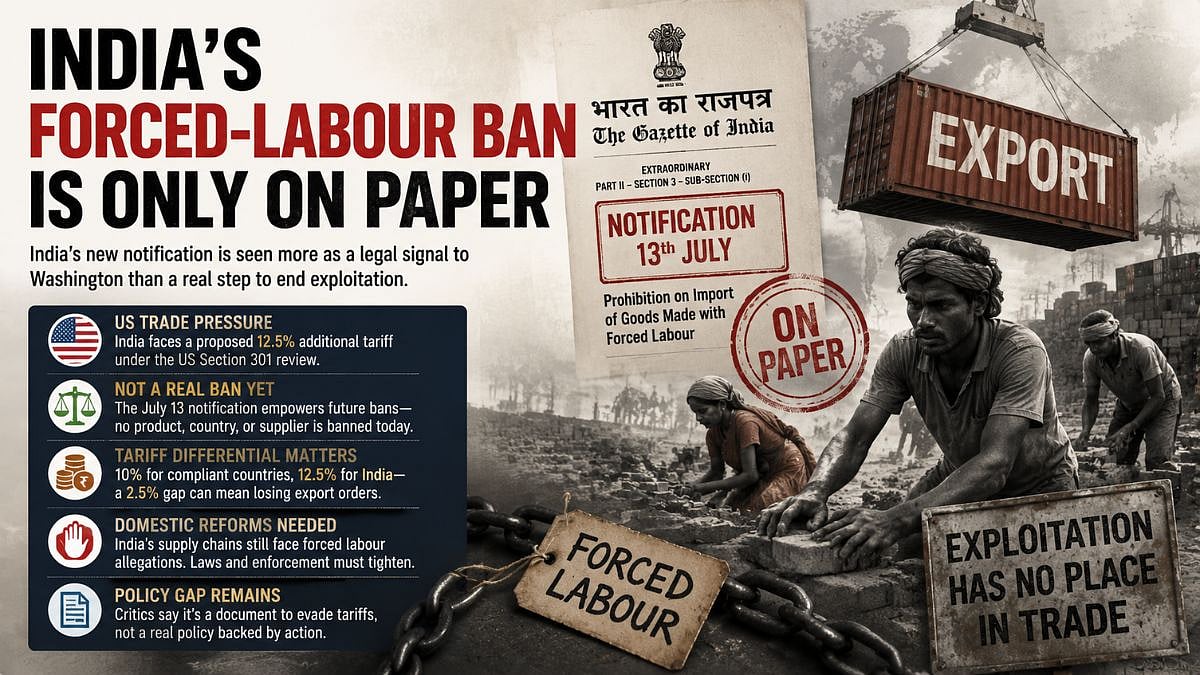
India has issued a gazette notification banning the import of goods made with forced labour, in a move seen as a response to potential tariffs from the United States. The notification, issued on July 13, comes ahead of a Section 301 report by the US Trade Representative, which could impose an additional tariff of 12.5% on Indian exports.
The US has been pushing countries to adopt measures against forced labour, and India's move is seen as an attempt to avoid the tariff. Countries that have adopted such measures, including the EU, Pakistan, and Indonesia, have been proposed a lower tariff rate of 10%. India's notification, however, does not actually ban any specific products, countries, or suppliers, but rather empowers the government to prohibit them later.
The US is India's largest export market, and a 2.5-percentage-point tariff differential could have a significant impact on Indian exporters. The sectors that would be most affected, including textiles, gems, and pharmaceuticals, operate on thin margins and could lose contracts to compliant rivals.
Critics argue that the government could have used this opportunity to address the issue of forced labour within India's own supply chains. India's brick kilns, quarries, agriculture, and textile sectors have faced allegations of forced labour, and the government needs to take a calibrated approach to overhaul the system.
The government needs to tighten laws governing forced labour and punish those who engage in it. Only then can India expect to eradicate forced labour from its own backyard and expect the same from its trading partners. However, this requires political will, which is currently lacking.
The notification is seen as a move to present a document to the US, rather than a genuine attempt to address the issue of forced labour. The actual policy and implementation will take time and effort, which may not happen soon.
The issue of forced labour is a complex one, and India's move is seen as a step in the right direction. However, it remains to be seen whether the government will follow through on its commitment to eradicate forced labour.
In the context of India's trade relationships, the move is significant. The US is a major trading partner, and India needs to comply with its regulations to avoid tariffs. The notification is also seen as a move to improve India's reputation as a responsible trading partner.
Overall, India's ban on forced labour imports is a positive step, but it remains to be seen whether it will be implemented effectively. The government needs to take concrete steps to address the issue of forced labour within its own supply chains and demonstrate its commitment to eradicating it.
The move has significant implications for India's trade relationships and its reputation as a responsible trading partner. It also highlights the need for the government to take a proactive approach to addressing the issue of forced labour and ensuring that Indian exporters are compliant with international regulations.
In conclusion, India's ban on forced labour imports is a step in the right direction, but it requires follow-through and implementation. The government needs to demonstrate its commitment to eradicating forced labour and ensuring that Indian exporters are compliant with international regulations.