Mumbai Ticketless Travel Drops 22% After Penalty Hike
Ticketless travel cases decline, fine collection rises after penalty doubles to ₹500.
'%3E%3Crect%20width%3D'96'%20height%3D'96'%20fill%3D'%23B3261E'%2F%3E%3Ccircle%20cx%3D'30'%20cy%3D'24'%20r%3D'44'%20fill%3D'%23fff'%20opacity%3D'.12'%2F%3E%3Ccircle%20cx%3D'60'%20cy%3D'74'%20r%3D'40'%20fill%3D'%23000'%20opacity%3D'.10'%2F%3E%3C%2Fg%3E%3Cg%20fill%3D'%23fff'%3E%3Crect%20x%3D'29'%20y%3D'49'%20width%3D'8'%20height%3D'19'%20rx%3D'1'%2F%3E%3Crect%20x%3D'39'%20y%3D'40'%20width%3D'9'%20height%3D'28'%20rx%3D'1'%2F%3E%3Crect%20x%3D'50'%20y%3D'45'%20width%3D'8'%20height%3D'23'%20rx%3D'1'%2F%3E%3Crect%20x%3D'60'%20y%3D'53'%20width%3D'7'%20height%3D'15'%20rx%3D'1'%2F%3E%3Crect%20x%3D'41'%20y%3D'34'%20width%3D'5'%20height%3D'6'%2F%3E%3C%2Fg%3E%3C%2Fsvg%3E)
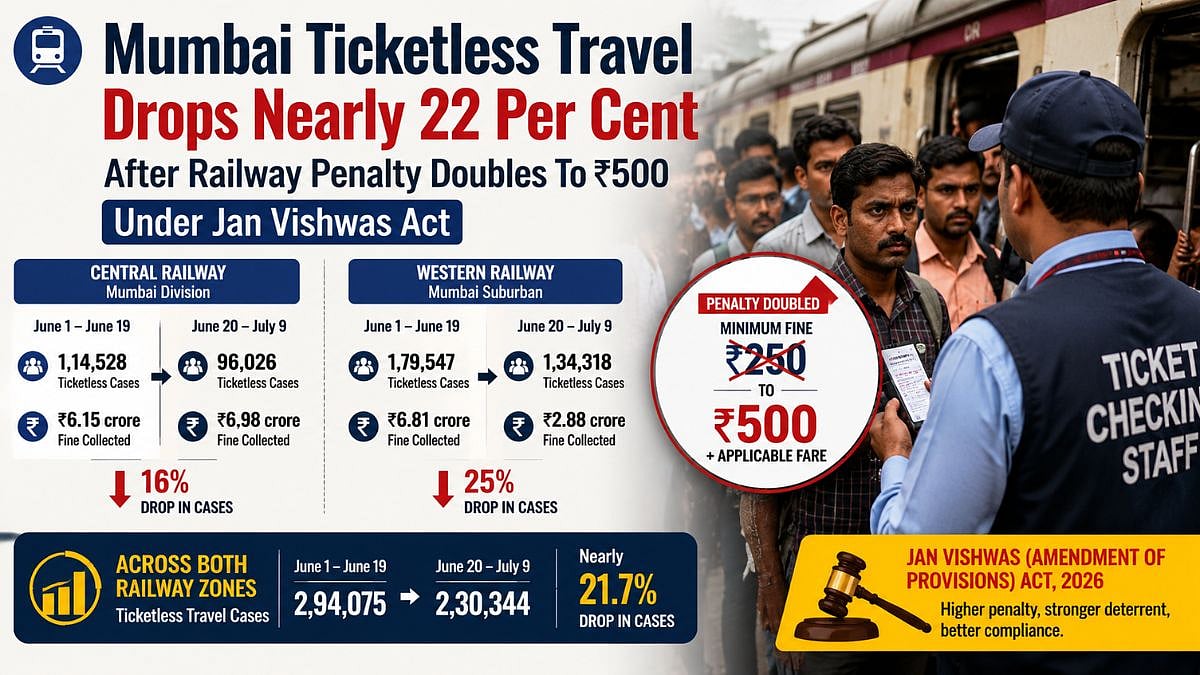
Mumbai has seen a significant drop in ticketless travel on its suburban railway network after the implementation of the Jan Vishwas Act, which increased the minimum penalty for travelling without a ticket to ₹500.
According to data from Central Railway and Western Railway, there was a combined decline of nearly 22% in ticketless travel cases after the new penalty came into force. On Central Railway's Mumbai Division, ticket-checking staff detected 1,14,528 ticketless passengers between June 1 and June 19, recovering ₹6.15 crore in fines.
In the next period, from June 20 to July 9, the number of cases fell to 96,026, a decline of about 16%, while fine collection increased to ₹6.98 crore due to the higher penalty. Western Railway's Mumbai suburban section also witnessed a sharper impact, with ticketless travel cases dropping from 1,79,547 to 1,34,318, a fall of around 25%.
Fine collection, however, rose slightly from ₹2.81 crore to ₹2.88 crore. The higher penalty appears to be acting as a deterrent, with fewer commuters taking the risk of travelling without tickets. Railway earnings from penalties have remained strong despite the reduction in offenders.
Across both railway zones, ticketless travel cases declined from 2,94,075 to 2,30,344, a drop of nearly 21.7%. Railway officials are likely to continue intensive ticket-checking drives to sustain compliance and improve revenue while encouraging passengers to purchase valid tickets before boarding trains.
The Jan Vishwas Act aims to promote transparency and accountability in government services, and the increased penalty for ticketless travel is a key aspect of this initiative. By doubling the minimum penalty, the government hopes to discourage people from travelling without tickets and increase revenue for the railways.
The decline in ticketless travel cases is a positive sign for the railways, which have been struggling to cope with the financial implications of ticketless travel. The increased penalty is expected to generate additional revenue for the railways, which can be used to improve services and infrastructure.
The success of the initiative will depend on the continued enforcement of the penalty and the effectiveness of ticket-checking drives. If the railways can sustain the current level of compliance, it could lead to a significant reduction in ticketless travel and an increase in revenue.
The impact of the increased penalty on ticketless travel in Mumbai is a significant development for the city's commuters and the railways. It highlights the importance of enforcing rules and regulations to promote transparency and accountability in government services.
In conclusion, the increase in penalty for ticketless travel has had a positive impact on reducing the number of cases in Mumbai. The railways must continue to enforce the penalty and promote compliance to sustain the current level of revenue and improve services for commuters.